
Airway Expansion for Children: How to Support Jaw Development?
If your child snores, breathes through their mouth, sleeps restlessly, or has a narrow upper jaw, you may wonder whether their dental development and breathing could be connected.
In some children, they can be. Airway expansion uses orthodontic treatment to widen a narrow upper jaw. This can improve the way the upper and lower teeth fit together, create more room for developing teeth, and may increase nasal airway space in some children.
However, airway expansion does not automatically treat snoring, mouth breathing, or sleep problems.
If you notice changes in your child’s breathing, sleep, bite, or dental development, schedule an appointment with our pediatric dentists.
Quick Answer: What Is Airway Expansion?
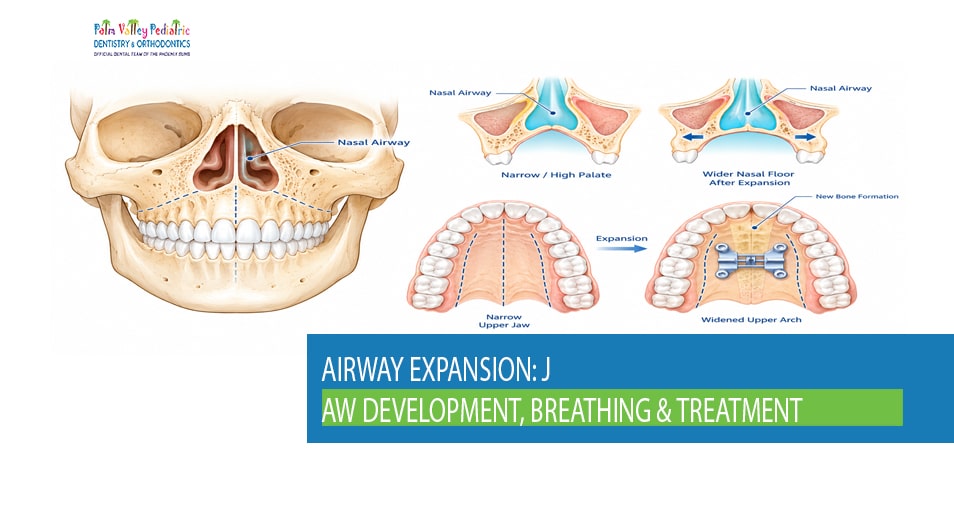
Airway expansion usually refers to orthodontic treatment that widens a narrow upper jaw or dental arch. A palatal expander applies controlled pressure to widen the upper jaw while a child is still growing.
For some children, expansion can:
- Correct a narrow upper jaw or crossbite
- Create more room for crowded teeth
- Improve space for erupting permanent teeth
- Increase parts of the nasal airway
- Support nasal breathing in appropriate cases
The treatment does not work the same way for every child. An orthodontist considers your child’s age, growth, jaw width, bite, teeth, and overall needs before recommending an expander.
Why Does a Child’s Upper Jaw Matter for Breathing?
Think about the roof of your child’s mouth. That same structure forms part of the floor of the nasal cavity.
According to Healthline, when the upper jaw develops too narrowly, the palate may also become high and narrow. Some children then find nasal breathing difficult and breathe through their mouths more often.
Mouth breathing, snoring, restless sleep, and frequent waking can have many causes. A narrow upper jaw may contribute in some children, but parents should not assume that expansion will solve every breathing problem.
For example, a child who snores every night may have enlarged tonsils, enlarged adenoids, allergies, sleep-disordered breathing, or another medical concern.

Is Your Child’s Smile on the Right Track?
Early dental visits aren’t just about cleaning teeth, they’re about catching problems before they become costly and painful. Our pediatric specialists create personalized care plans that grow with your child, from their very first tooth through their teen years.
Gentle, kid-friendly care in a welcoming environment.
What Signs May Lead to an Airway Evaluation?
Parents often notice the signs at home. Your child may:
- Breathe through their mouth often
- Snore regularly
- Sleep restlessly
- Grind their teeth at night
- Wake frequently
- Have a narrow upper dental arch
- Have a crossbite
- Show dental crowding
One sign does not prove that your child needs airway expansion. These signs simply give you a reason to ask questions.
PVPD offers airway obstruction evaluations for children who may show signs of airway problems. It helps families understand their child’s needs and appropriate next steps.
What Is a Palatal Expander?
A palatal expander is an orthodontic appliance that widens the upper jaw.
Imagine a box that feels too narrow for the items inside. Moving the items around may create a little room, but widening the box creates more space.
A palatal expander works on a similar principle. It can widen the upper arch so the teeth have more room and the upper jaw fits better with the lower jaw.
The appliance sits inside the mouth and connects to the teeth or other support points, depending on the design. Your orthodontist gives you specific activation instructions and checks your child regularly.
Children who are still growing often respond well to traditional expansion.
As children get older, the upper jaw becomes more resistant to conventional expansion, which can affect the appliance an orthodontist recommends.
Can Airway Expansion Improve Breathing?
Sometimes, but parents should keep expectations realistic.
Palatal expansion can widen the nasal floor and may improve nasal airflow in some children.
That does not mean every child will breathe better after expansion.
If your child snores, stops breathing during sleep, gasps, or shows other signs of sleep-disordered breathing, talk with your child’s healthcare provider.
Your child may need evaluation by a pediatrician, ENT, sleep specialist, or another appropriate professional.
Airway expansion should address an orthodontic or jaw problem when one exists. It should not replace a proper diagnosis of a breathing or sleep disorder.
What Does Airway Expansion Look Like at PVPD?
We start with evaluation, not an appliance.
Our orthodontic team looks at your child’s teeth, bite, jaw development, and growth. We consider the concerns you notice at home and determine whether your child needs additional evaluation.
If expansion makes sense, we explain the appliance and treatment process in simple language.
PVPD uses digital scanning technology for orthodontic treatment planning. These records help the team understand the teeth and jaw before treatment begins. PVPD provides orthodontic care for crowding, bite problems, jaw development, and alignment concerns.
A child’s experience matters too. We take time to explain what will happen so your child knows what to expect.
What About MARPE for Older Children and Teens?
Traditional expanders work well for many growing children, but older children and teens may need a different approach.
MARPE stands for miniscrew-assisted rapid palatal expansion. This appliance uses small orthodontic miniscrews in the palate to provide additional support while the expander widens the upper jaw.
MARPE may suit selected older children and teens with certain upper-jaw width problems.
The orthodontist considers skeletal maturity, palatal anatomy, bite, growth, and overall orthodontic needs before recommending it.
For example, a teenager with a narrow upper jaw and a crossbite may need more than simple tooth movement. If the orthodontist confirms a skeletal width problem, MARPE may offer one treatment option.
Does Airway Expansion Hurt?
Your child may feel pressure or mild soreness when an expander activates.
The appliance may also feel strange because it takes up space inside the mouth. Some children notice temporary changes in speech or extra saliva while their tongue adjusts.
These effects usually improve as the child adapts. Your orthodontic team will explain what to expect and what to do if discomfort becomes significant.
If your child develops severe pain, swelling, bleeding, or an appliance problem, contact our orthodontic office.
How Long Does Airway Expansion Take?
Treatment time varies from child to child.
The active expansion phase may last several weeks, but your child may keep the appliance in place longer to stabilize the new width. Some children then need braces or clear aligners to complete tooth alignment.
Your orthodontist bases the timeline on your child’s age and growth, the amount of expansion needed, the appliance type, the response to treatment, and whether additional orthodontic treatment follows.
Regular visits help the orthodontist monitor progress.
Help Your Child Breathe, Sleep, and Grow With the Right Care
Airway expansion can help children with a narrow upper jaw by widening the upper jaw, improving a crossbite, and creating room for developing teeth. It may also increase nasal airway space in some children.
Our pediatric dentists and orthodontic team evaluate your child’s bite, jaw development, dental growth, and airway-related concerns to determine whether expansion may be appropriate.
If your child snores, mouth breathes, or has a narrow palate, crowding, or a crossbite, schedule an evaluation with our team or call (623) 535-7873.
Give Your Child the Gift of a Healthy Smile
PVPD doesn’t just treat teeth; we build lasting relationships with families. More confident kids. More comfortable appointments. More reasons to smile. Our patients leave happier and healthier, visit after visit.
Serving families across Scottsdale, because every child deserves a great smile.
People Also Ask
Can a palate expander help a child breathe better?
It can help some children by increasing nasal airway space, but it does not guarantee better breathing. A healthcare provider should evaluate children who snore, stop breathing during sleep, or have other breathing concerns.
What age is best for airway expansion?
The best timing depends on your child’s growth and jaw development. Younger children often respond well to traditional expansion, while older children and teens may need other expansion options.
Does airway expansion fix snoring?
Not always. Snoring can have several causes. Expansion may help when a narrow upper jaw contributes to the problem, but your child may need a medical sleep or airway evaluation as well.
Does a palate expander hurt?
Children may feel pressure, tightness, or mild soreness, especially after activation. Your orthodontist will explain what to expect and how to handle discomfort.
Does every child with a narrow palate need an expander?
No. An orthodontist should determine whether the narrow jaw causes a functional or orthodontic problem and whether expansion offers a useful treatment option.
Pediatric Dental Specialist at PVPD

Dr. Olga
Dr. Olga brings years of specialized pediatric dental expertise and a genuine passion for children’s oral health to the PVPD team. She specializes in creating anxiety-free dental experiences and early-intervention care strategies that set children up for a lifetime of healthy smiles.
Medically reviewed by Dr. Olga Dolghier, DDS, Pediatric Dentist at Palm Valley Pediatric Dentistry & Orthodontics.


