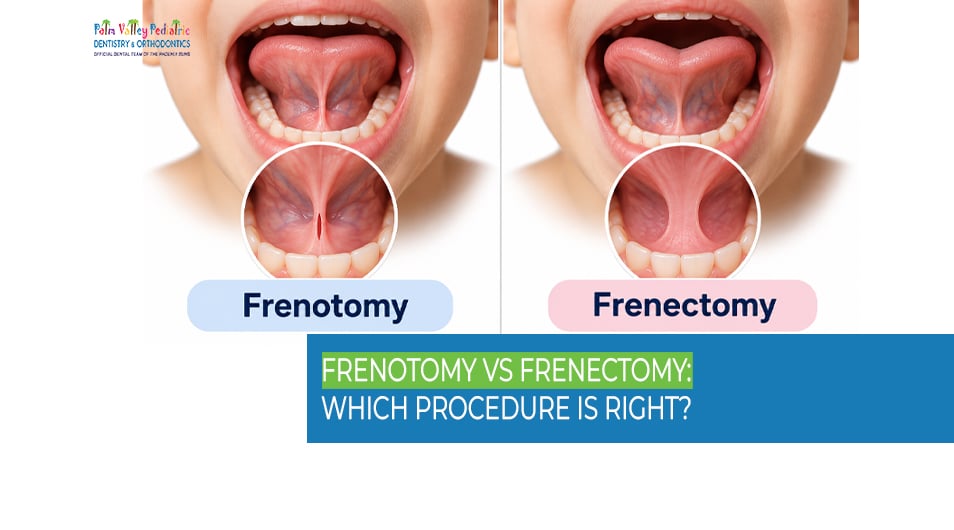
Frenotomy vs Frenectomy: Which Procedure Is Right?
Frenotomy and frenectomy are procedures used to release or remove a restrictive frenulum, the small fold of tissue that connects structures inside the mouth. They may recommend these procedures for children with tongue-tie or restrictive lip or oral frenulum attachments.
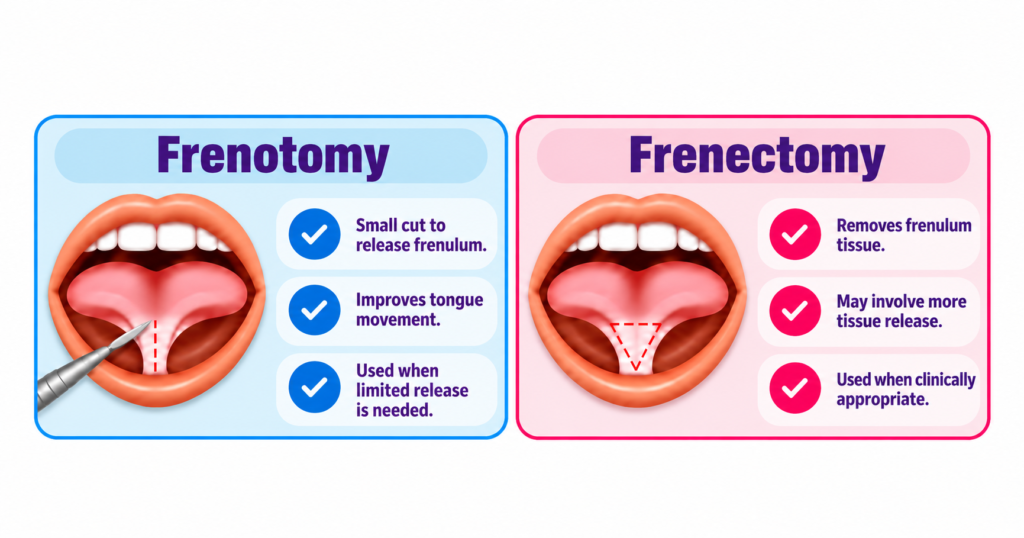
The main difference is how much tissue the dentist treats. A frenotomy cuts or releases the frenulum, while a frenectomy removes the frenulum or more of the tissue. However, healthcare providers may use these terms differently, so parents may hear them used in different ways.
At Palm Valley Pediatric Dentistry & Orthodontics, our pediatric dental team evaluates each child individually before recommending a tongue-tie or lip-tie release.
Quick Answer: What Is the Difference Between Frenotomy and Frenectomy?
A frenotomy is a procedure that makes a cut or release in a restrictive frenulum to improve movement.
A frenectomy generally involves removing the frenulum or a more extensive portion of the tissue.
Frenotomy, also called frenulotomy, is a simple cutting or incision of the frenulum. A frenectomy or frenulectomy is defined as complete removal of the frenum or frenulum, including its attachment to underlying bone.
However, terminology can vary between providers. Some healthcare sources use “frenotomy” and “frenectomy” interchangeably, particularly when discussing tongue-tie release in infants.
For this reason, parents should ask the dentist or healthcare provider exactly what procedure is being recommended and what tissue will be released or removed.

Is Your Child’s Smile on the Right Track?
Early dental visits aren’t just about cleaning teeth, they’re about catching problems before they become costly and painful. Our pediatric specialists create personalized care plans that grow with your child, from their very first tooth through their teen years.
Gentle, kid-friendly care in a welcoming environment.
What Is a Frenulum?
A frenulum is a small fold of tissue inside the mouth that helps connect and stabilize structures such as the lips, cheeks, and tongue.
Children have several oral frenula. The most commonly discussed include:
- The lingual frenulum, located underneath the tongue
- The maxillary labial frenulum, located between the upper lip and gum
- The mandibular labial frenulum, located between the lower lip and gum
- Buccal frenula, which connect the cheeks to the gums or oral tissues
A restrictive lingual frenulum can limit tongue movement and is commonly associated with a condition called ankyloglossia, or tongue-tie. A restrictive labial frenulum may be described as a lip-tie.
Not every prominent or tight-looking frenulum requires treatment. The appearance of the tissue is only one part of the evaluation. A pediatric dentist considers how the frenulum affects function, symptoms, development, and the child’s individual circumstances.
Frenotomy vs Frenectomy: What’s the Difference?
| Feature | Frenotomy | Frenectomy |
| Basic meaning | Incision or release of the frenulum | Removal of the frenulum or a larger portion of it |
| Amount of tissue treated | Usually less extensive | Generally more extensive |
| Common discussion | Tongue-tie or restrictive frenulum release | Tongue-tie, lip-tie, or other restrictive frenulum concerns |
| Purpose | Release restriction and improve movement or function | Remove restrictive tissue when indicated |
| Is it appropriate for every child? | No | No |
| Who decides? | A qualified healthcare professional after evaluation | A qualified healthcare professional after evaluation |
The exact technique depends on the location of the frenulum, the degree of restriction, the child’s age, symptoms, and the reason treatment is being considered.
What Is a Frenotomy?
A frenotomy is a simple procedure that cuts or releases the frenulum.
For example, a child with a tight lingual frenulum may have trouble moving their tongue. If the tight frenulum affects normal mouth function, a healthcare provider may recommend releasing the tissue.
In some infants, a frenotomy may help when tongue-tie is linked to breastfeeding problems. However, not every baby with tongue-tie needs surgery. Breastfeeding problems can have many causes, so the healthcare provider should look at the child’s overall situation before recommending treatment.
A frenotomy releases the tight tissue rather than completely removing the frenulum.
What Is a Frenectomy?
A frenectomy is a procedure in which the frenulum is removed, typically including its attachment as defined by the AAPD.
Frenectomy may be considered when a restrictive frenulum is contributing to a functional or oral health concern and surgical treatment is appropriate.
Depending on the location, a frenectomy may involve the lingual frenulum under the tongue or a labial frenulum between the lip and gum.
The timing, indications, and type of surgical treatment for frenulum restrictions should be considered individually because evidence and clinical recommendations are not completely uniform.
Is Frenotomy the Same as Frenectomy?
Not always. From a technical standpoint, the terms can describe different procedures. A frenotomy involves cutting or releasing the frenulum, while a frenectomy involves removing it.
However, medical terminology is not always consistent. Some providers use “frenotomy” and “frenectomy” interchangeably, particularly when talking about infant tongue-tie procedures.
This can be confusing for parents.
Instead of focusing only on the name of the procedure, ask:
- Which frenulum is being treated?
- What problem is the procedure intended to address?
- How much tissue will be released or removed?
- Why is surgery recommended for my child?
- Are there non-surgical options?
- What should we expect during recovery?
These questions can help you understand exactly what your child’s dentist is recommending.
Why Might a Child Need a Frenulum Release?
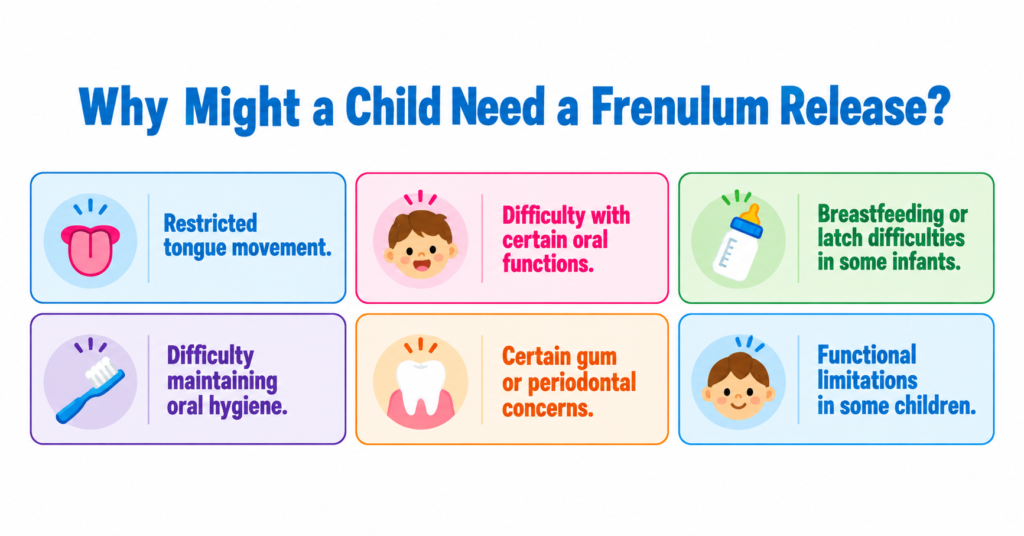
A restrictive frenulum may affect oral function in some children. Depending on the location and the child’s individual circumstances, concerns may include:
- Restricted tongue movement
- Difficulty with certain oral functions
- Breastfeeding or latch difficulties in some infants
- Difficulty maintaining adequate oral hygiene around a restrictive attachment
- Certain gum or periodontal concerns
- Functional limitations associated with a restrictive frenulum
However, a frenulum that looks prominent or tight does not automatically mean that surgery is necessary.
The AAPD emphasizes that the relationship between frenulum anatomy and problems such as breastfeeding difficulties, speech articulation, caries, periodontal disease, and oral development is complex. It also recognizes that further research is needed regarding the indications and long-term effects of frenulum procedures.
Frenotomy vs Frenectomy for Tongue-Tie
Tongue-tie, or ankyloglossia, occurs when the lingual frenulum restricts movement of the tongue.
A child with tongue-tie may have a lingual frenulum that is short, thick, or otherwise restrictive. The degree of restriction and its effect on function can vary significantly from one child to another.
When tongue-tie is being evaluated, the dentist or healthcare provider may look at:
- Tongue movement
- The appearance and attachment of the frenulum
- Feeding or functional concerns
- The child’s age and stage of development
- Other possible causes of the symptoms
- Whether non-surgical approaches have been tried
- Whether releasing the frenulum is likely to improve the specific problem
Surgery should not be recommended simply because a frenulum looks different from average.
The AAPD supports a team-based approach when appropriate, particularly because breastfeeding and other functional concerns can have multiple possible causes.
Frenotomy vs Frenectomy for Lip-Tie
A labial frenulum connects the inside of the lip to the gum and surrounding oral tissues.
Parents may notice a prominent upper lip frenulum and wonder whether their baby or child has a lip-tie problem that needs treatment.
A visible or prominent maxillary frenulum is common in children and does not automatically require a frenectomy.
A pediatric dentist evaluates whether the attachment is causing a meaningful functional or oral health concern before considering treatment.
For older children, the dentist may also consider the child’s dental development, gum health, oral hygiene, tooth spacing, and orthodontic needs when deciding whether treatment is appropriate.
Does Every Child With Tongue-Tie Need a Frenotomy or Frenectomy?
No.
Not every child with ankyloglossia needs surgical treatment. Cleveland Clinic also notes that some babies may not need a frenotomy if breastfeeding adjustments resolve the problem.
Some children have a restrictive-looking frenulum but normal function and no significant symptoms. In these situations, observation may be appropriate.
Other children may have functional difficulties that require a broader evaluation before deciding whether surgery could help.
The AAPD specifically states that not all infants with ankyloglossia require surgical intervention and recommends considering other possible causes of breastfeeding difficulties.
The decision should therefore be based on the child’s individual needs rather than the appearance of the frenulum alone.
What Happens During a Frenulum Release?
The exact procedure depends on the type of frenulum being treated, the child’s age, the treatment technique, and the provider’s clinical approach.
In general, the process may include:
- The pediatric dentist examines the frenulum and evaluates its effect on function.
- The dentist discusses the reason for treatment with the parent.
- Appropriate anesthesia or comfort measures are selected based on the child’s age and procedure.
- The restrictive tissue is released or removed using the planned technique.
- Bleeding is controlled.
- The dental team provides instructions for caring for the area during healing.
- Follow-up is arranged when appropriate.
AAPD guidance notes that frenulum procedures involve surgical incision, control of bleeding, and wound management.
Can Frenotomy or Frenectomy Be Done With a Laser?
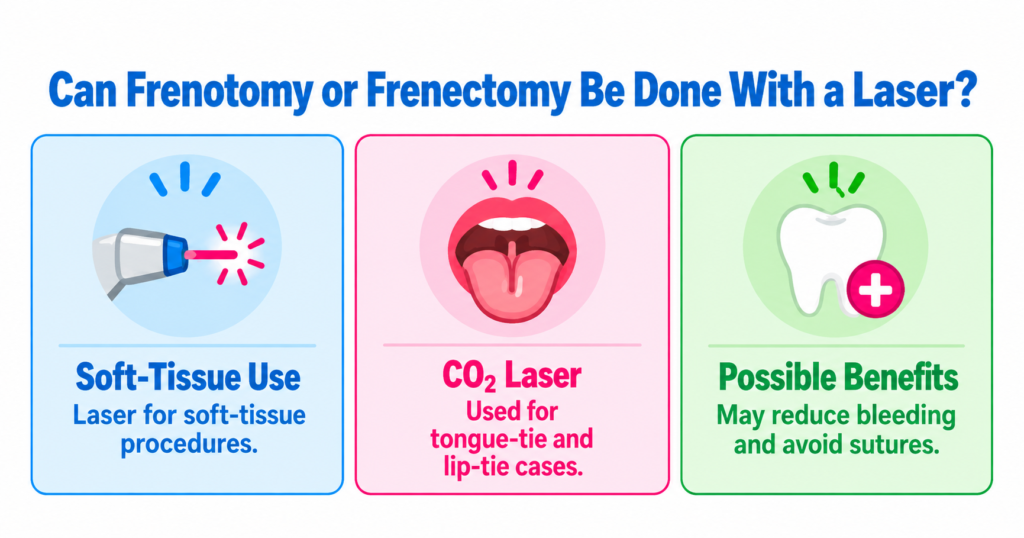
Laser technology can be used for certain soft-tissue dental procedures, including frenulum releases.
Palm Valley Pediatric Dentistry & Orthodontics uses CO₂ laser technology for certain tongue-tie and lip-tie procedures. The practice reports that laser treatment can help reduce bleeding and may eliminate the need for sutures in appropriate cases.
The choice of technique should depend on the child’s clinical needs and the provider’s training and experience.
A laser is a tool used to perform the procedure. It does not by itself determine whether a frenotomy or frenectomy is necessary.
Does Frenotomy or Frenectomy Hurt?
The procedure is performed with appropriate pain-control and comfort measures.
Children may experience some soreness or discomfort as the area heals, depending on the procedure and individual circumstances.
Your pediatric dental team will explain what to expect and provide aftercare instructions appropriate for your child’s procedure.
Parents should follow the specific instructions provided by their child’s dentist rather than relying on general recovery advice found online.
What Is Recovery Like After a Frenulum Procedure?
Recovery varies depending on the procedure, the location of the frenulum, the child’s age, and the technique used.
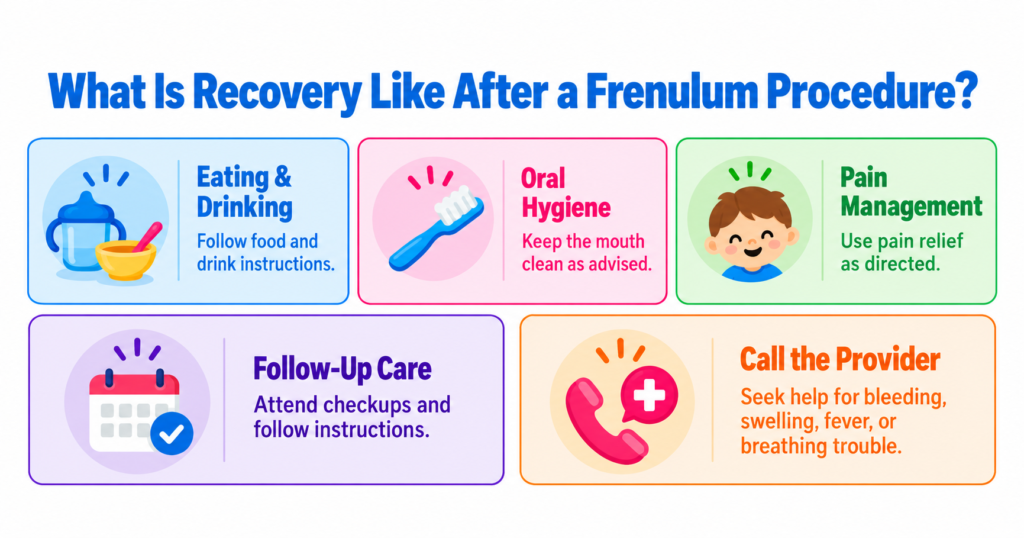
After a frenulum release, your child’s dental team may provide instructions about:
- Eating and drinking
- Oral hygiene
- Pain management
- Caring for the surgical area
- Follow-up visits
- Any exercises or functional therapy that are recommended
The AAPD’s oral surgery guidance includes soft foods, regular oral hygiene, and appropriate pain management among postoperative considerations for frenulum procedures.
If your child develops unusual bleeding, increasing swelling, fever, worsening pain, difficulty breathing, or another concerning symptom after a procedure, contact the treating healthcare provider promptly.
Help Your Child Get the Right Care for Tongue-Tie or Lip-Tie
Frenotomy and frenectomy are terms parents often hear when a child has a restrictive oral frenulum. Although they can describe different procedures, the terminology is not always used consistently.
What matters most is understanding why treatment is being recommended and how it may help your child.
At Palm Valley Pediatric Dentistry & Orthodontics, our pediatric dental team can evaluate your child’s tongue or lip frenulum and explain whether treatment may be appropriate.
If you have questions about tongue-tie, lip-tie, frenotomy, or frenectomy, schedule an evaluation with Palm Valley Pediatric Dentistry & Orthodontics.
Give Your Child the Gift of a Healthy Smile
PVPD doesn’t just treat teeth; we build lasting relationships with families. More confident kids. More comfortable appointments. More reasons to smile. Our patients leave happier and healthier, visit after visit.
Serving families across Scottsdale, because every child deserves a great smile.
People Also Ask
Is a frenotomy or frenectomy better for tongue-tie?
Neither procedure is automatically better for every child. The appropriate approach depends on the child’s anatomy, symptoms, function, age, and treatment needs.
Is frenotomy the same as tongue-tie release?
Frenotomy can be used to describe a tongue-tie release in which the restrictive lingual frenulum is cut or released. However, terminology varies between healthcare providers.
Does every baby with tongue-tie need a frenotomy?
No. Not every baby with ankyloglossia requires surgery. Feeding difficulties can have several causes, and an evaluation may be needed before deciding whether a frenotomy is appropriate.
Can a frenectomy treat a lip-tie?
A frenectomy may be considered for a restrictive labial frenulum when there is a clinical reason for treatment. A prominent lip frenulum alone does not necessarily mean that surgery is needed.
Does a frenulum grow back after frenotomy?
Healing and tissue appearance can vary depending on the procedure, location, and individual child. Follow the treating dentist’s instructions for postoperative care and follow-up.
Does a frenectomy hurt?
The procedure is performed using appropriate pain-control and comfort measures. Some children may experience soreness during healing, but the dental team will provide instructions for managing discomfort.
Pediatric Dental Specialist at PVPD

Dr. Olga
Dr. Olga brings years of specialized pediatric dental expertise and a genuine passion for children’s oral health to the PVPD team. She specializes in creating anxiety-free dental experiences and early-intervention care strategies that set children up for a lifetime of healthy smiles.
Medically reviewed by Dr. Olga Dolghier, DDS, Pediatric Dentist at Palm Valley Pediatric Dentistry & Orthodontics.