
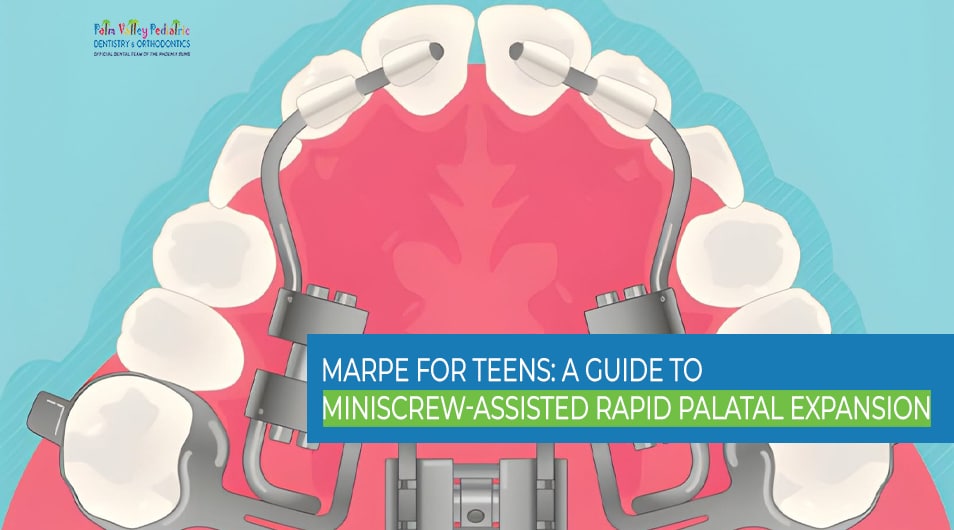
MARPE for Teens: A Guide to Miniscrew-Assisted Rapid Palatal Expansion
Does your child’s upper jaw look narrow?
Maybe their teeth appear crowded. Maybe their bite does not fit together properly. Or perhaps their orthodontist has mentioned that the upper jaw needs more room.
Parents hear the words “palate expander” in these situations.
But traditional expanders are not the only option.
For some older children and teenagers, an orthodontist may recommend MARPE.
MARPE stands for Miniscrew-Assisted Rapid Palatal Expansion. It uses small orthodontic screws to help anchor an expander to the upper jaw.
At Palm Valley Pediatric Dentistry & Orthodontics, our Orthodontic Care services help address crowded teeth, bite problems, jaw development, and alignment concerns.
So, is MARPE right for your child?
Let’s see.
What Is MARPE?
MARPE is a type of rapid palatal expansion appliance.
The full name is Miniscrew-Assisted Rapid Palatal Expansion.
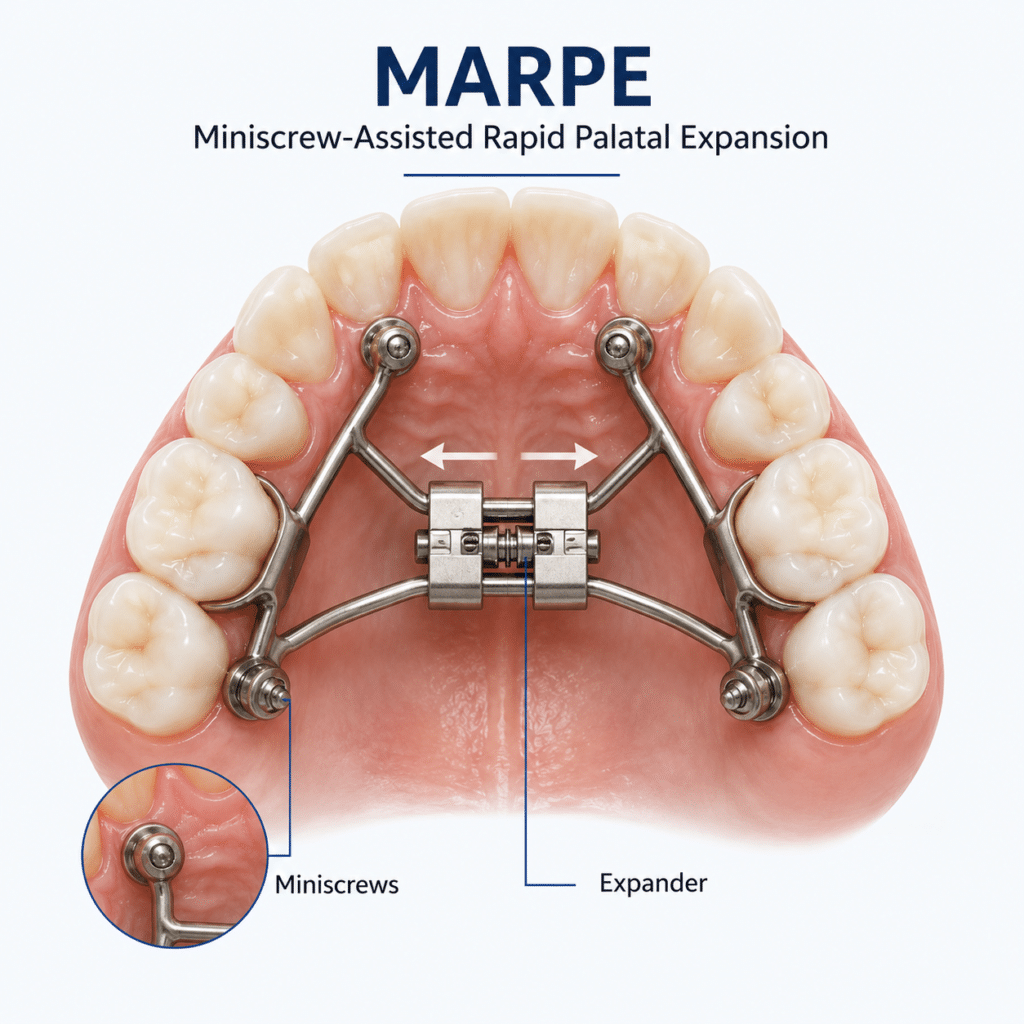
A traditional palate expander usually connects to the teeth. MARPE adds small temporary screws that anchor the appliance to the palate.
These screws help transfer expansion forces to the upper jaw.
The goal is to widen a narrow upper jaw when a child or teenager has a transverse maxillary deficiency.
Research shows that MARPE can create skeletal expansion in appropriate patients. It can also reduce unwanted tooth movement that may occur with conventional expansion.
Think of it this way.
Imagine a child has an upper jaw that is too narrow for the lower jaw. The teeth may become crowded, or the bite may not fit properly.
MARPE can help widen the upper jaw.
Your orthodontist decides whether this approach fits your child’s needs after a detailed examination.

Is Your Child’s Smile on the Right Track?
Early dental visits aren’t just about cleaning teeth, they’re about catching problems before they become costly and painful. Our pediatric specialists create personalized care plans that grow with your child, from their very first tooth through their teen years.
Gentle, kid-friendly care in a welcoming environment.
Why Would a Child Need MARPE?
Not every child needs MARPE.
Orthodontists may consider it when a child has a transverse discrepancy, meaning the upper jaw is narrower than the lower jaw.
A child may have:
- A narrow upper jaw.
- A posterior crossbite.
- Significant dental crowding related to a narrow upper arch.
- A transverse jaw discrepancy.
- Limited response to traditional expansion.
- Growth or skeletal characteristics that make MARPE appropriate.
The exact treatment depends on your child’s age, skeletal development, dental condition, and anatomy.
An orthodontist should never recommend MARPE based on appearance alone.
A proper evaluation helps determine whether the problem comes from the teeth, the upper jaw, the lower jaw, or a combination of factors.
How Does MARPE Work?
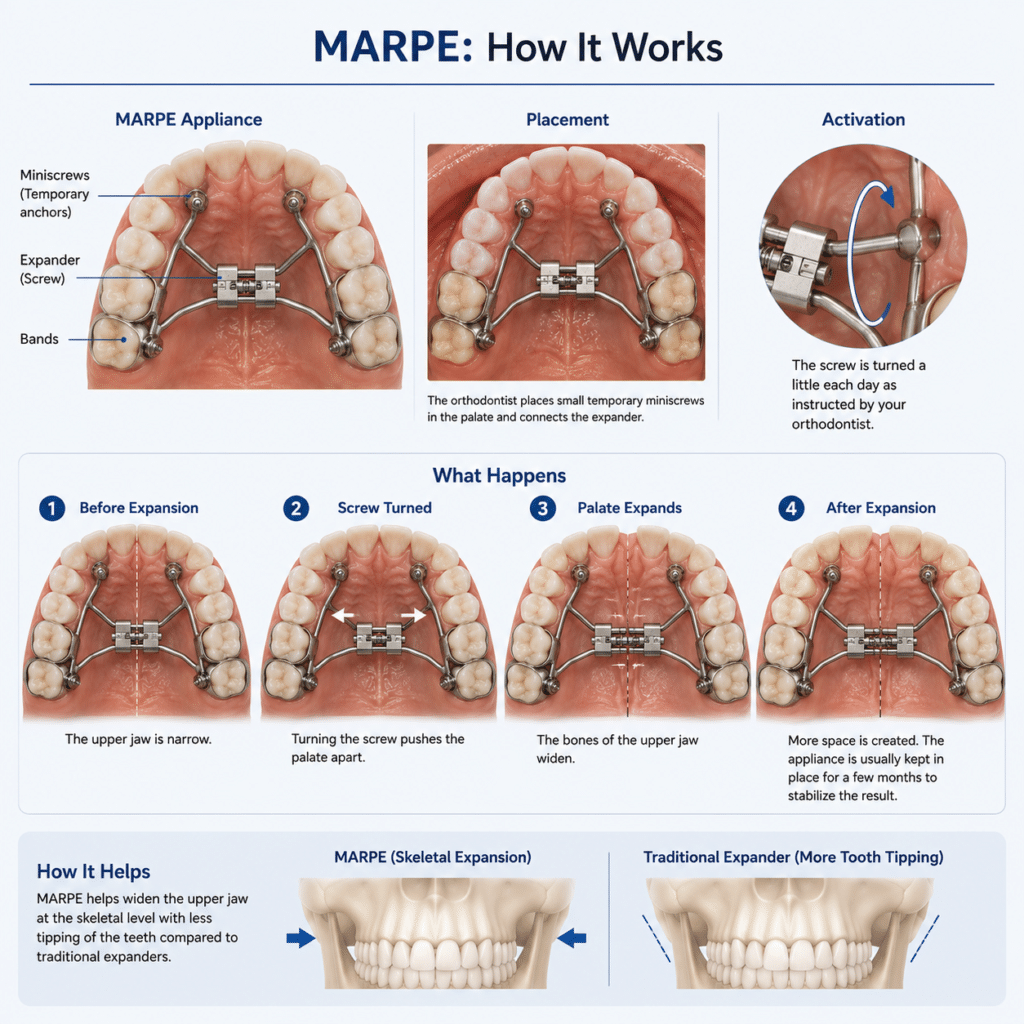
MARPE uses an appliance that sits across the roof of the mouth.
Small temporary screws anchor the appliance to the palate.
Your orthodontist activates the expander according to the treatment plan.
As the appliance expands, it applies controlled forces to the upper jaw.
The goal is to create skeletal expansion rather than relying mainly on tipping the teeth outward.
That is why your orthodontist must plan the treatment carefully.
MARPE vs Traditional Palate Expander
Parents often ask about the difference between MARPE and a traditional rapid palatal expander.
Both appliances aim to widen the upper jaw.
The main difference comes from how they anchor to the mouth.
| Feature | Traditional Palate Expander | MARPE |
| Main purpose | Widens the upper jaw | Widens the upper jaw |
| How it is supported | Relies mainly on the teeth for support | Uses teeth and small orthodontic miniscrews for support |
| Main focus of expansion | Can produce both dental and skeletal expansion | Designed to direct more expansion force toward the upper jaw |
| Common use | Often works well in younger children whose upper jaw is still developing | May suit older children and teens with certain skeletal jaw-width problems |
| Skeletal maturity | Works best when the upper jaw is still developing | Can be considered when conventional expansion may produce more dental movement |
| Treatment decision | Depends on the child’s age, bite, growth, and dental needs | Depends on skeletal maturity, palatal anatomy, bite, and overall orthodontic needs |
What Age Is MARPE Used For?
There is no single age that works for every child.
Orthodontists consider skeletal development rather than simply looking at the child’s birthday.
Younger children often respond well to conventional expansion because their facial bones are still developing.
As children grow older, the midpalatal suture becomes more resistant to conventional expansion.
This can make MARPE an option for some adolescents and young adults with transverse maxillary deficiency.
So, MARPE is not automatically “better” because a child is older.
The right appliance depends on the individual patient.
What Happens During MARPE Treatment?
Many parents worry when they hear that MARPE uses small screws.
Understanding the process can make the treatment feel less intimidating.
Many parents feel nervous when they hear that MARPE uses small orthodontic screws. That reaction is completely understandable.
We start the treatment process with a detailed evaluation. Our orthodontic team explains each step and monitors your child’s progress throughout treatment.
1. Orthodontic Evaluation
The first step involves a detailed examination of your child’s teeth, bite, and upper jaw.
Digital scans and X-rays can help show the teeth, jaw, and palate in greater detail.
PVPD uses digital scanning technology to create detailed 3D images for orthodontic treatment planning. The evaluation also looks at:
- Your child’s age and growth.
- Skeletal development.
- Upper jaw width.
- Tooth position.
- Bite.
- Palatal anatomy.
- Overall orthodontic needs.
These details help determine whether MARPE suits your child’s needs.
2. Treatment Planning
If MARPE is appropriate, the orthodontist creates a treatment plan based on your child’s teeth and jaw development.
The treatment plan explains why expansion may help and what you can expect during treatment.
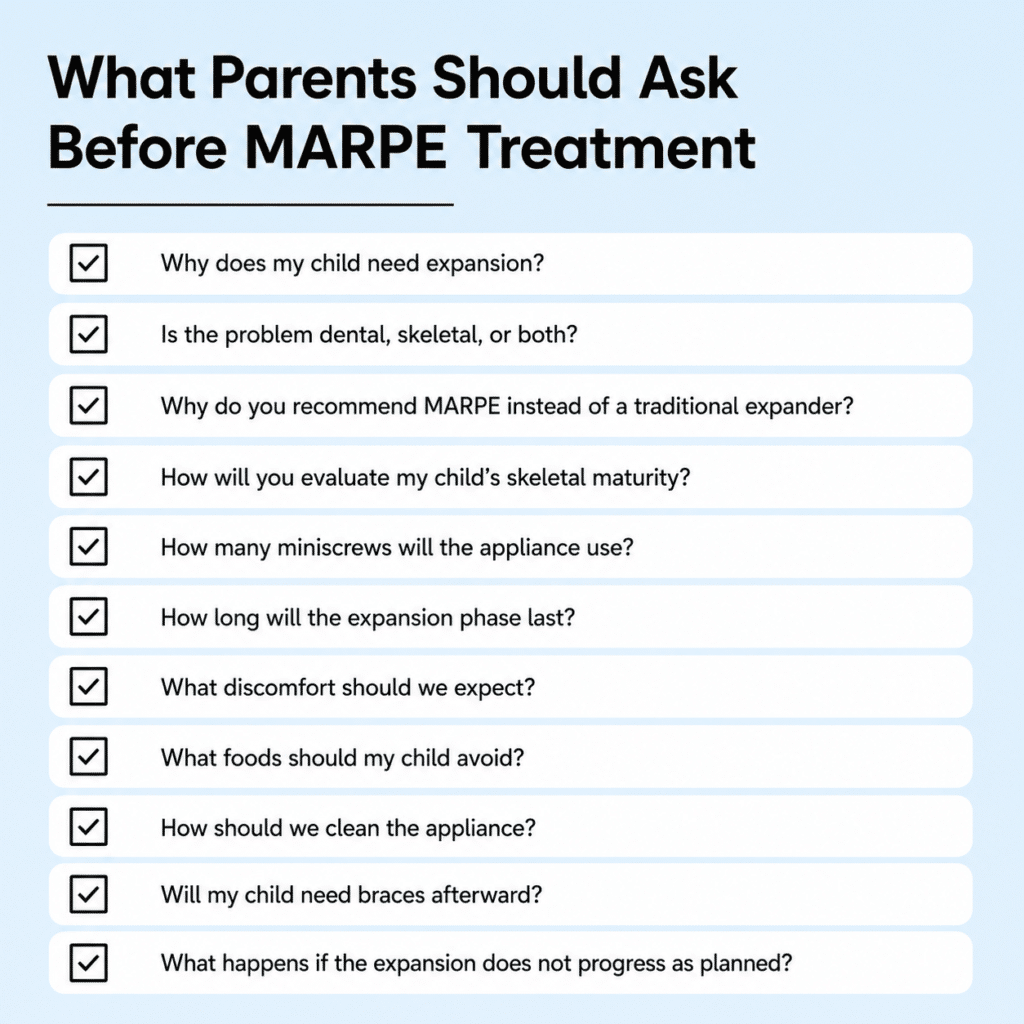
Parents can also ask questions about the appliance, activation process, treatment time, and expected results before treatment begins.
3. Appliance Placement
The MARPE appliance sits against the roof of your child’s mouth.
Small miniscrews provide additional support for the appliance.
The orthodontist plans the placement carefully based on your child’s anatomy.
Before the procedure, the team explains what will happen in simple terms. This can help your child feel more prepared and comfortable.
4. Expansion
After placement, the expansion phase begins.
The orthodontist provides specific instructions for activating the appliance. Your child’s activation schedule depends on their treatment plan and response to expansion.
Follow the instructions carefully. Never change the activation schedule without speaking with the orthodontic team.
5. Regular Monitoring
Your child will return for regular orthodontic appointments during the expansion phase. At each visit, the orthodontist checks:
- The MARPE appliance.
- Tooth position.
- Bite changes.
- Jaw expansion.
- Your child’s overall progress.
These appointments also give parents a chance to discuss any discomfort or concerns. The orthodontist can adjust the treatment plan when necessary.
6. Stabilization
Once the upper jaw reaches the desired width, the treatment enters the stabilization stage.
The orthodontist may keep the appliance in place for a period of time. This gives the jaw and surrounding tissues time to adjust to the new position.
The length of this stage varies from child to child.
After expansion, some children may need braces or other orthodontic treatment to align their teeth and complete their smiles.
What Does MARPE Feel Like?
Your child may notice pressure or tightness when the orthodontist activates the expander.
Some children also experience temporary soreness or discomfort.
The experience varies from one child to another.
Your orthodontist will explain what sensations to expect and how to manage discomfort.
Parents should contact the orthodontic office if their child experiences severe pain, significant swelling, appliance movement, or another unexpected problem.
Will MARPE Create a Gap Between the Front Teeth?
It can.
Some patients develop a temporary gap between the upper front teeth during expansion. This happens because the upper jaw expands. The gap does not automatically mean something has gone wrong.
As treatment continues, orthodontic treatment can address the position of the teeth. Your orthodontist will monitor the changes and decide what happens next.
What Are the Benefits of MARPE?
MARPE can help children and teens with a narrow upper jaw. It uses a palate expander with small orthodontic screws to gently widen the upper jaw.
For the right child, this can improve the fit of the teeth and create a better foundation for orthodontic treatment.
1. It Can Widen a Narrow Upper Jaw
Some children have an upper jaw that is too narrow for their teeth to fit properly.
This can affect their bite and the way their upper and lower teeth meet.
MARPE helps widen the upper jaw in suitable patients. It gives the orthodontist more control over where the expansion force goes.
2. It Can Help Keep Teeth in a Better Position
Traditional expanders primarily rely on the teeth for support.
MARPE also uses small screws in the palate. This gives the appliance extra support.
As a result, the orthodontist can focus more of the expansion on the upper jaw instead of pushing only on the teeth.
This can help limit unwanted tooth movement during treatment.
3. It Can Help With a Crossbite
A narrow upper jaw can cause a crossbite.
With a crossbite, some upper back teeth sit inside the lower back teeth when your child bites down.
This can affect the way your child’s teeth meet.
MARPE can widen the upper jaw and help improve the bite when a narrow jaw causes the crossbite.
4. It Can Make More Room for Crowded Teeth
A narrow upper jaw can leave less room for the teeth.
This can contribute to crowding.
Widening the upper jaw can create more space across the upper dental arch.
For example, a teenager may have a narrow upper jaw and crowded front teeth. The orthodontist may use MARPE first to widen the upper jaw. Braces or Invisalign can then straighten the teeth.
MARPE does not always replace braces. It can work as one part of a complete orthodontic treatment plan.
5. It Can Help Older Children and Teens
Younger children often respond well to traditional palate expanders.
As children grow, the upper jaw becomes harder to widen with a traditional expander alone.
MARPE can give some older children and teens another option.
The orthodontist looks at your child’s age, growth, jaw, teeth, bite, and palate before recommending treatment.
6. It Can Support a Healthier Bite
A balanced bite helps the upper and lower teeth work together properly.
When the upper jaw stays too narrow, the teeth may not fit together as they should.
MARPE can help improve the width of the upper jaw when skeletal expansion is needed.
A wider upper jaw can give the orthodontist a better starting point for the next stage of treatment.
Does MARPE Improve Breathing?
Many parents ask if MARPE can help their child breathe better.
Maxillary expansion can increase the size of parts of the nasal airway. However, this does not mean that MARPE will improve every child’s breathing.
Researchers still do not have enough evidence to say exactly how much MARPE can help with breathing.
If your child snores, breathes through their mouth, stops breathing during sleep, or has other breathing problems, talk to their healthcare provider.
MARPE should not replace a proper check for breathing or sleep problems.
If your child has these concerns, find out what is causing the problem before choosing treatment.
Is MARPE Safe?
MARPE can be a safe treatment for some children and teens. An orthodontist should carefully assess the child before treatment and monitor their progress throughout treatment.
Like any orthodontic treatment, MARPE can have some risks. Studies have found that MARPE may affect the teeth, gums, jaw bone, and nearby soft tissues. In some cases, the teeth or jaw may move back after treatment. Doctors call this relapse.
Before recommending MARPE, your orthodontist will check your child’s teeth, jaw, age, and growth.
These checks help the orthodontist decide if MARPE will work well for your child.
Remember, not every child needs MARPE.
Some children may get better results from another type of expander. Your orthodontist can choose the option that best matches your child’s needs and stage of growth.
How Long Does MARPE Treatment Take?
Treatment time varies.
The active expansion phase may take several weeks, but the full treatment plan can last much longer. Your child may need additional orthodontic treatment after expansion. Your orthodontist can give you a more accurate timeline after examining your child’s teeth and jaw. The exact timeline depends on:
- The amount of expansion needed.
- Your child’s skeletal maturity.
- The response to treatment.
- The appliance design.
- Whether braces or aligners follow.
- How well your child follows the treatment instructions.
How Should Your Child Care for a MARPE Expander?
Good oral hygiene becomes especially important during orthodontic treatment.
Food can collect around the appliance. Plaque can also build up around the teeth and gums. Younger children may need extra help with cleaning.
Help your child:
- Brush carefully around the appliance.
- Clean between the teeth as instructed.
- Follow the orthodontist’s cleaning instructions.
- Avoid foods that can damage the appliance.
- Attend every scheduled appointment.
- Follow the activation schedule exactly.
- Tell the orthodontist about pain or appliance problems.
A clean appliance can make the treatment experience easier and help protect your child’s teeth and gums.
Does Every Teen With a Narrow Palate Need MARPE?
No.
MARPE is only one orthodontic treatment option. Some children may respond well to a conventional palate expander. Others may need braces, aligners, or a different approach.
In some patients, orthodontic treatment may require additional procedures.
Your orthodontist considers the complete picture before recommending treatment. That includes your child’s growth, bite, teeth, and jaw relationship, as well as treatment goals.
Is MARPE the Right Treatment for Your Child?
MARPE can help create skeletal expansion for carefully selected patients with a narrow upper jaw.
It may offer an alternative to conventional expansion for some older children and teenagers.
However, it does not suit every child.
Your child’s orthodontist needs to evaluate their teeth, jaw, growth, and anatomy before recommending treatment.
If you think your child may have a narrow upper jaw, crossbite, or crowding, schedule an orthodontic evaluation.
Give Your Child the Gift of a Healthy Smile
PVPD doesn’t just treat teeth; we build lasting relationships with families. More confident kids. More comfortable appointments. More reasons to smile. Our patients leave happier and healthier, visit after visit.
Serving families across Scottsdale, because every child deserves a great smile.
Give Your Child the Right Orthodontic Start!
Every child’s smile develops differently.
Some children need only routine monitoring. Others need early orthodontic treatment to guide the growth and development of their teeth and jaws.
MARPE can play an important role for selected patients with a narrow upper jaw.
The first step is a proper evaluation.
We help families understand their child’s orthodontic needs and treatment options in a comfortable, child-friendly environment.
Schedule your child’s orthodontic consultation to learn whether palatal expansion or another orthodontic treatment may be right for your child.
Pediatric Dental Specialist at PVPD

Dr. Olga
Dr. Olga brings years of specialized pediatric dental expertise and a genuine passion for children’s oral health to the PVPD team. She specializes in creating anxiety-free dental experiences and early-intervention care strategies that set children up for a lifetime of healthy smiles.
Medically reviewed by Dr. Olga Dolghier, DDS, Pediatric Dentist at Palm Valley Pediatric Dentistry & Orthodontics.


