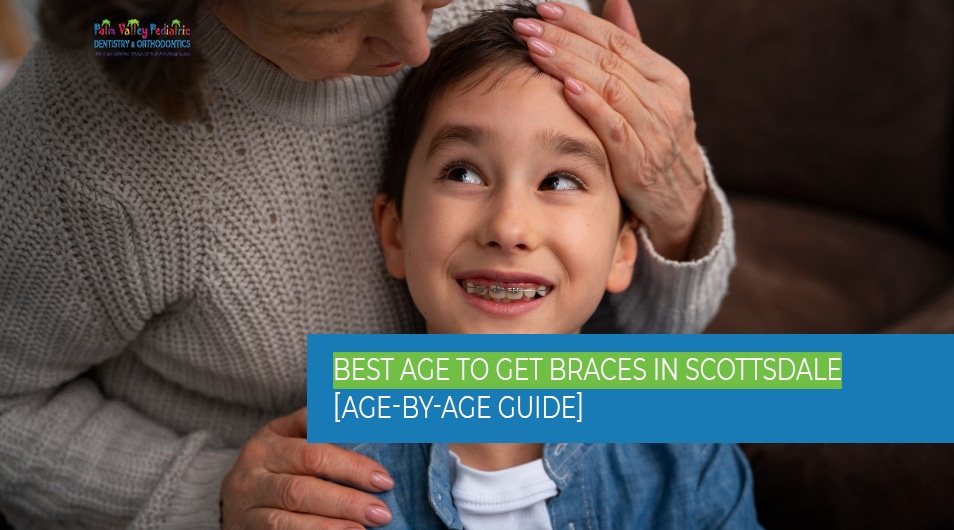
Best Age to Get Braces in Scottsdale [Age-by-Age Guide]


The best age to get braces in Scottsdale is usually between 10 and 14 years old, when adult teeth are in place, and the jaw is still growing. Palm Valley Pediatric Dentistry & Orthodontics recommends an initial orthodontic evaluation around age 7 to identify issues early and plan the right timing for treatment.
Every parent wants nothing but the best for their child. And that need becomes all the more apparent when it comes to getting their child braces.
Because if you start too early, then your child may end up in treatment longer than needed. On the other hand, if you wait too long, it might lead to more complex orthodontic issues for your child.
This guide will encompass the following:
- The ideal age range for braces
- Signs your child is ready
- What happens if you wait
- How to get started in Scottsdale
What Is the Best Age to Get Braces?
10 to 14 is the ideal age for your child to get braces. And here is why:
- Your child has all the permanent teeth in place by this age
- The jaw is still actively growing
- Teeth move more easily when the bone is still developing
If you start within this window, the treatment time will be short and the results will be positive.
But do understand that every child is different. Some need treatment earlier. Some do fine starting a little later. The key factor is understanding your child’s dental situation and starting treatment at the right stage.
Why Age 7 Is the Right Time for an Orthodontic Checkup
Age 7 is an important time in your child’s dental development. This is when adult teeth start coming in, and bite problems can first be clearly seen. Most children do not need braces at age 7. But an early checkup helps the dentist watch how the teeth and jaw are growing and decide the best time for treatment.
The First Orthodontic Evaluation
The American Association of Orthodontists recommends that children visit an orthodontist at age 7.
At this age, there is a mixture of baby and permanent teeth. A skilled orthodontist can identify emerging complications that cannot be seen by the naked eye.
Early detection means:
- Better planning
- Shorter treatment when the time comes
- Fewer surprises down the road
Think of it as a head start. Not a commitment to treatment right now.

Is Your Child’s Smile on the Right Track?
Early dental visits aren’t just about cleaning teeth, they’re about catching problems before they become costly and painful. Our pediatric specialists create personalized care plans that grow with your child, from their very first tooth through their teen years.
Gentle, kid-friendly care in a welcoming environment.
Age-by-Age Guide to Braces Timing
Each stage of a child’s development presents its own orthodontic opportunities. These are the things to expect at each age.
Ages 6 to 7 – Early Screening Stage
This is the observation phase. The goal is not treatment. It is early detection. An orthodontist will monitor the development of teeth and the jaw.
If anything looks off, they will catch it now before it becomes harder to correct.
Ages 8 to 10 – Early Treatment Stage
Some children require Phase 1 treatment during this window. These are not full braces. It is a targeted intervention to guide growth.
Common treatments include:
- Space maintainers to hold room for incoming teeth
- Partial braces on specific teeth
- Palate expanders or jaw correction devices
Not every child needs Phase 1 treatment. But for those who do, acting early makes everything go more smoothly later.
10 to 14 – The Most Common Braces Age
This is the sweet spot. Your child has mostly permanent teeth. The jaw is still growing. This combination makes teeth easier to move and align.
Children who start braces in this range typically see the best outcomes with the shortest treatment times.
.
Ages 15 to 18 – Teen Treatment Stage
Teens can still get excellent results from braces. The jaw may be less flexible than it was at 12, but orthodontic treatment is still absolutely effective at this age.
Treatment may take slightly longer depending on the complexity of the case.
Adults – It’s Never Too Late
Braces are not just for kids. As a matter of fact, about every three orthodontic patients today are adults.
The process of adult treatment may take longer, as the jaw has already developed. But the results are just as real.
At Palm Valley Pediatric Dentistry and Orthodontics in Scottsdale, we treat patients of all ages.
How to Tell If Your Child Is Ready for Braces
You do not have to wait until your child complains. There are clear signs indicating a need for an orthodontic evaluation.
7 Signs to Watch For If Your Child is Ready for Braces:
Here are the seven signs to watch for in your child:
- Crowded or overlapping teeth
- Overbite, underbite, or crossbite
- Premature or delayed loss of baby teeth
- Difficulty chewing or biting food
- Thumb sucking beyond age 4
- Language problems or speech lisp.
- Shifting teeth that seem to move rapidly
The presence of at least one of these signs is enough to arrange a consultation. Catching issues early is always better than watching and waiting.
What Happens If You Start Braces Too Early
One might think that the sooner the better. However, it is not necessarily so. Early onset of braces before sufficient permanent teeth eruption may result in:
- Longer overall treatment time
- More frequent adjustments
- Higher costs because a second phase of treatment may be needed
That is why professional evaluation matters. A skilled orthodontist understands when to start.
What Happens If You Wait Too Long
There are risks associated with treatment delays.
Once the jaw has stopped growing, some issues can be very difficult to correct with braces alone. In some cases, they may require surgery. Waiting too long can also mean:
- More complex treatment plans
- Longer time in braces
- Greater risk of tooth or gum damage from untreated crowding
There is a reason why the window between ages 10 and 14 exists. Missing it does not completely close the door, but it does make the path a little steeper.
How Long Do Braces Take?
The average teenager and child wears braces for 18 to 24 months. The timeline is tied to several variables.
- The severity of the misalignment
- The age treatment starts
- The type of braces used
- How well the patient follows care instructions
Those children who begin treatment at the optimal age will usually complete treatment around 18 months, at the end of the range.
How Much Do Braces Cost in Scottsdale?
It is one of the most frequently asked questions by parents, and it’s a fair one. In Scottsdale, the average cost of braces is between $3,000 and $ 13,000. The variation comes down to:
- The type of braces selected
- How complex the case is
- Length of treatment
Orthodontic treatment for children is covered by most dental insurance plans. Our team at PVPD will walk you through what your plan covers before treatment begins.
We also offer flexible payment plans so the cost does not stand between your child and a healthy smile.
Many parents do not realize that early treatment usually costs less than late treatment. A simple evaluation at age 7 can save you significantly in the long run.
Types of Braces Available for Kids and Teens
There are three types of available braces for kids and teens:
Metal Braces
Metal braces are very effective in a large variety of alignment problems. Today’s metal braces are smaller and more comfortable than they used to be.
Ceramic Braces
The same mechanism is used, only with tooth-coloured brackets. Less visible and a popular choice for kids who want a more discreet look.
Clear Aligners
A series of removable, transparent trays that gradually shift teeth. A great option for teens who want flexibility.
Our team will assist you in deciding on the best option for your child based on their case and lifestyle.
Why Early Orthodontic Evaluation Saves Money
Scheduling that first evaluation at age 7 is not just about health. It is also a smart financial decision. When problems are caught early:
- Treatment is often simpler and shorter
- Less intervention is needed overall
- The risk of needing surgery or complex correction later is reduced
Parents who invest in an early screening often save thousands compared to those who wait until problems are obvious.
When Parents in Scottsdale Should Schedule a Consultation
If you are unsure whether your child is ready, here are clear triggers that mean it is time to call:
- Your child has turned 7
- Their teeth look crowded or crooked
- Their bite looks uneven
- You have noticed speech issues or a lisp
- Baby teeth were lost very early or very late
- Teeth appear to be shifting noticeably
You do not need to see a problem to schedule. A routine evaluation at the right age gives your child’s smile the best possible start.
At Palm Valley Pediatric Dentistry and Orthodontics of Scottsdale, we provide free consultations, take you through all options, and never pressure you.
Is Your Child’s Smile on the Right Track?
Early dental visits aren’t just about cleaning teeth, they’re about catching problems before they become costly and painful. Our pediatric specialists create personalized care plans that grow with your child, from their very first tooth through their teen years.
Gentle, kid-friendly care in a welcoming environment.
Frequently Asked Questions
What is the best age for braces?
The best age for getting braces lies between 10 and 14. But an early evaluation of your child around age 7 is highly recommended.
Is 7 too early for braces?
Yes, age 7 is usually too early to start braces, but it is the right age for a dental or orthodontic checkup.
This early visit helps the dentist find problems early and decide the best time for treatment.
Can a 5-year-old get braces?
Full braces at the age of 5 are neither recommended nor typical. But if your child is suffering from a severe orthodontic problem, then doctors can recommend this.
At what age is it too late for braces?
There is no age that is too late. You can benefit from orthodontic treatments at any age. But the results can take longer, once the jaw growth is complete.
Do braces hurt more for adults?
Yes, because jaw growth in adults is complete. In younger patients, getting braces is rather less painful because the jaw is less flexible. Soreness after adjustments is normal and manageable for everyone.
How long will my child wear braces?
Most children wear braces for 18 to 24 months. But the timeline can vary depending on the severity and complexity of the orthodontic issue.
Do braces cost more if you wait?
Often, yes. That is because the longer you wait, the more severe the issue becomes. And once the jaw
Can adults get braces in Scottsdale?
Absolutely. Palm Valley Pediatric Dentistry and Orthodontics treats patients of all ages across our Scottsdale locations. We offer traditional braces and clear aligners for adults.
Key Takeaways
This is what every Scottsdale parent must bear in mind:
- Most children receive braces when they are between 10 and 14 years old.
- The first orthodontic evaluation should be carried out at age 7
- Problems can be avoided by screening at an earlier stage, saving bigger and more expensive problems
- Braces are effective at any age
- Timely initiation decreases the duration and total cost of treatment
You do not need to work this out yourself. At Palm Valley Pediatric Dentistry and Orthodontics, our team is ready to assist you in every step.
Schedule a free consultation at our Scottsdale office. We will provide you with a clear picture of your child’s position and what, if anything, must happen next.
Ready to Take the Next Step?
Visit Palm Valley Pediatric Dentistry and Orthodontics in Scottsdale. Our board-certified staff offers candid and stress-free services to families in Arizona.