
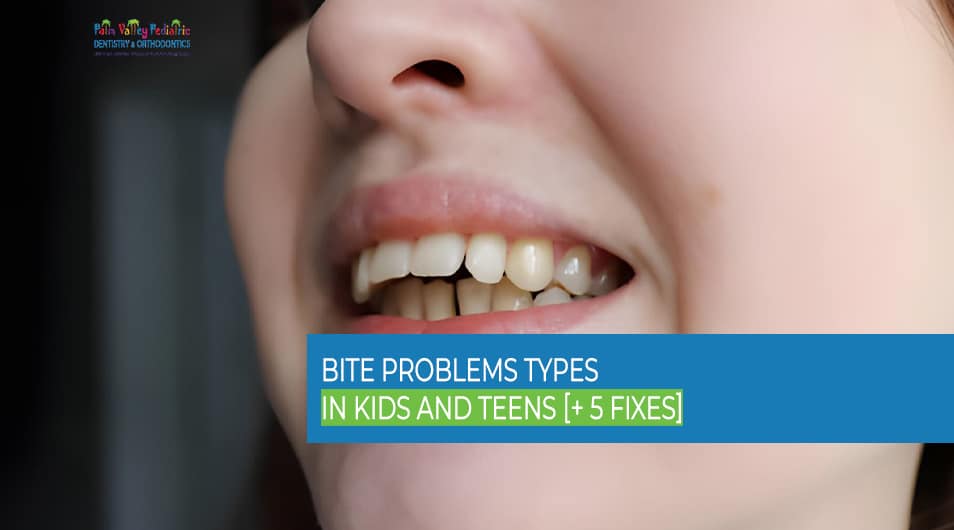
Bite Problems Types in Kids and Teens [+ 5 Fixes]
A bite problem happens when the top and bottom teeth don’t line up the way they should when your child closes their mouth.
Dentists call this malocclusion, and it shows up in kids and teens as overbites, underbites, crossbites, or open bites.
Most parents in Scottsdale spot something odd first: teeth that stick out, a jaw that shifts sideways, or a child who chews only on one side.
The hard part is knowing whether it’s a real problem or just a phase a child grows out of.
A bite problem rarely fixes itself. Left alone, it usually gets harder to correct as the jaw finishes growing.
Palm Valley Pediatric Dentistry & Orthodontics diagnoses and treats bite problems in kids and teens right here in Scottsdale.
The 4 Types of Bite Problems Parents Should Know
Each bite problem looks different in your child’s mouth, and each one causes its own set of issues.
Knowing which is which helps you describe what you’re seeing when you call.
1- Overbite: When the Top Teeth Cover Too Much
An overbite means the upper front teeth sit too far over the lower ones when your child bites down. A small overlap is normal. A deep one isn’t.
This matters because a deep overbite wears down the lower front teeth over time, and in severe cases the lower teeth bite into the roof of the mouth.
It also pushes the upper teeth forward, which raises the risk of a chipped or knocked-out tooth during sports or a fall.
2- Underbite: When the Lower Jaw Sits Forward
An underbite means the lower teeth sit in front of the upper teeth. This one traces back to jaw growth more than tooth position, so it usually needs early attention.
The reason underbites need early care is simple: they come from a lower jaw growing too far forward.
Catch it while the jaw still grows, and an orthodontist can guide that growth.
Wait until the teen years, and the same case can end up needing jaw surgery instead.
3- Crossbite: When Teeth Bite on the Wrong Side
A crossbite means some upper teeth sit inside the lower teeth instead of outside them. It can affect the front teeth, the back teeth, or both.
A crossbite matters because it forces the jaw to shift sideways to find a comfortable bite.
Over years, that constant shift wears teeth unevenly and can pull the jaw off-center as it grows, which changes the shape of your child’s face.
4- Open Bite: When Teeth Don’t Meet at All
An open bite means the front teeth don’t touch even when the back teeth close together. You will see a visible gap between the top and bottom front teeth.
This one usually links back to habits like thumb sucking or long-term pacifier use.
It matters because kids with an open bite often struggle to bite into food cleanly and sometimes develop speech issues, since the tongue pushes through the gap when they talk.
Bite Problems Warning Signs You Can Spot at Home
You don’t need a dental degree to notice a bite problem forming.
Most parents catch the early clues months before a checkup. Watch for these between visits:
- Front teeth that stick out, tilt in, or don’t meet when your child closes their mouth
- A jaw that shifts to one side as your child bites down
- Chewing on only one side, or complaints that eating feels awkward
- Speech issues like lisps that don’t fade with age
- Mouth breathing, snoring, or trouble closing the lips fully at rest
- Thumb sucking or pacifier use that continues past age 4 or 5
Spotting one of these doesn’t mean treatment starts tomorrow.
It means the next dental visit should include a real bite check, so a professional can decide if it needs action or just monitoring.
What Actually Causes Bite Problems?
Bite problems don’t come from one single thing.
They usually come from a mix of what your child inherited and what happened as they grew.
1- Genetics
Jaw size and shape pass down through families.
A child can inherit a small lower jaw from one parent and larger teeth from the other, and those two don’t fit together well.
This mismatch is the most common root cause, which is why bite problems often run in families.
2- Childhood Habits That Reshape the Jaw
Thumb sucking, prolonged pacifier use, and tongue thrusting all push against growing teeth.
Sucking habits past age 3 can change how the teeth and jaw develop, especially the front teeth.
Timing is what makes these habits so powerful.
A child’s jaw stays soft and moldable for years, so steady pressure from a thumb or tongue slowly reshapes it, the same way a brace guides teeth on purpose.
3- Early Baby Tooth Loss and Crowding
Baby teeth hold space for the adult teeth coming in behind them.
When a baby tooth falls out too early from decay or injury, nearby teeth drift into the empty spot.
That drift blocks the adult tooth from coming in straight, which sets up crowding and a bad bite down the line.
The Consequences of Ignoring a Bite Problem
A bite problem isn’t just about a crooked smile. Left untreated, it affects how your child eats, speaks, and stays healthy.
Uneven bites wear teeth down faster, since the force of chewing lands on the wrong spots.
Misaligned teeth also trap food in places a toothbrush can’t reach, which raises the risk of cavities and gum problems.
Some bite problems even affect breathing and sleep, especially when a narrow jaw crowds the airway.
That’s why an early bite check does more than straighten teeth.
How Can You Fix Bite Problems?
The fix depends on the type of bite problem and your child’s age. This is exactly why early evaluation helps so much.
A young child’s jaw still grows, so an orthodontist can guide that growth before the jaw sets.
Once a teen’s jaw finishes growing, the same problem often needs a different, more involved approach.
That single difference is why the same bite problem can take six months to fix at age 8 and two years at age 14.
1- Palate Expanders for Crossbites and Narrow Jaws
A palate expander widens a narrow upper jaw slowly over a few months. It works best in kids, while the jaw still has a soft growth line down the middle that hasn’t fused yet.
This is the go-to early fix for crossbites, since it corrects the width before the bite locks into the wrong position.
2- Partial Braces for Guiding Young Teeth
Partial braces move a few specific teeth while the rest of the adult teeth are still coming in.
Orthodontists use these in kids to clear a path, so the remaining permanent teeth erupt into better positions on their own.
This early step often reduces how much work full braces need to do later.
3- Full Braces and Clear Aligners for Teens
Once most permanent teeth are in, full braces or clear aligners correct overbites, underbites, and remaining alignment issues.
These handle the heavy lifting in the teen years, moving teeth into their final positions and fixing how the top and bottom teeth meet.
4- Habit Correction for Open Bites
An open bite caused by thumb sucking or tongue thrusting won’t stay fixed until the habit stops.
Treatment usually starts by breaking the habit, sometimes with a small appliance, then uses braces or aligners to close the gap.
Skipping the habit step means the open bite comes right back.
5- Surgery for Severe Jaw Cases
When a jaw problem is severe, and the child has already finished growing, surgery corrects the jaw position that braces alone can’t fix.
This is the least common route and usually only comes up when an underbite or major misalignment gets caught late, which is one more reason early evaluation matters.
Every Plan Starts With a Full Evaluation!
No two bite problems follow the same path. At PVPD, our team maps the exact type, cause, and severity before recommending anything, so your child gets the simplest fix that actually works, not a one-size-fits-all plan.
Ready to Get Your Child’s Bite Checked?
Overbite, underbite, crossbite, or open bite: each one needs a different fix, and a single evaluation tells you exactly which your child has.
Dr. Olga and the team at Palm Valley Pediatric Dentistry & Orthodontics diagnose and treat all four bite problems in kids and teens.
We map the type, cause, and severity, then match it to the right treatment for your child’s stage of growth, whether that’s a palate expander, partial braces, or full alignment.
Book your child’s bite evaluation with our Orthodontics Team today.
People Also Ask
At what age should a bite problem get checked?
The best time for a first bite check is around age 7, when a mix of baby and adult teeth gives the orthodontist a clear picture of how the jaw is developing. Catching a problem this early often means a simpler fix than waiting for the teen years.
Can a child grow out of a bite problem on their own?
Most bite problems don’t correct themselves and tend to get harder to fix as the jaw finishes growing. A habit-related open bite sometimes improves once thumb sucking stops, but the safest move is to have a dentist confirm rather than wait and hope.
How are bite problems treated in kids versus teens?
In young kids, orthodontists guide the still-growing jaw with tools like palate expanders or partial braces. In teens, most permanent teeth are already in, so treatment shifts to full braces or clear aligners, and severe jaw cases occasionally need surgery.