When Do Baby Teeth Fall Out? Ages, Order, and How Many Kids Lose Them
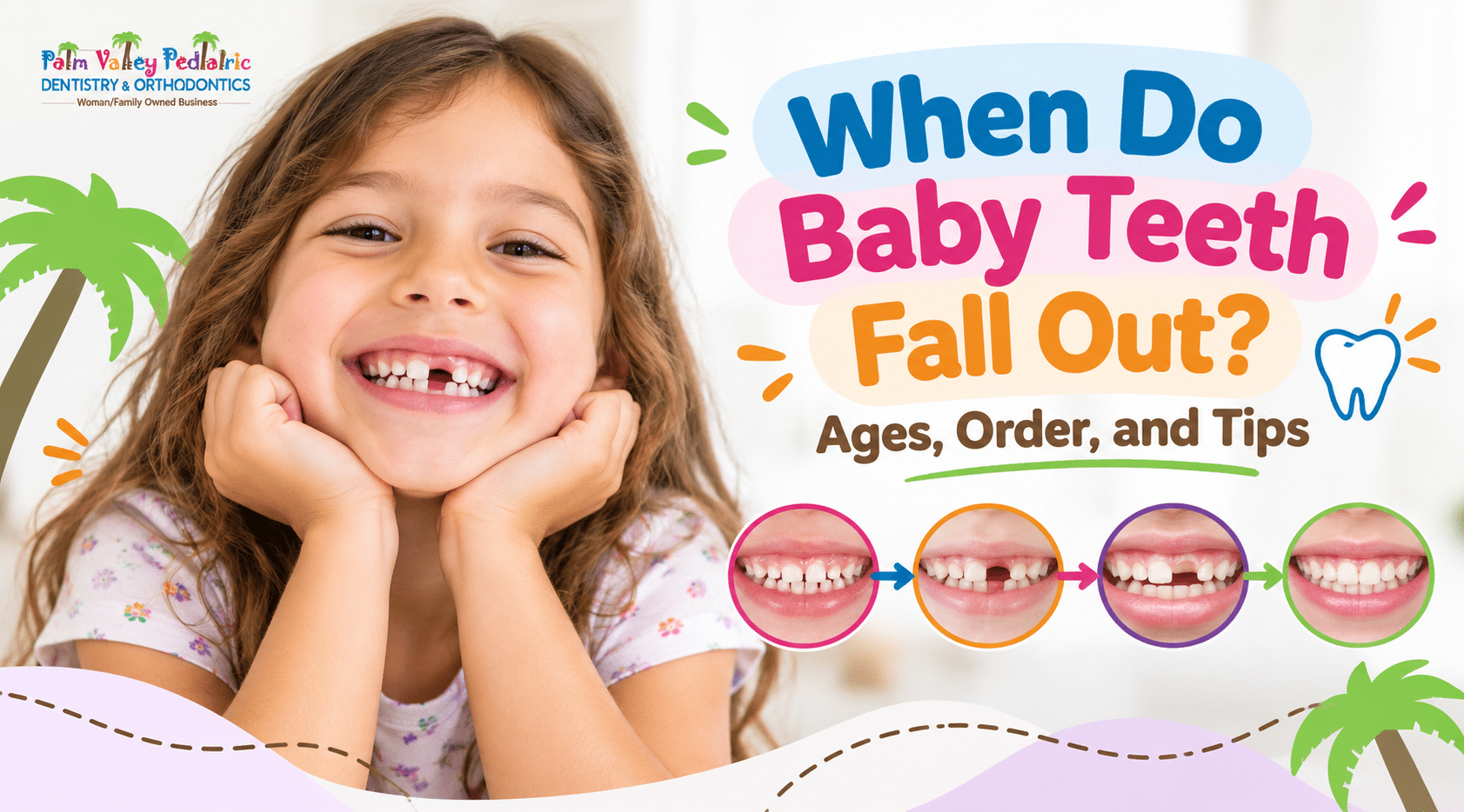
Most kids lose their first baby tooth around age 6, and they lose all 20 baby teeth by about age 12 or 13.
We will be honest. We love this stage. A wiggly tooth gets announced at breakfast, poked at all day, and checked in the mirror every night. Kids feel very grown up about it. Parents, on the other hand, come to us with questions. Is my child too young for this? Too late? Is that new tooth supposed to be coming in crooked like that?
At Palm Valley Pediatric Dentistry & Orthodontics, Dr. Olga and our team help children build healthy smiles from their first tooth onward. A baby’s first dental cleaning can help establish healthy habits early and guide parents in caring for their child’s smile.
As a parent, you should care about how adult teeth come in. Bring your child to their first dental appointment for a complete evaluation.
How Many Baby Teeth Do Kids Lose?
Children lose all 20 of their baby teeth. This means that there are 10 in the top row and 10 in the bottom row.
Baby teeth are called primary teeth, and most children have a complete set by age three. These teeth stay in the mouth for several years, doing an important job. They help children chew, support speech development, and act as placeholders for the permanent teeth growing beneath them.
Over six years, permanent teeth replace them one by one.
Most adults have an average of 32 permanent teeth. This total includes four wisdom teeth that appear later, in the late teens or early twenties. Sometimes, people never grow them.
So, you can have 28 permanent teeth in your early teens.

Is Your Child’s Smile on the Right Track?
Early dental visits aren’t just about cleaning teeth, they’re about catching problems before they become costly and painful. Our pediatric specialists create personalized care plans that grow with your child, from their very first tooth through their teen years.
Gentle, kid-friendly care in a welcoming environment.
When Do Baby Teeth Start Falling Out?
The first tooth typically falls out around age 6. Normal ages range between 4 to 7 years. Females lose theirs slightly earlier than males.
One basic principle makes it easier. Teeth come out in much the same order as they appear. Thus, for example, the first teeth that your child had as a baby will typically be lost first; that is to say, the two bottom front teeth.
| Baby tooth | age it falls out |
| Bottom front teeth (lower central incisors) | 6 to 7 |
| Top front teeth (upper central incisors) | 6 to 8 |
| Teeth beside the front teeth (lateral incisors) | 7 to 8 |
| First baby molars | 9 to 11 |
| Canines, or eye teeth | 9 to 12 |
| Second baby molars | 10 to 12 |
You will probably notice a quiet stretch in the middle. Kids lose their front teeth between 6 and 8, then things slow down for a year or two before the back teeth start to loosen. Parents sometimes worry during this pause, but it’s completely normal.
Most kids lose their last baby tooth by 12 or 13.
A Few Things That Surprise Parents
1- The six-year molars
At age 6, the large molars erupt behind the baby teeth.
Many parents don’t know they exist, since none of the baby teeth were lost to make room for the adult tooth. They are meant to last a lifetime and have grooves that collect food debris, which is why dentists recommend sealants.
2- Shark teeth
An adult tooth can come up behind a baby tooth that hasn’t fallen off yet. In this case, you get to see a double row of teeth like sharks have. This is most common in the lower front teeth, and it’s more frightening than it actually is.
“Shark teeth is something that we get many calls about from parents,” says Dr. Olga. “In most cases, the baby tooth falls out by itself, and the tongue pushes it forward.”
If the baby tooth remains firmly attached for several months or your kid feels uncomfortable, make an appointment. Extracting a stubborn tooth is a quick, simple procedure.
3- Losing a tooth too early
If a baby tooth falls out prematurely due to trauma or decay, the surrounding teeth may shift into the space left behind.
This can cause problems for the erupting adult tooth that won’t have enough space to erupt. Your pediatric dentist may recommend a space maintainer for your child’s teeth.
4- Losing teeth late
If your 8-year-old still hasn’t lost any of their baby teeth, parents might want to take them to the dentist.
An X-ray may show the adult tooth coming in sideways or a tooth that didn’t develop properly. Some children don’t have some of their permanent teeth, and it is easier to plan if we know from the beginning.
Helping a Loose Tooth Along at Home
Honestly, the best approach is usually the boring one.
Let it happen.
A loose tooth comes out when the root underneath has dissolved enough, and pulling it before then can hurt and bleed more.
Your child can wiggle it gently with a clean finger or their tongue. Crunchy foods like apples and carrots sometimes finish the job without anyone noticing. Skip the string tied to the doorknob, though. It makes a funny video, but it can tear the gum.
When the tooth finally comes out, expect a little blood.
Have your child bite on clean gauze or a damp washcloth for a few minutes.
That’s usually all it takes.
Keep brushing the area gently, and let the new tooth come in at its own pace.
New adult teeth can look a bit more yellow than the baby teeth beside them, and the edges may look bumpy. Both are normal, and those little bumps wear down over time.
When to Call Your Pediatric Dentist
Most tooth loss needs no help. Still, call us if a baby tooth is knocked out by an injury, if bleeding doesn’t stop after 10 to 15 minutes of steady pressure, or if you see swelling or pain around a loose tooth.
You should also check in if a shark tooth hasn’t sorted itself out after a few months, or if your child is past 8 and hasn’t lost any teeth.
This stage is also a good time for a first orthodontic check.
The American Association of Orthodontists recommends that every child see an orthodontist by age 7. At that age, the mix of baby and adult teeth gives us a clear picture of how the bite is developing.
PVPD offers both pediatric dentistry and orthodontics; we can look at everything in one visit, in one place.
Every Smile Has Its Own Timeline
Losing baby teeth takes about six years, and every child moves through it at their own speed. Regular checkups help us make sure adult teeth come in where they should. They also give you a relaxed moment to ask about anything that looks a little off.
If your child has a wiggly tooth, a shark tooth, or a tooth that just won’t budge, we are happy to take a look.
Palm Valley Pediatric Dentistry & Orthodontics has offices in Scottsdale, Buckeye, Surprise, Goodyear, Chandler, and East Mesa. Book an appointment online.
Give Your Child the Gift of a Healthy Smile
PVPD doesn’t just treat teeth; we build lasting relationships with families. More confident kids. More comfortable appointments. More reasons to smile. Our patients leave happier and healthier, visit after visit.
Serving families across Scottsdale, because every child deserves a great smile.
People Also Ask
At what age do kids lose their first tooth?
Most kids lose their first tooth around age 6. Anywhere between 4 and 7 is considered normal.
How many baby teeth do kids lose in total?
Children lose all 20 baby teeth, 10 on top and 10 on the bottom.
Which baby teeth fall out first?
The bottom front teeth usually go first, followed by the top front teeth.
Is it a problem if my child lost a tooth at 4?
If it fell out on its own, it’s often just early timing. If it came out because of an injury or a cavity, see your dentist so they can check the space.
What if a baby tooth won’t fall out?
If an adult tooth is coming in behind it, or the baby tooth is still firm well past the usual age, book a dental visit.
Should I pull my child’s loose tooth?
It’s best to let it come out naturally. Gentle wiggling is fine, but yanking it early can hurt and cause extra bleeding.
Pediatric Dental Specialist at PVPD

Dr. Olga
Dr. Olga brings years of specialized pediatric dental expertise and a genuine passion for children’s oral health to the PVPD team. She specializes in creating anxiety-free dental experiences and early-intervention care strategies that set children up for a lifetime of healthy smiles.
Medically reviewed by Dr. Olga Dolghier, DDS, Pediatric Dentist at Palm Valley Pediatric Dentistry & Orthodontics.