Baby Teeth Chart: Names, Order, and Eruption Ages
Children have 20 baby teeth that usually appear between 6 months and 3 years of age. A baby teeth chart shows the names of these teeth, where they are located, and when they typically come in.
Your baby’s first tooth is a little milestone. One day, you notice a tiny white edge on the gums, and before you know it, more teeth start appearing. But which teeth should come in next? And how can you tell if your child’s teeth are developing as expected?
At Palm Valley Pediatric Dentistry & Orthodontics, Dr. Olga and our team help parents understand every stage of their child’s dental development.
Book an appointment with our team to check your child’s growing teeth and get answers to your questions about their baby teeth chart.
Baby Teeth Chart: Names and Eruption Ages
Baby teeth, which are also known as primary teeth, develop in a particular order. The bottom front teeth will come in before the top front teeth, with the back teeth developing last.
Use this chart to determine the order of development for each type of baby tooth.
| Type of baby tooth | Upper teeth appear | Lower teeth appear |
| Central incisors (front teeth) | 8-12 months | 6-10 months |
| Lateral incisors (teeth beside the front teeth) | 9-13 months | 10-16 months |
| First molars (front back teeth) | 13-19 months | 14-18 months |
| Canines (pointed teeth) | 16-22 months | 17-23 months |
| Second molars (back teeth) | 25-33 months | 23-31 months |

Is Your Child’s Smile on the Right Track?
Early dental visits aren’t just about cleaning teeth, they’re about catching problems before they become costly and painful. Our pediatric specialists create personalized care plans that grow with your child, from their very first tooth through their teen years.
Gentle, kid-friendly care in a welcoming environment.
How to Read a Baby Teeth Chart
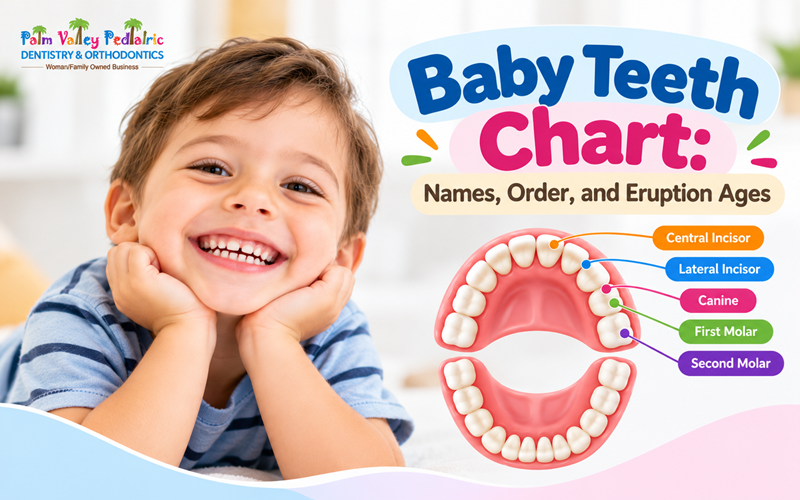
The upper teeth are in your child’s top jaw, while the lower teeth are in the bottom jaw. Each type of tooth has a different shape and job.
- Central incisors: The two front teeth in each jaw.
- Lateral incisors: The teeth immediately beside the central incisors.
- Canines: The pointed teeth next to the lateral incisors.
- First molars: The larger teeth behind the canines.
- Second molars: The last baby teeth at the back of the mouth.
Each jaw contains two central incisors, two lateral incisors, two canines, and four molars. These are what comprise the 20 baby teeth.
How Many Baby Teeth Do Children Have?
Your children’s teeth consist of 20 milk teeth: 10 teeth in the upper jaw and 10 in the lower jaw. All children usually have 20 teeth by the age of 3 years.
In addition to giving them an adorable smile, their teeth allow them to bite and chew on their food, help with speaking, and act as placeholders for the coming permanent teeth beneath them.
This is the breakdown of the 20 teeth:
| Type of tooth | Number of teeth | Main job |
| Incisors | 8 | Bite and cut food |
| Canines | 4 | Help tear food |
| Molars | 8 | Crush and chew food |
| Total | 20 |
While baby teeth do fall out in the end, they still need proper care. Tooth cavities and infections will hurt, making eating difficult for the child.
Maintaining good dental hygiene for these teeth is important for your child’s overall dental health.
What Are the Different Types of Baby Teeth?
Every baby tooth has a purpose.
Once you know the names and locations, it becomes much easier to understand your child’s teeth chart.
1. Incisors: The Front Teeth
Incisors are the teeth that are flat and found at the front of the mouth. Incisors are eight teeth in total in children’s mouths, with four in the upper part and four in the lower part.
The central incisors of the lower part normally develop first, followed by those in the upper jaw. Lateral incisors develop last, just beside the front teeth.
These teeth help your child bite fruits and other food.
2. Canines: The Pointed Teeth
The canine teeth are the somewhat pointed teeth next to the incisors. Your child has four canine teeth, two upper and two lower.
They erupt after the first molars and help break down food into smaller pieces.
Parents might see a space between the front teeth and the canines when they come in.
Since the appearance of the teeth may be different once other teeth come in, it is best to consult with a pediatric dentist regarding this matter.
3. Molars: The Back Teeth
Molars are the bigger teeth found at the rear of the mouth. The child’s set of teeth comprises eight baby molars, four in each jaw.
The first molars tend to erupt between 13 and 19 months in the upper jaw and 14 to 18 months in the lower jaw. The second molars tend to emerge later than the first molars, between 23 and 33 months depending on their locations.
Molars aid in chewing and grinding the food. They also have grooves that tend to collect food particles and thus should be brushed thoroughly.
What Order Do Baby Teeth Come In?
Baby teeth usually follow a predictable pattern, although the exact order can vary from child to child.
This is the typical order:
- Lower central incisors: The two bottom front teeth usually appear first.
- Upper central incisors: The two top front teeth generally follow.
- Lateral incisors: The teeth beside the central incisors begin to appear.
- First molars: The first larger back teeth come in.
- Canines: The pointed teeth between the incisors and molars appear.
- Second molars: The final baby teeth emerge at the back of the mouth.
You might find that the first molars erupt before the canines. This is a typical occurrence, but not all children will have their teeth erupt following the same order.
Just because your child’s tooth erupts early or late does not necessarily mean there is a problem.
More important is the overall dental development of your child than matching the ages perfectly.
Baby Teeth Timeline by Age
Worried about what to expect with the development of your child’s teeth in their first three years? The following chart can make everything clear for you.
6-12 Months: The First Teeth Appear
The first baby teeth usually arrive around 6 months, although some babies get them earlier or later.
The lower central incisors often appear first, followed by the upper front teeth.
During this stage, you may notice swollen gums, extra drooling, or a desire to chew on safe objects.
Once the first tooth appears, start brushing it gently with a soft, age-appropriate toothbrush. The Cleveland Clinic suggests a tiny smear of fluoride toothpaste about the size of a grain of rice.
12-24 Months: More Teeth Fill the Smile
During the second year, more incisors, first molars, and canines usually appear. Your child may have several teeth at the front and larger teeth at the back by the end of this period.
This is a good time to build a consistent brushing routine. Brush twice a day, especially before bedtime, and help your child clean all tooth surfaces.
Try to make brushing a normal part of the day rather than something that happens only when you remember.
24-36 Months: The Last Baby Teeth Arrive
The second molars usually appear during the second half of the second year or during the third year. These are typically the last baby teeth to come in.
By around age 3, most children have a full set of 20 baby teeth.
Your child may not have exactly 20 teeth by their third birthday, and that alone does not confirm a dental problem.
What If My Baby’s Teeth Come In Late or Out of Order?
It is natural to compare your baby’s teeth with a chart or another child’s smile. However, babies do not all get their teeth at the same age.
Some children get their first tooth before 6 months, while others may not have a visible tooth until after their first birthday. Teeth may also appear in a slightly different order.
These are a few things to keep in mind:
- No teeth by 12 months: Some babies develop teeth later than others. Schedule a dental visit if your baby has no visible teeth by their first birthday so the dentist can assess their development.
- Teeth appearing out of order: A different eruption sequence is not necessarily a problem. A dentist can check whether the teeth are developing as expected.
- One side developing before the other: Teeth on one side may appear before their matching teeth on the other side. Mention any concerns at your child’s dental visit.
- Unusual changes in the gums: Swelling, persistent pain, or signs of infection deserve a dental examination.
A teeth chart is a useful guide, but it cannot tell you everything about your child’s oral health.
How to Care for Your Baby’s New Teeth
Baby teeth need care from the moment the first tooth appears.
Even though they will eventually fall out, keeping them clean helps protect your child’s mouth from cavities and discomfort.
These are a few simple habits to follow.
- Brush twice a day. Use a soft toothbrush made for babies or young children. Brush gently along the front, back, and chewing surfaces of every tooth.
- Use the right amount of fluoride toothpaste. For children younger than 3, use a smear about the size of a grain of rice. For children aged 3 to 6, use a pea-sized amount and supervise brushing.
- Limit frequent sugary snacks and drinks. Offer water between meals when appropriate, and avoid letting your child fall asleep with a bottle containing milk, formula, juice, or other sugary liquids.
- Make brushing part of the daily routine. Young children cannot clean their teeth effectively on their own, so parents should do the brushing or help until the child has the skills to do it well.
- Schedule regular dental visits. Early checkups help your dentist monitor tooth development, check for cavities, and show you how to care for your child’s teeth at home.
Every Baby’s Smile Develops at Its Own Pace!
A baby teeth chart is an effective tool to know the time at which your child’s teeth will erupt and the names of the teeth.
Your child will develop all 20 baby teeth by the age of three years.
However, if you are not sure about your baby’s teeth development, you do not have to wonder alone. Regular visits to the dentist will give you the opportunity to ask questions regarding the same.
Palm Valley Pediatric Dentistry & Orthodontics welcomes families at our offices in Scottsdale, Buckeye, Surprise, Goodyear, Chandler, and East Mesa.
If your baby has a first tooth, needs a first dental visit, or you simply have questions about their teeth chart, our team is here to help.
Give Your Child the Gift of a Healthy Smile
PVPD doesn’t just treat teeth; we build lasting relationships with families. More confident kids. More comfortable appointments. More reasons to smile. Our patients leave happier and healthier, visit after visit.
Serving families across Scottsdale, because every child deserves a great smile.
People Also Ask
1- How many teeth should a 1-year-old have?
Many 1-year-olds have a few baby teeth, usually the front teeth. Some babies have more, while others may have only one or two. If your baby has no teeth by their first birthday, check with a pediatric dentist.
2- How many teeth should a 2-year-old have?
Most 2-year-olds have several baby teeth, including their front teeth, canines, and first molars. The second molars may still be coming in. Most children have all 20 baby teeth by age 3.
3- Which baby teeth come in first?
The two bottom front teeth, called lower central incisors, usually come in first. They typically appear between 6 and 10 months, followed by the top front teeth.
4- What are the last baby teeth to come in?
The second molars are usually the last baby teeth to appear. The lower second molars typically come in between 23 and 31 months, while the upper second molars usually appear between 25 and 33 months.
5- Is it normal for baby teeth to come in out of order?
Yes, baby teeth do not always follow the same order or timeline. One tooth may appear before its matching tooth on the other side. If you notice a significant delay or unusual changes in your child’s gums, ask your pediatric dentist for advice.
Pediatric Dental Specialist at PVPD

Dr. Olga
Dr. Olga brings years of specialized pediatric dental expertise and a genuine passion for children’s oral health to the PVPD team. She specializes in creating anxiety-free dental experiences and early-intervention care strategies that set children up for a lifetime of healthy smiles.
Medically reviewed by Dr. Olga Dolghier, DDS, Pediatric Dentist at Palm Valley Pediatric Dentistry & Orthodontics.