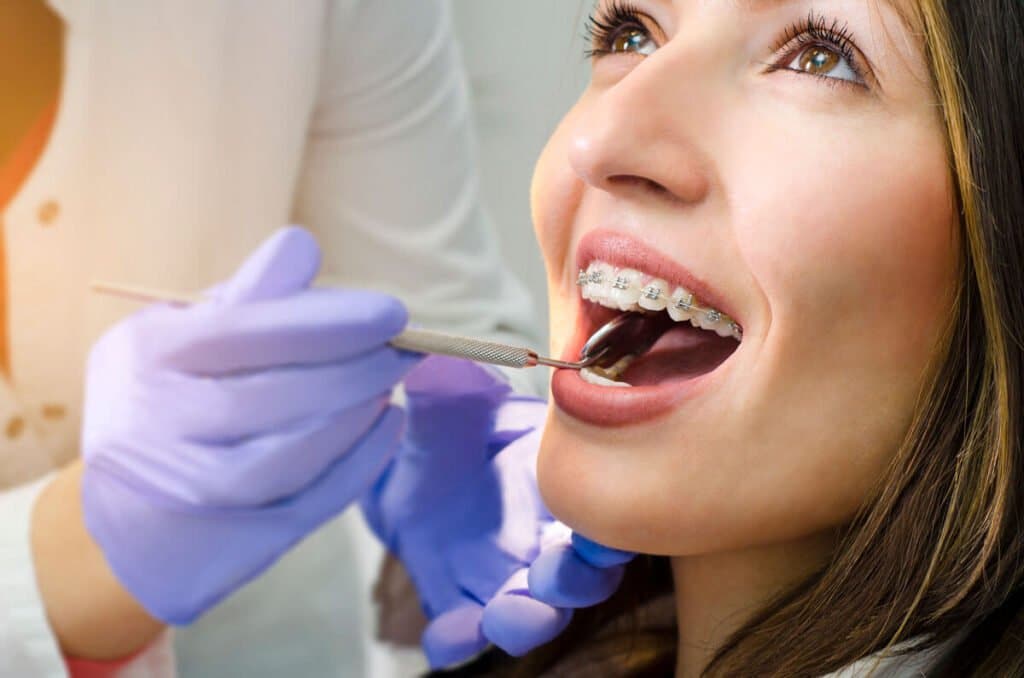
Power Chain Braces: How They Close Gaps and Straighten Teeth
Power chain braces are small elastic loops that connect the brackets on your teeth. They help close gaps and move teeth into the right position.
Your orthodontist may add power chains when there are still spaces between your teeth. They help bring teeth closer together as your treatment progresses.
If your child is getting power chains, you may wonder if they hurt, how long they need to wear them, or when the gaps will close.
Knowing what to expect can make the process easier for both you and your child.
If your child needs braces or is already wearing them, orthodontic services in Arizona can help you find the right care for their growing smile. Book an appointment with our team today.
What Are Power Chain Braces?
Power chains are connected elastic rings that fit over the brackets of traditional braces. Unlike the individual elastic bands that sit around separate brackets, a power chain links several brackets together.
This connection allows the orthodontist to apply a continuous pulling force across a group of teeth.
The American Association of Orthodontists explains that power chains can apply more force than individual elastic rings when needed during orthodontic treatment.
Power chains are not a separate type of braces. They are an additional component used during certain stages of treatment, depending on how your teeth need to move.
Your orthodontist may suggest them to:
- Close gaps between teeth.
- Bring teeth closer together after a tooth extraction where space closure is involved in the process of treatment.
- Enhance spacing and alignment.
- Enable the teeth to reach the desired positions during the process of treatment.
Not all people with braces need a power chain. There are some who are able to achieve their treatment objectives through other orthodontic techniques, while there are those who need to have a power chain added to them at a certain point in time.

Is Your Child’s Smile on the Right Track?
Early dental visits aren’t just about cleaning teeth, they’re about catching problems before they become costly and painful. Our pediatric specialists create personalized care plans that grow with your child, from their very first tooth through their teen years.
Gentle, kid-friendly care in a welcoming environment.
How Do Power Chains Work?
Consider the small rubber bands that surround your braces brackets. The band ensures that the archwire is attached to the bracket, thus ensuring that the wire is guiding your teeth into position.
A power chain is used to link a number of points instead of having them remain unconnected.
As your orthodontist stretches the chain across the brackets, the elasticity of the material results in tension. The tension causes a pull that moves your teeth into position.
Your braces’ archwire keeps guiding your teeth into position. The power chain does not take over the entire braces but operates in conjunction with them.
It takes time for teeth to move due to the tissues around the roots of the tooth responding to orthodontic forces. This explains why you will not notice a gap closing up straight away.
What is significant here is that power chains do more than just keep your braces intact.
Why Would Your Orthodontist Recommend Power Chains?
The reason for adding a power chain depends on what needs to happen next in your treatment.
1. To close gaps between teeth
Spaces between teeth may be natural or acquired as part of orthodontic treatment. There may be gaps after a tooth has been extracted.
In situations where closing the gap is needed, the use of a power chain may prove useful in moving certain teeth closer to one another.
It should be noted that closing a gap does not necessarily involve just bringing two teeth closer together. Your orthodontist needs to take into account various factors.
2. To manage spaces left after tooth extraction
Orthodontic treatment sometimes requires the extraction of a tooth to deal with issues like crowding. The space left as a result has to be dealt with.
Power chains may be used in closing the space created by moving teeth in accordance with the treatment process.
This procedure takes time, and the distance moved by the teeth varies depending on the individual patient.
3. To refine tooth alignment
Sometimes, teeth may look straight but still have small gaps or need a little more adjustment.
Your orthodontist may use power chains to bring your teeth closer together and improve their position. This helps your teeth fit together properly, not just look straighter.
Straight teeth can also make a difference in the overall appearance of your smile. PVPD offers cosmetic dentistry services to help patients improve their smiles.
Types of Power Chains for Braces
Power chains come in different configurations. The main difference is the spacing between their elastic loops.
1- Closed power chains
Closed power chains have loops placed close together, with little or no space between them. They help connect several braces brackets and bring teeth closer together.
2- Short power chains
Short power chains have small spaces between the loops. Your orthodontist may use them when a specific type of tooth movement is needed.
3- Long power chains
Long power chains have larger spaces between the loops. They give your orthodontist another option for connecting brackets and moving teeth.
The names describe the space between the loops, not how long you need to wear them. Your orthodontist will choose the right type based on your teeth and treatment needs.
Do Power Chain Braces Hurt?
This is normally the first question you will ask once you have been informed that you require a power chain.
The placement process is not usually complicated. Your orthodontist places the elastic chain over your brackets during your appointment.
There is likely to be some discomfort or sensitivity on the same day or the following day. You may find that biting into food is uncomfortable for the first few days.
This happens because your braces are exerting pressure on your teeth to move them.
There are a few ways to make those first days more comfortable:
- Choose softer foods. Yogurt, eggs, pasta, oatmeal, and soft-cooked vegetables are easier to eat when your teeth feel tender.
- Eat slowly. Avoid biting directly into hard foods while your teeth are sensitive.
- Keep drinking water. Water helps keep your mouth comfortable without exposing your teeth to sugary drinks.
- Follow your orthodontist’s advice. If you need pain relief, ask which option is appropriate for you or your child.
The pain generally improves within a couple of days.
Persistent pain, swelling, or worsening pain is something to take seriously.
Make an appointment with your orthodontist for any odd symptoms that do not seem to get better.
How Long Do You Have to Wear Power Chains?
Some patients wear power chains for a short time, while others have to use them for several months. It all depends on the degree of tooth movement, how the teeth react, and any other changes that need to be made.
The orthodontist may change or modify the chain during routine visits since the elastic material loses some of its strength with time.
It is also crucial to know that just wearing power chains does not necessarily imply that your braces will come off soon.
The power chain may be added later during treatment, or it could be used at any other time when your orthodontist thinks that it is required by the treatment plan. Even after closing the space, there may still be a need for fine-tuning the tooth positions and making other bite corrections.
Instead of counting weeks, focus on what the orthodontist sees during your visits.
Do Power Chains Close Gaps Faster?
Power chains can help in the closure of spaces, but they cannot ensure that all patients receive fast treatment.
The movement of teeth would depend on a number of variables, such as the size of the space, the placement of the roots, the tissues around the teeth, as well as the mechanics used.
More force does not always equal better and faster results. Orthodontics work on the principle of carefully controlled forces.
Your orthodontist might also have to move certain teeth in a specific order to ensure that you get the result and healthy bite that is desired.
If the closure of your space is taking longer than anticipated, you should inquire about the same from your orthodontist.
There is much more to it than meets the eye.
How to Care for Your Teeth With Power Chains
Power chains add another area where food particles and plaque can collect. Keeping your teeth clean is especially important while wearing braces because plaque can accumulate around brackets and along the gumline.
A consistent routine helps protect your teeth throughout treatment.
Brush carefully around every bracket.
Brush at least twice a day using fluoride toothpaste and a soft-bristled toothbrush. Pay attention to the areas above and below the brackets, along with the gumline and chewing surfaces.
Take your time rather than brushing quickly across the front of your teeth.
Brushing and flossing carefully are important when wearing braces. The Dental Resource Center provides information on dental care and maintaining healthy teeth and gums.
Clean between your teeth.
Food can become trapped around brackets and beneath the elastic chain. Flossing daily, with an appropriate flossing aid if needed, helps clean areas your toothbrush cannot easily reach.
An orthodontic floss threader or interdental brush may make cleaning easier. Ask your dental team to demonstrate the method that works best for your braces.
Be careful with sticky and hard foods.
Hard candies, sticky sweets, and very crunchy foods can damage orthodontic appliances or make cleaning more difficult.
Choose foods that are easier to chew, particularly when your teeth feel tender after an adjustment.
Keep your orthodontic appointments.
Regular visits allow your orthodontist to assess tooth movement, check your braces, and replace or adjust the chain when necessary.
If a power chain breaks or comes loose, contact your orthodontic office for instructions rather than trying to repair it yourself.
What If Your Power Chain Breaks?
A damaged power chain can be alarming when you are trying to narrow the gap.
First, see if the chain has become detached from just one bracket or if part of the chain has actually broken. Do not try to pull or stretch the chain back into position.
Get in touch with your orthodontist and describe what has happened. They will be able to advise if you need to come in for an appointment sooner or if it is alright to wait until your next appointment.
If there is a bracket that is loose, a wire that is poking your cheek, or the broken chain is irritating you, inform your orthodontist’s office about it.
A broken chain doesn’t necessarily mean that your treatment has not been successful. But your orthodontist needs to decide if something has to be done.
Are Power Chains a Sign That You Are Almost Done With Braces?
Not necessarily.
It is understandable to see a power chain as a sign that your teeth are coming together and treatment is progressing. In some cases, it may be part of the later stages of orthodontic treatment.
But braces involve more than closing visible spaces.
Your orthodontist also evaluates how your upper and lower teeth fit together, whether individual teeth are properly positioned, and whether the final result meets your treatment goals.
Some patients need further adjustments after gaps have closed. Others may require additional time to achieve the intended bite.
The best way to find out how much treatment remains is to ask your orthodontist about your individual progress.
Every Part of Your Braces Has a Purpose
Power chains help close gaps and move teeth into the right position. Some pressure or tenderness is normal after getting them, so keep brushing carefully and follow your orthodontist’s advice.
At Palm Valley Pediatric Dentistry & Orthodontics, we help families understand every stage of orthodontic treatment. Explore our orthodontic services in Arizona to learn how we can help your child achieve a healthier, straighter smile.
Give Your Child the Gift of a Healthy Smile
PVPD doesn’t just treat teeth; we build lasting relationships with families. More confident kids. More comfortable appointments. More reasons to smile. Our patients leave happier and healthier, visit after visit.
Serving families across Scottsdale, because every child deserves a great smile.
People Also Ask
Can power chains stain?
Depending on the material and your eating and drinking habits, clear or light-colored elastic chains may become discolored over time. Dark-colored chains may make staining less noticeable. Good oral hygiene helps keep your teeth clean, but it cannot prevent every change in the chain’s color.
Can power chains close a gap between the front teeth?
They can help close certain gaps between front teeth when that movement is appropriate for the treatment plan. Your orthodontist will assess the cause of the gap, the position of the teeth, and your bite before deciding how to manage it.
Will my teeth move backward if my power chain breaks?
A broken chain does not automatically mean your teeth will move backward. However, it may interrupt the force being applied, so you should contact your orthodontist for advice. Do not assume that the chain can be left broken until your next appointment.
Can children wear power chains?
Power chains may be used in children and teenagers who are receiving orthodontic treatment with braces, when clinically appropriate. The decision depends on their individual dental development and treatment needs.
Are power chains better than regular elastic bands?
Individual elastic bands and power chains serve different purposes in orthodontic treatment. Your orthodontist chooses the option that provides the appropriate force for the movement required.
Pediatric Dental Specialist at PVPD

Dr. Olga
Dr. Olga brings years of specialized pediatric dental expertise and a genuine passion for children’s oral health to the PVPD team. She specializes in creating anxiety-free dental experiences and early-intervention care strategies that set children up for a lifetime of healthy smiles.
Medically reviewed by Dr. Olga Dolghier, DDS, Pediatric Dentist at Palm Valley Pediatric Dentistry & Orthodontics.