Tooth Cap vs Crown for Kids: Same Thing, Plus What Parents Should Know
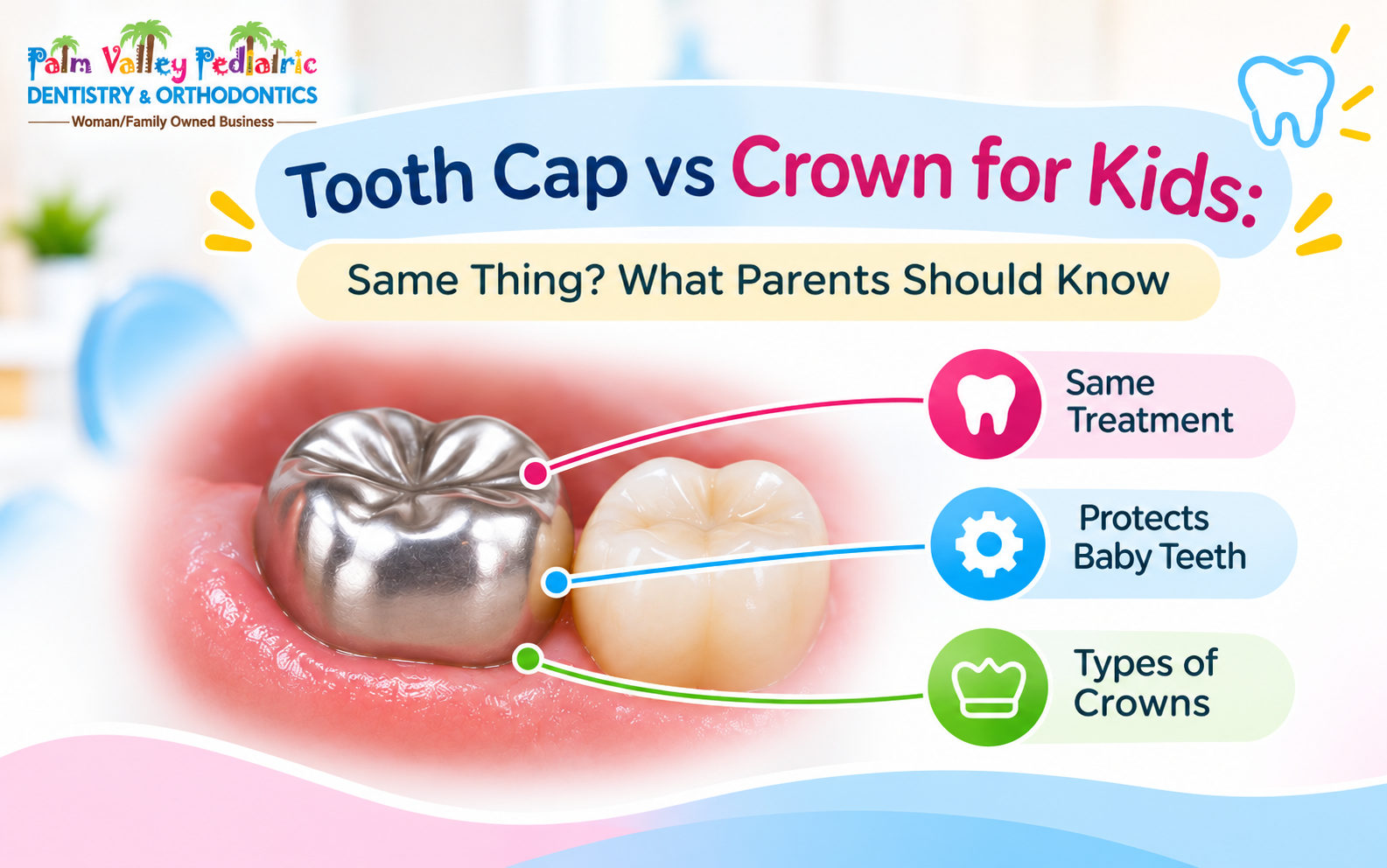
If your dentist said “crown” and you’ve been calling it a “cap,” you’re both talking about the same thing. Parents tend to say cap; dentists write crown on the treatment plan. Either way, it’s a small tooth-shaped shell that slips over a weakened tooth and shields it from further damage.
The name, then, is the easy part.
What most parents actually want to know is whether their child’s baby tooth needs one at all, and what the visit will be like. This guide covers why dentists recommend crowns for kids, which types are used, what they cost, and how to care for one afterward.
Already been told your child needs a crown and want a second opinion? Bring your child to Palm Valley Pediatric Dentistry & Orthodontics, and one of our pediatric dentists will go over the tooth and the X-rays with you.
What Is a Tooth Cap?
In a dentist’s notes, a tooth cap is simply called a dental crown. The two names describe the same treatment: a covering that sits over the whole visible part of a tooth, from the gumline up, to restore its shape, strength, and protection.
The real confusion is usually between a crown, a filling, and a veneer. Here’s how they differ.
| Treatment | What it covers | Where it is used in children |
| Filling | Only the cavity area | Small to moderate cavities with plenty of healthy tooth left |
| Crown (cap) | The entire tooth above the gumline | Large cavities, weak or treated teeth, damaged enamel |
| Veneer | The front surface of a tooth | Mostly cosmetic work on permanent teeth in older teens and adults |
For most kids, the real decision is crown vs. filling. A filling only works if there’s enough sound tooth around it to grip, and that’s what your dentist checks first. Many dentists describe a crown to children as a little helmet for the tooth.

Is Your Child’s Smile on the Right Track?
Early dental visits aren’t just about cleaning teeth, they’re about catching problems before they become costly and painful. Our pediatric specialists create personalized care plans that grow with your child, from their very first tooth through their teen years.
Gentle, kid-friendly care in a welcoming environment.
Why Would a Child Need a Tooth Crown?
Crowns come in when a filling alone can’t hold a tooth together, usually because decay or a break has taken too much of it. Pediatric dental guidelines, including the American Academy of Pediatric Dentistry’s guideline on restorative dentistry, list crowns among the restorations used for children’s teeth.
Your dentist may recommend one when:
● A cavity is large or covers more than one surface. A filling is anchored by the tooth walls around it. Once decay has worn most of those walls away, there’s nothing left to grip, so a crown covers the whole tooth instead.
● The tooth has had pulp treatment. After a pulpotomy, the treatment of the inner part of a baby tooth, the tooth may be more fragile, and a crown helps protect it.
● The enamel did not form properly. Some children have teeth with thin or weak enamel, which wears down or decays quickly.
● The tooth is cracked or broken. A crown holds the tooth together and restores its shape.
● Cavities keep coming back. For a child with a high risk of decay, a crown can last longer than a filling.
Is it worth fixing a baby tooth that will fall out?
It’s the first thing many parents ask, and it’s a fair question. Baby teeth do three jobs while they’re here: they let your child chew properly, they support clear speech, and each one saves a spot for the permanent tooth developing below it.
Baby molars usually stay until age 10 to 12, so a damaged molar in a 4-year-old may need to last another six to eight years.
When a molar is lost years ahead of schedule, the teeth on either side tend to tip into the empty space. The adult tooth then has less room to come in, which can mean a space maintainer or braces down the road. A cavity left alone also doesn’t stay small: it can reach the nerve and lead to toothache, an abscess, or swelling.
A dental crown may only be recommended by your child’s dentist after an examination and, if necessary, dental X-rays.
What Types of Crowns Are Used for Children?
Most children’s crowns come ready-made in sizes designed for baby teeth. The dentist prepares the tooth, then picks the size that fits best. Here’s how the main types compare.
Stainless steel crowns
These silver-colored crowns have been used on baby molars for decades.
They’re strong, handle chewing well, and are more forgiving to place, even if the tooth can’t be kept perfectly dry. That is why reviews of the research still describe them as a widely used standard.
The main drawback is appearance.
Zirconia crowns
These are tooth-colored ceramic crowns, and they can be used for front and back primary teeth. Parents appreciate their natural appearance.
Cons include that the tooth may require more preparation, the fit is more technique-sensitive, and they are generally more expensive.
Research on zirconia crowns is also newer, and one literature review found little evidence so far to favor one type over the other.
Other tooth-colored options
For front baby teeth, dentists may also use resin (strip) crowns or steel crowns with a tooth-colored facing, depending on the tooth and how much of it remains.
Which one is best for your child?
No one crown type is right for every child. The right choice depends on which tooth it is, how much healthy tooth is left, your child’s risk of new cavities, and your priorities for appearance and budget.
It is fair to ask your dentist why they recommend one type over another.
| Stainless steel | Zirconia | Resin (strip) crowns | |
| Look | Silver | Tooth-colored | Tooth-colored |
| Used on | Mainly back teeth | Front and back teeth | Front teeth |
| Strength | Very durable | Durable, can’t be adjusted much | Less durable |
| Tooth prep | Minimal | More shaping needed | Moderate |
| Placement | Forgiving, even if the tooth can’t stay dry | Technique-sensitive | Technique-sensitive |
| Track record | Decades of use | Newer research | Long use on front teeth |
| Cost | Lowest | Highest | Mid-range |
What Does a Child’s Dental Crown Cost?
A crown on a baby tooth typically costs $150 to $800 before insurance. Where your child lands in that range depends less on the tooth and more on three things: the crown material, how your child will be kept comfortable, and whether the nerve needs treatment first.
The crown itself
Stainless steel: around $150 to $700. The workhorse of pediatric dentistry for baby molars. It’s nearly unbreakable and rarely needs replacing.
Resin strip crown (front teeth): around $200 to $400. Tooth-colored and natural looking, but it can chip if your child bites hard objects.
Zirconia: around $300 to $800. White, strong, and stain-resistant. It costs more partly because the dentist must remove more tooth and fit it carefully, which takes longer.
The costs parents don’t see coming
Surprisingly, the crown itself may be one of the smaller charges. If a young child needs several crowns, treatment under sedation or general anesthesia can cost more than the crowns combined, especially when a hospital or surgery center fee is involved. A baby root canal (pulpotomy) adds a separate charge when decay has reached the nerve. Ask for these to be listed separately on your estimate.
Ask about the no-drill option
If your child is a good candidate for the no-drill Hall Technique (see the FAQ below), it can mean a shorter visit and sometimes no sedation, which can lower the total cost.
Why a crown can be the cheaper choice
Pulling a baby molar seems less expensive at first, but it often isn’t. The neighboring teeth can drift into the gap, so your child may need a space maintainer, an appliance that holds the space open, and possibly more orthodontic work later. A crown on a molar that stays in place until age 10 to 12 often works out to a modest cost per year of use.
Insurance basics
Most dental plans cover stainless steel crowns on baby teeth when they’re needed to treat decay. Many cover tooth-colored crowns only at the stainless steel rate, leaving you to pay the difference. In Arizona, AHCCCS and KidsCare generally cover medically necessary crowns for children, often limited to stainless steel. Sedation coverage varies widely, so check it before the appointment.
Questions to ask your child’s dentist
● Which crown type do you recommend for this tooth, and why?
● Is my child a candidate for the no-drill Hall technique?
● Will my child need sedation, and what does it cost?
● What will insurance pay, and what will I owe?
What Happens When a Child Gets a Crown?
Most children’s crowns are placed in a single visit, though your dentist will tell you what your child’s treatment involves. This is the usual order of things:
- Numbing. The dentist numbs the area first, so the procedure itself shouldn’t hurt. Kids often notice a pushing sensation or a buzz from the instruments; that’s expected and isn’t pain.
- Preparing the tooth. Any decay is cleaned out, and the outside of the tooth is trimmed slightly to make room for the crown to slide on.
- Fitting the crown. The dentist chooses the right size, checks the fit, and makes sure your child’s bite feels comfortable.
- Cementing it in place. The dentist secures the crown and checks it one last time.
Does a tooth cap hurt?
The process shouldn’t be painful because the area around the tooth is numb.
Most kids get the full feeling back in their mouth within a few hours. Until then, kids often don’t notice they’re chewing on a numb lip or cheek, so keep an eye on them and stick to soft foods or drinks until the feeling is back. The gums around the new crown may feel a bit tender for a day or two, and that usually settle without treatment.
How Long Does a Child’s Crown Last? Plus Daily Care
In most cases, yes: a crown on a baby tooth stays put and comes out with the tooth when the adult tooth pushes it loose. Occasionally one comes loose, which is one reason checkups matter.
The crown itself can’t decay, but the tooth underneath can, usually along the edge at the gumline where plaque settles. These habits help protect it.
Brush along the gumline.
No special products are needed. A soft toothbrush and regular fluoride toothpaste, twice a day, are enough. Most kids need a parent’s help until about age 7 or 8. Pay extra attention to the gumline around the crown, where plaque builds up most easily.
Floss every day
Food and plaque collect easily between the crowned tooth and the one next to it. Floss picks can make daily flossing easier for kids.
Go easy on sticky and hard foods.
Sticky and crunchy treats are a crown’s biggest enemies: caramel, taffy, and gummy bears can tug it loose, while hard candy and chewed ice can weaken the cement. Your child doesn’t need to give up treats; just keep the sticky ones occasional.
Keep the checkups on the calendar.
At each checkup, your dentist can spot a loose crown or early decay before it becomes a bigger problem. A quick checkup beats an emergency visit.
When Should You Call the Dentist?
After the crown is placed, call your dentist if you spot any of these signs:
- The crown feels loose or falls off. Keep it and bring it to your appointment. Don’t try to glue it back on.
- A sharp or rough edge is irritating the cheek, tongue or gums.
- The bite feels off, or your child can’t close their mouth comfortably.
- Pain is getting worse instead of better, or hasn’t eased after two or three days.
- A red, puffy gum or a tiny bump that looks like a pimple shows up near the crown.
Go to the emergency room right away if your child has facial swelling with a fever, or any trouble swallowing or breathing.
One Small Cap, One Big Job!
Call it a cap or a crown; either way, it keeps a damaged baby tooth strong and pain-free until the permanent one is ready.
At Palm Valley Pediatric Dentistry & Orthodontics, we walk you and your child through every step.
Not sure your child really needs a crown? Book a visit, and we’ll check the tooth, explain your options, and give you a clear estimate before anything is done.
Give Your Child the Gift of a Healthy Smile
PVPD doesn’t just treat teeth; we build lasting relationships with families. More confident kids. More comfortable appointments. More reasons to smile. Our patients leave happier and healthier, visit after visit.
Serving families across Scottsdale, because every child deserves a great smile.
People Also Ask
Is a tooth cap different from a dental crown?
No. “Crown” is what I write in your child’s chart, and “cap” is what most families say at home. It’s the same restoration either way.
Does my child’s baby tooth actually need a crown?
Not every time. I only suggest a crown when a filling won’t hold up: the decay is deep or spread across several surfaces, the nerve has been treated, or the enamel came in soft. In those cases, the crown keeps the tooth working until it falls out on its own, and that tooth is quietly saving room for the adult one underneath.
Are silver crowns safe for kids’ teeth?
Yes. Pediatric dentists, me included, have relied on silver crowns for baby molars for generations because they’re tough and dependable. They do contain a little nickel, so please tell me about any nickel or metal allergy before the visit. In that case, I’d usually choose a tooth-colored zirconia crown instead.
Is a child’s crown expensive?
Usually $150 to $800 per tooth before insurance, with stainless steel at the low end and zirconia at the top. Sedation and pulp treatment are billed separately, so ask for a written, itemized estimate first.
Can a child’s crown fall off?
It can. A crown may loosen over time or from chewing very sticky or hard foods. If it comes off, keep it and call your dentist rather than trying to put it back yourself.
Is there a no-drill option?
Sometimes. With the Hall Technique, the dentist seals decay under a stainless steel crown that’s pressed onto the baby tooth, with no drilling and usually no numbing shots. It’s only an option when the decay is still clear of the nerve and the tooth shows no signs of infection. Your child’s bite may feel a little high for a few weeks, then it settles on its own.
How can I help my child if they’re nervous about getting a dental crown?
Many pediatric dentists offer laughing gas (nitrous oxide), which helps children relax while staying awake and wears off within minutes. A child who is very fearful, or who needs several teeth treated at once, may do better with oral sedation or treatment under general anesthesia.
Dentists also explain each step of the crown procedure in kid-friendly words and show the tools before they start, so nothing comes as a surprise.
Will a crown on a baby tooth affect the adult tooth coming in?
Normally, no. A crowned baby tooth loosens and falls out on schedule, and the adult tooth comes in as usual.
Pediatric Dental Specialist at PVPD

Dr. Olga
Dr. Olga brings years of specialized pediatric dental expertise and a genuine passion for children’s oral health to the PVPD team. She specializes in creating anxiety-free dental experiences and early-intervention care strategies that set children up for a lifetime of healthy smiles.
Medically reviewed by Dr. Olga Dolghier, DDS, Pediatric Dentist at Palm Valley Pediatric Dentistry & Orthodontics.