Rotten Teeth in Kids: What They Look Like & How to Fix Them
Rotten teeth are teeth damaged by advanced tooth decay. In kids, they show up as brown or black spots, holes, or broken pieces on baby teeth. These teeth are common, and they can be treated.
However, it is very unnerving when you see a black mark on your toddler’s tooth. You may be wondering if you did something wrong, if it hurts, or if the tooth needs to be pulled. I beg you not to worry and not to beat yourself up. Decay affects many loving, concerned families.
The key is catching it early. Small spots are quick and easy to fix. Bigger ones need more work, but there’s almost always a good plan.
At Palm Valley Pediatric Dentistry & Orthodontics, our team provides gentle pediatric dental care for kids across the Phoenix area.
Seeing a dark or sore tooth right now? Call us or book a visit, and we will take a look.
What Are Rotten Teeth?
Rotten teeth are teeth that have severe tooth decay. The bacteria in the mouth consume sugar and create acid. Eventually, the acid starts eroding the hard outer layer of enamel, followed by the softer dentin underneath. This can lead to pain or even infection of the nerve when left untreated.
The medical term for this is dental caries, or early childhood caries in children. But people often refer to them simply as rotten teeth.
Let’s give you some hopeful news. According to the CDC, untreated decay in US children aged 2 to 5 dropped from 21% (1999 to 2004) to 10% (2011 to 2016). But about 17% of kids from low-income families still have it. So it’s still very common, and it’s not a sign of bad parenting.

Is Your Child’s Smile on the Right Track?
Early dental visits aren’t just about cleaning teeth, they’re about catching problems before they become costly and painful. Our pediatric specialists create personalized care plans that grow with your child, from their very first tooth through their teen years.
Gentle, kid-friendly care in a welcoming environment.
What Do Rotten Teeth Look Like?
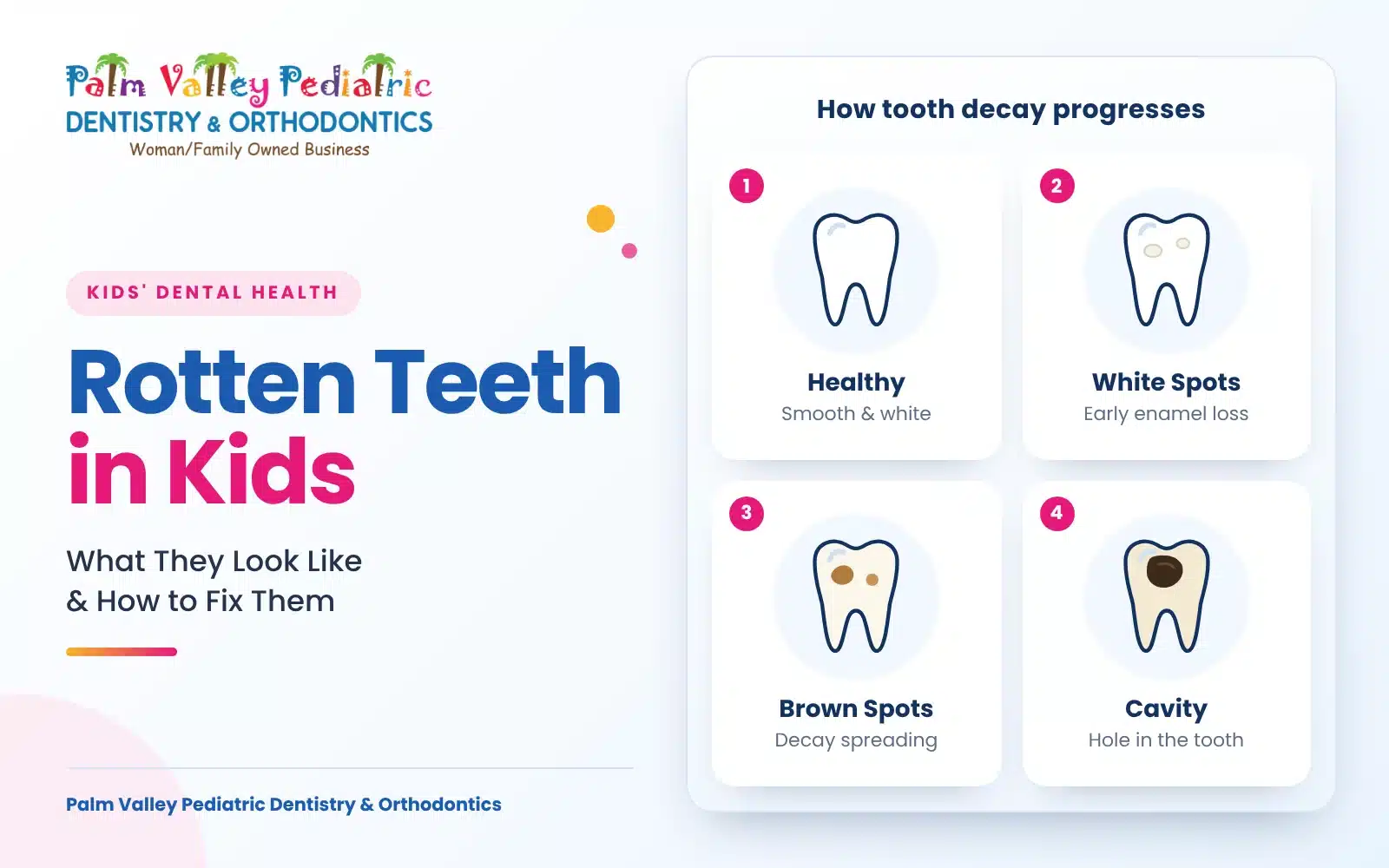
The decayed teeth start with chalky white spots and progress to brown or black coloration as the decay progresses. The process looks like this:
| Stage | What you will see | What’s happening |
| 1 | Chalky white spots near the gumline | Enamel is losing minerals |
| 2 | Yellow or brown spots | Decay is setting in |
| 3 | A small hole (cavity) | Enamel has broken through |
| 4 | Black, broken, or crumbling tooth | Decay has reached deep inside, near the nerve |
| 5 | A bump on the gum or a swollen face | Infection (abscess) |
Sometimes, kids cannot let you know what is hurting them. So look out for other symptoms as well. Your kid may chew only on one side, not eat any hard food items, get irritated while eating, cringe while drinking cold things or even sweets, or have persistent bad breath. Small children do not complain. They just become poor sleepers.
What Causes Rotten Teeth in Children?
Rotten teeth in kids usually come from a mix of sugar, time, and bacteria. No single thing causes it.
Sugary Drinks and Frequent Snacking
Sugar is found in juice, sweetened milk, and soda, which coat the teeth. Gummy candies, cookies, and dried fruits stick to the teeth for a long period of time. It is more important to snack throughout the day than the amount of sugar consumed.
Baby Bottle Tooth Decay
Falling asleep with a baby bottle or sippy-cup filled with juice or milk is very common. This allows milk to sit in a pool near the baby’s front teeth throughout the night. Placing a pacifier in honey or sugar has the same effect. The reasons parents do this are very simple: it makes their babies fall asleep easily.
Missed Brushing and No Fluoride
Brushing your teeth two times a day helps remove plaque, which causes tooth decay. Fluoride makes the teeth stronger. Without one of them, decay takes place faster.
Thinner Baby Enamel and Deep Grooves
Decay in baby teeth is quick because their enamel layer is thin. The deep grooves present in back teeth trap food particles. In addition, dry mouth due to mouth breathing and some medications means reduced saliva flow.
Why is Rotten Baby Teeth Still Important?
Decayed milk teeth are important because they may cause pain and infection, despite the fact that they will eventually fall off.
Pain in the teeth may make it difficult for your kid to eat, sleep, concentrate at school, and smile confidently. When the infection spreads to the nerve, it can affect the gums and, rarely, the entire body.
Baby teeth also save space for adult teeth. Some of them stay until age 10 to 12. If one comes out too early, nearby teeth can drift into the empty spot, which can lead to crowded adult teeth later.
That’s why we sometimes use space maintainers to hold that spot open.
How a Pediatric Dentist Treats Rotten Teeth
A pediatric dentist treats rotten teeth based on how deep the decay goes. Early stages need very little. Later stages need a bit more, but your child’s comfort always comes first.
| Stage | Treatment | What it involves | Visit time |
| White spots | Fluoride varnish | A quick paint-on coating that strengthens enamel | A few minutes |
| Early cavity | Silver diamine fluoride | A liquid that stops decay from growing; it turns the spot dark | A few minutes |
| Small to medium cavity | Tooth-colored filling | Decay is removed, and the hole is filled | 20 to 40 minutes |
| Large cavity | Pediatric crown | A cap covers and protects the whole tooth | 30 to 60 minutes |
| Decay near the nerve | Pulp therapy (pulpotomy) | Infected nerve tissue is removed, then the tooth is sealed and capped | 30 to 60 minutes |
| Tooth can’t be saved | Tooth extraction plus space maintainer | The tooth is removed gently, and the space is held open | 20 to 45 minutes |
Crowns are one of the most common fixes for badly decayed baby teeth.
Comfort Options for Nervous Kids
Some kids are anxious, very young, or need extra support. We offer laughing gas (nitrous oxide), sedation dentistry, in-office anesthesia, and care for children with special needs. Many children feel calm and relaxed through the whole visit.
Worried About Cost?
Treatment costs depend on what your child needs. If you don’t have insurance, our in-house savings plans can help, and we also accept CareCredit. Please don’t let cost stop you from booking. Early care is almost always cheaper than waiting.
When Is a Rotten Tooth an Emergency?
A rotten tooth becomes an emergency when there are signs of infection or severe pain. Call us for a same-day visit if your child has facial swelling, a fever, pus or a pimple-like bump on the gum, pain that wakes them up at night, or a broken tooth after a fall. These can be signs of a dental abscess.
Should there be any swelling in the area surrounding the eye or difficulty breathing or swallowing, immediately head to the emergency department.
Same-day emergency services are available Monday through Saturday, as well as Sundays, giving you no cause to wait and worry.
How to Prevent Rotten Teeth at Every Age
You can prevent most rotten teeth with daily brushing, the right amount of fluoride, smart snacks and regular checkups. This is what that looks like as your child grows:
| Age | Brushing | Fluoride toothpaste | Diet tip | Dental visit |
| First tooth to 3 years | Twice a day, you brush | A smear the size of a grain of rice | No bottle or sippy cup in bed | First visit by age 1 |
| 3 to 6 years | Twice a day, you help | A pea-sized amount | Save sweets for mealtimes | Every 6 months |
| 6+ years | Twice a day, you check | A pea-sized amount | Water between meals | Every 6 months, ask about sealants on molars |
The American Academy of Pediatric Dentistry recommends a first dental visit by your child’s first birthday. It’s a short, happy visit, and ours is free.
Learn more about your baby’s first dental cleaning.
One simple swap helps a lot: make water the main drink between meals. It rinses teeth and costs nothing.
Don’t Wait for Pain
Rotting teeth in children are common and easily treated. Early diagnosis ensures easy treatment, such as a simple coating or filling. Pain is a sign of severe decay; therefore, there should be no delay.
Should you spot a black spot, a hole or a sore tooth, we can help you out. Call us at Palm Valley Pediatric Dentistry & Orthodontics in Scottsdale, Chandler, East Mesa, Goodyear, Surprise, or Buckeye.
Little one with a brand-new tooth? Start with a free baby’s first dental cleaning.
This article is for educational purposes only and is not a diagnosis. If your child has a dark, broken or painful tooth, please book an exam with a dentist.
Give Your Child the Gift of a Healthy Smile
PVPD doesn’t just treat teeth; we build lasting relationships with families. More confident kids. More comfortable appointments. More reasons to smile. Our patients leave happier and healthier, visit after visit.
Serving families across Scottsdale, because every child deserves a great smile.
People Also Ask
Are rotten baby teeth salvageable, or are they supposed to be extracted?
In most cases, rotten baby teeth can be restored using fluoride, filling, crown or pulp therapy. We extract a tooth only when it cannot be salvaged or has become infected.
Can a rotten tooth make my kid ill?
Yes, it can. Deep decay causes infection that results in swelling, fever, and pain. For this reason, infected teeth are treated promptly before the condition worsens.
Does a black tooth of my toddler mean tooth decay?
No, not necessarily. A tooth can darken following an injury, and iron supplements can stain a tooth. This condition is confirmed by examining a tooth.
How fast do baby teeth rot?
This may occur within a few months due to the weak nature of baby enamel. Sugary beverages and poor oral hygiene can accelerate this process.
Pediatric Dental Specialist at PVPD

Dr. Olga
Dr. Olga brings years of specialized pediatric dental expertise and a genuine passion for children’s oral health to the PVPD team. She specializes in creating anxiety-free dental experiences and early-intervention care strategies that set children up for a lifetime of healthy smiles.
Medically reviewed by Dr. Olga Dolghier, DDS, Pediatric Dentist at Palm Valley Pediatric Dentistry & Orthodontics.