
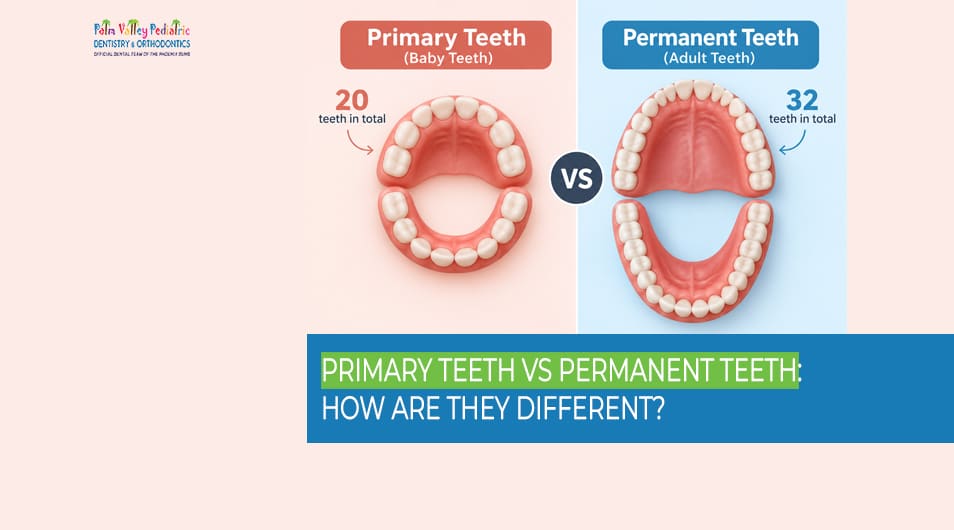
Primary Teeth vs Permanent Teeth: How Are They Different?
Your child’s smile changes a lot during the early years. First, those tiny baby teeth begin to appear. Then, they slowly fall out and make room for permanent teeth.
Many parents assume that baby teeth do not matter much because they eventually fall out. That is not true.
Primary teeth help children chew food, speak clearly, and develop healthy oral habits. They also help maintain space for permanent teeth. Permanent teeth need care too. Your child will use most of these teeth for the rest of their life.
At Palm Valley Pediatric Dentistry & Orthodontics, we help children build healthy dental habits from their earliest years.
Your child’s first dental visit is an important part of this process. We offer a baby’s first dental cleaning to help parents start their child’s oral care early and learn how to protect those first little teeth.
What Are Primary Teeth?
Primary teeth are also called baby teeth, milk teeth, or deciduous teeth. Children usually have 20 primary teeth. They include:
- 8 incisors
- 4 canines
- 8 molars
These teeth usually begin appearing during infancy. Most children have their full set of 20 primary teeth by about age 3.
Your child’s primary teeth do much more than create a cute smile. They help your child bite and chew food. They also support speech development.
Most importantly, primary teeth hold space for the permanent teeth that develop underneath them.
Why Do Baby Teeth Matter If They Fall Out?
This question comes up often.
Parents sometimes think, “If that tooth will fall out anyway, why treat a cavity?”
A cavity can still cause pain and infection in a baby tooth. Untreated decay can also make it harder for children to eat, speak, play, and learn.
Imagine your four-year-old has a large cavity in a baby molar.
The tooth may still need to stay in place for several more years. If decay leads to an infection, your child may experience pain or require more extensive treatment.
That is why dentists do not simply ignore cavities in primary teeth.
We focus on keeping children’s teeth healthy through every stage of development.
Our Pediatric Dental team provides preventive and restorative care for children and teens.
What Are Permanent Teeth?
Permanent teeth are also called adult teeth.
Most adults have 32 permanent teeth, including wisdom teeth. These teeth include:
- 8 incisors
- 4 canines
- 8 premolars
- 12 molars
Unlike primary teeth, most permanent teeth do not have a replacement waiting underneath them. Once your child loses a permanent tooth, they will not naturally grow another one in its place.
That makes permanent teeth especially important to protect.
Permanent teeth also include the first molars that usually appear around age 6. These teeth do not replace baby teeth.
They grow behind the primary molars.
This creates an important moment for parents. Some parents mistake these new molars for baby teeth because they do not replace an existing tooth.
Your child needs to brush these teeth carefully from the day they appear.

Is Your Child’s Smile on the Right Track?
Early dental visits aren’t just about cleaning teeth, they’re about catching problems before they become costly and painful. Our pediatric specialists create personalized care plans that grow with your child, from their very first tooth through their teen years.
Gentle, kid-friendly care in a welcoming environment.
Primary Teeth vs Permanent Teeth: Key Differences
Primary and permanent teeth help your child chew, speak, and maintain a healthy smile. However, they have several important differences.
Knowing these differences can help you understand what happens as your child’s smile changes.
1. Number of Teeth
Children have 20 primary teeth.
These include incisors, canines, and molars.
Most adults have 32 permanent teeth, including premolars and wisdom teeth. However, not everyone develops or keeps all four wisdom teeth.
Your child will gradually replace their 20 primary teeth with a larger set of permanent teeth as they grow.
2. Size and Enamel
Primary teeth usually look smaller and more delicate than permanent teeth.
Their enamel also differs from permanent teeth. Primary enamel has a lower mineral density and can be more susceptible to acid-related demineralization.
This matters when your child develops a cavity.
Tooth decay can progress quickly in young children. That makes early dental care especially important.
For example, a small cavity in a baby molar may seem harmless because the tooth will eventually fall out. However, untreated decay can cause pain and infection.
That is why dentists treat cavities in primary teeth seriously. The American Dental Association provides separate clinical recommendations for treating cavities in primary and permanent teeth.
3. Color
Have you noticed that your child’s new adult teeth look slightly more yellow than their baby teeth?
That can be normal.
Primary teeth often look whiter. Permanent teeth can have a more yellow or cream-colored appearance.
The difference becomes easier to notice when a new permanent tooth appears next to a bright white baby tooth.
Color alone does not mean that your child’s permanent tooth has a problem.
However, tell your child’s dentist if you notice sudden or unusual discoloration. A dental examination can help identify the cause.
4. Lifespan
Primary teeth stay in your child’s mouth for a limited period.
Permanent teeth should serve your child for many decades.
The first baby teeth usually appear during infancy. Children often begin losing them around age 6. Permanent teeth then begin to appear and gradually replace the primary teeth.
For example, your six-year-old may lose a lower front baby tooth and soon see a permanent tooth appear in its place.
The exact timing varies from child to child.
Your child may also have both primary and permanent teeth at the same time. Dentists call this the mixed dentition stage. This stage usually occurs between about ages 6 and 11.
5. Root Structure
Primary teeth have roots, just like permanent teeth.
However, their roots gradually resorb as the permanent teeth develop underneath them.
As the roots become shorter, the baby tooth becomes loose. Eventually, your child loses the tooth and the permanent tooth can move into its place.
Think about a loose baby tooth that your child keeps wiggling with their tongue.
That looseness happens because the tooth’s roots have gradually broken down.
Permanent teeth do not normally go through this natural process of root resorption and replacement. They remain in place instead of making room for another set of teeth.
6. The Types of Teeth Are Different
Primary teeth and permanent teeth do not have exactly the same lineup.
Primary teeth include:
- Incisors
- Canines
- First molars
- Second molars
Permanent teeth include all of these basic tooth types, along with premolars and additional molars.
Premolars replace the primary molars as your child’s permanent teeth develop.
Permanent first molars do something different. They usually erupt behind the primary molars rather than replace them. The first permanent molars commonly appear around ages 5 to 7.
This can surprise parents.
Your child may suddenly have a new tooth at the back of their mouth without losing a baby tooth first.
That new tooth is permanent.
How Do Primary Teeth Help Permanent Teeth?
Think of primary teeth as placeholders.
They help maintain the space that permanent teeth need. They also guide permanent teeth into the mouth as your child grows. This explains why early tooth loss can sometimes create dental problems.
For example, imagine a five-year-old loses a baby molar because of severe decay.
The permanent tooth may not come through for several years.
Nearby teeth can shift into the empty space. That movement can reduce the space available for the permanent tooth.
A pediatric dentist may recommend a space maintainer when a child loses a primary tooth too early.
PVPD offers space maintainers to help prevent future dental problems after premature tooth loss.
Imagine two children.
Child A keeps their baby molars healthy until they fall out naturally. The teeth remain in place while the permanent teeth develop.
Child B loses a baby molar several years early because of untreated decay. Nearby teeth may move into the open space.
The two children may need different dental care as their permanent teeth develop. This example shows why parents should not treat baby teeth as disposable teeth.
Can Baby Teeth Get Cavities?
Yes.
Baby teeth can develop cavities just like permanent teeth.
In fact, young children can develop tooth decay quickly because primary teeth have thinner enamel.
The Centers for Disease Control & Prevention reports that more than 1 in 10 children ages 2 to 5 have at least one untreated cavity in a primary tooth.
By ages 6 to 8, the number approaches 1 in 5.
That makes prevention very important.
Parents can help protect primary teeth by:
- Brushing twice a day with fluoride toothpaste.
- Helping young children brush properly.
- Flossing between teeth when they touch.
- Limiting frequent sugary snacks and drinks.
- Scheduling regular dental visits.
- Asking the dentist about fluoride treatments and sealants when appropriate.
Fluoride varnish can reduce cavities in primary teeth by about one-third.
What Happens When Permanent Teeth Start Coming In?
Permanent teeth do not appear all at once.
They arrive gradually as your child grows.
Around age 6, many children get their first permanent molars. They may also start losing their lower front teeth.
Your child may have a mix of primary and permanent teeth for several years. You may notice:
- Loose baby teeth.
- Gaps between teeth.
- Larger permanent teeth.
- Permanent molars appearing behind baby teeth.
- Temporary crowding as teeth change position.
- Changes in your child’s bite.
These changes often look strange to parents.
In many cases, they form part of normal dental development.
However, your child’s pediatric dentist can check whether the teeth are developing as expected.
What If a Permanent Tooth Looks Yellow?
Do not panic if your child’s new permanent teeth look slightly darker than their baby teeth.
Permanent teeth often have a naturally different color.
The contrast can make the new tooth look yellow next to bright white baby teeth.
However, parents should mention unusual discoloration to the dentist.
A dentist can determine whether the color is due to normal enamel variation, an injury, decay, or another dental concern.
What If a Baby Tooth Does Not Fall Out?
Sometimes a permanent tooth starts coming in while the baby tooth remains in place.
You may notice two rows of teeth.
Parents sometimes call this “shark teeth.”
The lower front teeth often show this pattern.
Your child’s dentist can check the position of both teeth and decide whether the baby tooth needs more time or treatment.
Do not pull the tooth yourself unless your dentist gives you specific instructions.
A pediatric dentist can monitor the eruption pattern and check whether the permanent tooth has enough room.
A Six-Year-Old With a New Permanent Molar
Consider a six-year-old who comes home excited because a new tooth appeared behind the baby teeth.
The parent assumes the tooth will eventually fall out because it looks like the other childhood teeth.
But this tooth is actually a permanent first molar.
It will not replace a baby tooth.
Our dentist explained that this molar needs careful brushing and may benefit from preventive care, such as a dental sealant.
This simple situation happens because permanent molars can appear without pushing out a baby tooth. Regular dental visits help parents recognize these changes early.
Why Should Parents Care for Baby Teeth and Permanent Teeth Differently?
The basic rules stay the same.
Your child needs to brush, floss, eat a balanced diet, and visit the dentist regularly.
However, the dentist may recommend different treatments depending on the tooth and your child’s age.
For example, a dentist may treat a cavity in a baby tooth with a filling or crown when the tooth needs to remain in place.
Permanent teeth may require different treatment because they need to serve your child for many years.
Your dentist considers the tooth’s development, condition, and expected lifespan before recommending treatment.
5 Ways to Protect Your Child’s Teeth
Good dental habits start early.
1. Start brushing early
Begin caring for your child’s mouth as soon as the first tooth appears. Use fluoride toothpaste as recommended for your child’s age. Young children often need help brushing until they can clean every surface properly.
2. Watch sugary snacks and drinks
Frequent exposure to sugar can increase the risk of cavities. The bacteria in the mouth use sugars to produce acids that attack tooth enamel. Water makes a better everyday drink than sugary beverages.
3. Do not ignore baby-tooth cavities
A cavity in a baby tooth still needs attention. Your child may experience pain or infection if decay continues. Early treatment can also help protect your child’s comfort and oral health.
4. Protect new permanent molars
Pay special attention when your child’s first permanent molars appear. These teeth contain grooves and pits that can trap food and plaque. Ask your pediatric dentist whether sealants can help protect them.
Dental sealants can prevent about 80% of cavities in back teeth.
5. Keep regular dental appointments
Regular visits allow your dentist to monitor tooth eruption and development. Your dentist can also spot cavities, crowding, bite problems, and other concerns early. Early care often gives parents more options.
Give Your Child a Healthy Smile From the Start!
Primary teeth may not stay forever, but they still matter.
They help your child eat, speak, smile, and grow. They also help guide permanent teeth into the right spaces.
Permanent teeth need even more attention because your child will rely on them for many years.
The best approach is simple: care for both.
If you have questions about your child’s baby teeth, loose teeth, new permanent teeth, cavities, or tooth development, a pediatric dentist can help.
Schedule your child’s dental appointment with Palm Valley Pediatric Dentistry & Orthodontics to keep their smile healthy through every stage of growth.
Give Your Child the Gift of a Healthy Smile
PVPD doesn’t just treat teeth; we build lasting relationships with families. More confident kids. More comfortable appointments. More reasons to smile. Our patients leave happier and healthier, visit after visit.
Serving families across Scottsdale, because every child deserves a great smile.
People Also Ask
Are permanent teeth stronger than primary teeth?
Permanent teeth have thicker enamel than primary teeth. However, they can still develop cavities without proper brushing, flossing, and dental care.
Why are baby teeth important if they fall out?
Baby teeth help children chew and speak. They also hold space for permanent teeth and support healthy oral development.
Can a baby tooth get a cavity?
Yes. Primary teeth can develop cavities. Untreated decay can cause pain, infection, and problems with eating and other daily activities.
What happens if a child loses a baby tooth too early?
Nearby teeth can shift into the empty space. In some cases, a pediatric dentist may recommend a space maintainer to help preserve the space for the developing permanent tooth.
When do permanent teeth start coming in?
Many children begin getting permanent teeth around age 6. The first permanent molars often appear around this time. The exact timing varies from child to child.
Should parents worry about yellow permanent teeth?
Not always. Permanent teeth can naturally look slightly more yellow or cream-colored than baby teeth. However, parents should ask a dentist about unusual or sudden discoloration.
Pediatric Dental Specialist at PVPD

Dr. Olga
Dr. Olga brings years of specialized pediatric dental expertise and a genuine passion for children’s oral health to the PVPD team. She specializes in creating anxiety-free dental experiences and early-intervention care strategies that set children up for a lifetime of healthy smiles.
Medically reviewed by Dr. Olga Dolghier, DDS, Pediatric Dentist at Palm Valley Pediatric Dentistry & Orthodontics.


