Deprecated: KadenceWP\KadenceBlocks\StellarWP\DB\DB::generate_results(): Implicitly marking parameter $query as nullable is deprecated, the explicit nullable type must be used instead in /home/pvpd/public_html/wp-content/plugins/kadence-blocks/vendor/vendor-prefixed/stellarwp/db/src/DB/DB.php on line 463
Deprecated: KadenceWP\KadenceBlocks\StellarWP\DB\DB::generate_col(): Implicitly marking parameter $query as nullable is deprecated, the explicit nullable type must be used instead in /home/pvpd/public_html/wp-content/plugins/kadence-blocks/vendor/vendor-prefixed/stellarwp/db/src/DB/DB.php on line 480
Deprecated: KadenceWP\KadenceBlocks\StellarWP\Uplink\Pipeline\Pipeline::__construct(): Implicitly marking parameter $container as nullable is deprecated, the explicit nullable type must be used instead in /home/pvpd/public_html/wp-content/plugins/kadence-blocks/vendor/vendor-prefixed/stellarwp/uplink/src/Uplink/Pipeline/Pipeline.php on line 52
Deprecated: KadenceWP\KadenceBlocks\StellarWP\Uplink\Resources\Plugin::register(): Implicitly marking parameter $license_class as nullable is deprecated, the explicit nullable type must be used instead in /home/pvpd/public_html/wp-content/plugins/kadence-blocks/vendor/vendor-prefixed/stellarwp/uplink/src/Uplink/Resources/Plugin.php on line 172
Deprecated: KadenceWP\KadenceBlocks\StellarWP\Uplink\Resources\Resource::__construct(): Implicitly marking parameter $license_class as nullable is deprecated, the explicit nullable type must be used instead in /home/pvpd/public_html/wp-content/plugins/kadence-blocks/vendor/vendor-prefixed/stellarwp/uplink/src/Uplink/Resources/Resource.php on line 128
Deprecated: KadenceWP\KadenceBlocks\StellarWP\Uplink\Resources\Resource::register(): Implicitly marking parameter $license_class as nullable is deprecated, the explicit nullable type must be used instead in /home/pvpd/public_html/wp-content/plugins/kadence-blocks/vendor/vendor-prefixed/stellarwp/uplink/src/Uplink/Resources/Resource.php on line 400
Deprecated: KadenceWP\KadenceBlocks\StellarWP\Uplink\Resources\Resource::register_resource(): Implicitly marking parameter $license_class as nullable is deprecated, the explicit nullable type must be used instead in /home/pvpd/public_html/wp-content/plugins/kadence-blocks/vendor/vendor-prefixed/stellarwp/uplink/src/Uplink/Resources/Resource.php on line 417
Deprecated: KadenceWP\KadencePro\Container::bind(): Implicitly marking parameter $afterBuildMethods as nullable is deprecated, the explicit nullable type must be used instead in /home/pvpd/public_html/wp-content/plugins/kadence-pro/includes/container/Container.php on line 21
Deprecated: KadenceWP\KadencePro\Container::singleton(): Implicitly marking parameter $afterBuildMethods as nullable is deprecated, the explicit nullable type must be used instead in /home/pvpd/public_html/wp-content/plugins/kadence-pro/includes/container/Container.php on line 42
Deprecated: KadenceWP\KadencePro\lucatume\DI52\Container::singleton(): Implicitly marking parameter $afterBuildMethods as nullable is deprecated, the explicit nullable type must be used instead in /home/pvpd/public_html/wp-content/plugins/kadence-pro/vendor/vendor-prefixed/lucatume/di52/src/Container.php on line 154
Deprecated: KadenceWP\KadencePro\lucatume\DI52\Container::bind(): Implicitly marking parameter $afterBuildMethods as nullable is deprecated, the explicit nullable type must be used instead in /home/pvpd/public_html/wp-content/plugins/kadence-pro/vendor/vendor-prefixed/lucatume/di52/src/Container.php on line 532
Deprecated: KadenceWP\KadencePro\lucatume\DI52\Container::singletonDecorators(): Implicitly marking parameter $afterBuildMethods as nullable is deprecated, the explicit nullable type must be used instead in /home/pvpd/public_html/wp-content/plugins/kadence-pro/vendor/vendor-prefixed/lucatume/di52/src/Container.php on line 580
Deprecated: KadenceWP\KadencePro\lucatume\DI52\Container::getDecoratorBuilder(): Implicitly marking parameter $afterBuildMethods as nullable is deprecated, the explicit nullable type must be used instead in /home/pvpd/public_html/wp-content/plugins/kadence-pro/vendor/vendor-prefixed/lucatume/di52/src/Container.php on line 603
Deprecated: KadenceWP\KadencePro\lucatume\DI52\Container::bindDecorators(): Implicitly marking parameter $afterBuildMethods as nullable is deprecated, the explicit nullable type must be used instead in /home/pvpd/public_html/wp-content/plugins/kadence-pro/vendor/vendor-prefixed/lucatume/di52/src/Container.php on line 645
Deprecated: KadenceWP\KadencePro\lucatume\DI52\Container::instance(): Implicitly marking parameter $afterBuildMethods as nullable is deprecated, the explicit nullable type must be used instead in /home/pvpd/public_html/wp-content/plugins/kadence-pro/vendor/vendor-prefixed/lucatume/di52/src/Container.php on line 824
Deprecated: KadenceWP\KadencePro\lucatume\DI52\Builders\Resolver::resolveWithArgs(): Implicitly marking parameter $afterBuildMethods as nullable is deprecated, the explicit nullable type must be used instead in /home/pvpd/public_html/wp-content/plugins/kadence-pro/vendor/vendor-prefixed/lucatume/di52/src/Builders/Resolver.php on line 176
Deprecated: KadenceWP\KadencePro\lucatume\DI52\Builders\Resolver::resolve(): Implicitly marking parameter $buildLine as nullable is deprecated, the explicit nullable type must be used instead in /home/pvpd/public_html/wp-content/plugins/kadence-pro/vendor/vendor-prefixed/lucatume/di52/src/Builders/Resolver.php on line 203
Deprecated: KadenceWP\KadencePro\lucatume\DI52\Builders\Resolver::cloneBuilder(): Implicitly marking parameter $afterBuildMethods as nullable is deprecated, the explicit nullable type must be used instead in /home/pvpd/public_html/wp-content/plugins/kadence-pro/vendor/vendor-prefixed/lucatume/di52/src/Builders/Resolver.php on line 277
Deprecated: KadenceWP\KadencePro\lucatume\DI52\Builders\Factory::getBuilder(): Implicitly marking parameter $afterBuildMethods as nullable is deprecated, the explicit nullable type must be used instead in /home/pvpd/public_html/wp-content/plugins/kadence-pro/vendor/vendor-prefixed/lucatume/di52/src/Builders/Factory.php on line 62
Deprecated: KadenceWP\KadencePro\lucatume\DI52\Builders\ClassBuilder::__construct(): Implicitly marking parameter $afterBuildMethods as nullable is deprecated, the explicit nullable type must be used instead in /home/pvpd/public_html/wp-content/plugins/kadence-pro/vendor/vendor-prefixed/lucatume/di52/src/Builders/ClassBuilder.php on line 81
Deprecated: KadenceWP\KadencePro\lucatume\DI52\Builders\ClassBuilder::reinit(): Implicitly marking parameter $afterBuildMethods as nullable is deprecated, the explicit nullable type must be used instead in /home/pvpd/public_html/wp-content/plugins/kadence-pro/vendor/vendor-prefixed/lucatume/di52/src/Builders/ClassBuilder.php on line 242
Deprecated: KadenceWP\KadencePro\lucatume\DI52\Builders\ReinitializableBuilderInterface::reinit(): Implicitly marking parameter $afterBuildMethods as nullable is deprecated, the explicit nullable type must be used instead in /home/pvpd/public_html/wp-content/plugins/kadence-pro/vendor/vendor-prefixed/lucatume/di52/src/Builders/ReinitializableBuilderInterface.php on line 28
Deprecated: KadenceWP\KadencePro\StellarWP\Uplink\Resources\Plugin::register(): Implicitly marking parameter $license_class as nullable is deprecated, the explicit nullable type must be used instead in /home/pvpd/public_html/wp-content/plugins/kadence-pro/vendor/vendor-prefixed/stellarwp/uplink/src/Uplink/Resources/Plugin.php on line 177
Deprecated: KadenceWP\KadencePro\StellarWP\Uplink\Resources\Resource::__construct(): Implicitly marking parameter $license_class as nullable is deprecated, the explicit nullable type must be used instead in /home/pvpd/public_html/wp-content/plugins/kadence-pro/vendor/vendor-prefixed/stellarwp/uplink/src/Uplink/Resources/Resource.php on line 133
Deprecated: KadenceWP\KadencePro\StellarWP\Uplink\Resources\Resource::register(): Implicitly marking parameter $license_class as nullable is deprecated, the explicit nullable type must be used instead in /home/pvpd/public_html/wp-content/plugins/kadence-pro/vendor/vendor-prefixed/stellarwp/uplink/src/Uplink/Resources/Resource.php on line 405
Deprecated: KadenceWP\KadencePro\StellarWP\Uplink\Resources\Resource::register_resource(): Implicitly marking parameter $license_class as nullable is deprecated, the explicit nullable type must be used instead in /home/pvpd/public_html/wp-content/plugins/kadence-pro/vendor/vendor-prefixed/stellarwp/uplink/src/Uplink/Resources/Resource.php on line 422
Deprecated: KadenceWP\KadenceStarterTemplates\Container::bind(): Implicitly marking parameter $afterBuildMethods as nullable is deprecated, the explicit nullable type must be used instead in /home/pvpd/public_html/wp-content/plugins/kadence-starter-templates/inc/resources/Container.php on line 29
Deprecated: KadenceWP\KadenceStarterTemplates\Container::singleton(): Implicitly marking parameter $afterBuildMethods as nullable is deprecated, the explicit nullable type must be used instead in /home/pvpd/public_html/wp-content/plugins/kadence-starter-templates/inc/resources/Container.php on line 50
Deprecated: KadenceWP\KadenceStarterTemplates\lucatume\DI52\Container::singleton(): Implicitly marking parameter $afterBuildMethods as nullable is deprecated, the explicit nullable type must be used instead in /home/pvpd/public_html/wp-content/plugins/kadence-starter-templates/vendor/vendor-prefixed/lucatume/di52/src/Container.php on line 154
Deprecated: KadenceWP\KadenceStarterTemplates\lucatume\DI52\Container::bind(): Implicitly marking parameter $afterBuildMethods as nullable is deprecated, the explicit nullable type must be used instead in /home/pvpd/public_html/wp-content/plugins/kadence-starter-templates/vendor/vendor-prefixed/lucatume/di52/src/Container.php on line 532
Deprecated: KadenceWP\KadenceStarterTemplates\lucatume\DI52\Container::singletonDecorators(): Implicitly marking parameter $afterBuildMethods as nullable is deprecated, the explicit nullable type must be used instead in /home/pvpd/public_html/wp-content/plugins/kadence-starter-templates/vendor/vendor-prefixed/lucatume/di52/src/Container.php on line 580
Deprecated: KadenceWP\KadenceStarterTemplates\lucatume\DI52\Container::getDecoratorBuilder(): Implicitly marking parameter $afterBuildMethods as nullable is deprecated, the explicit nullable type must be used instead in /home/pvpd/public_html/wp-content/plugins/kadence-starter-templates/vendor/vendor-prefixed/lucatume/di52/src/Container.php on line 603
Deprecated: KadenceWP\KadenceStarterTemplates\lucatume\DI52\Container::bindDecorators(): Implicitly marking parameter $afterBuildMethods as nullable is deprecated, the explicit nullable type must be used instead in /home/pvpd/public_html/wp-content/plugins/kadence-starter-templates/vendor/vendor-prefixed/lucatume/di52/src/Container.php on line 645
Deprecated: KadenceWP\KadenceStarterTemplates\lucatume\DI52\Container::instance(): Implicitly marking parameter $afterBuildMethods as nullable is deprecated, the explicit nullable type must be used instead in /home/pvpd/public_html/wp-content/plugins/kadence-starter-templates/vendor/vendor-prefixed/lucatume/di52/src/Container.php on line 824
Deprecated: KadenceWP\KadenceStarterTemplates\lucatume\DI52\Builders\Resolver::resolveWithArgs(): Implicitly marking parameter $afterBuildMethods as nullable is deprecated, the explicit nullable type must be used instead in /home/pvpd/public_html/wp-content/plugins/kadence-starter-templates/vendor/vendor-prefixed/lucatume/di52/src/Builders/Resolver.php on line 176
Deprecated: KadenceWP\KadenceStarterTemplates\lucatume\DI52\Builders\Resolver::resolve(): Implicitly marking parameter $buildLine as nullable is deprecated, the explicit nullable type must be used instead in /home/pvpd/public_html/wp-content/plugins/kadence-starter-templates/vendor/vendor-prefixed/lucatume/di52/src/Builders/Resolver.php on line 203
Deprecated: KadenceWP\KadenceStarterTemplates\lucatume\DI52\Builders\Resolver::cloneBuilder(): Implicitly marking parameter $afterBuildMethods as nullable is deprecated, the explicit nullable type must be used instead in /home/pvpd/public_html/wp-content/plugins/kadence-starter-templates/vendor/vendor-prefixed/lucatume/di52/src/Builders/Resolver.php on line 277
Deprecated: KadenceWP\KadenceStarterTemplates\lucatume\DI52\Builders\Factory::getBuilder(): Implicitly marking parameter $afterBuildMethods as nullable is deprecated, the explicit nullable type must be used instead in /home/pvpd/public_html/wp-content/plugins/kadence-starter-templates/vendor/vendor-prefixed/lucatume/di52/src/Builders/Factory.php on line 62
Deprecated: KadenceWP\KadenceStarterTemplates\StellarWP\ProphecyMonorepo\Container\ContainerAdapter::bind(): Implicitly marking parameter $afterBuildMethods as nullable is deprecated, the explicit nullable type must be used instead in /home/pvpd/public_html/wp-content/plugins/kadence-starter-templates/vendor/vendor-prefixed/stellarwp/prophecy-container/ContainerAdapter.php on line 39
Deprecated: KadenceWP\KadenceStarterTemplates\StellarWP\ProphecyMonorepo\Container\ContainerAdapter::singleton(): Implicitly marking parameter $afterBuildMethods as nullable is deprecated, the explicit nullable type must be used instead in /home/pvpd/public_html/wp-content/plugins/kadence-starter-templates/vendor/vendor-prefixed/stellarwp/prophecy-container/ContainerAdapter.php on line 74
Deprecated: KadenceWP\KadenceStarterTemplates\lucatume\DI52\Builders\ClassBuilder::__construct(): Implicitly marking parameter $afterBuildMethods as nullable is deprecated, the explicit nullable type must be used instead in /home/pvpd/public_html/wp-content/plugins/kadence-starter-templates/vendor/vendor-prefixed/lucatume/di52/src/Builders/ClassBuilder.php on line 81
Deprecated: KadenceWP\KadenceStarterTemplates\lucatume\DI52\Builders\ClassBuilder::reinit(): Implicitly marking parameter $afterBuildMethods as nullable is deprecated, the explicit nullable type must be used instead in /home/pvpd/public_html/wp-content/plugins/kadence-starter-templates/vendor/vendor-prefixed/lucatume/di52/src/Builders/ClassBuilder.php on line 242
Deprecated: KadenceWP\KadenceStarterTemplates\lucatume\DI52\Builders\ReinitializableBuilderInterface::reinit(): Implicitly marking parameter $afterBuildMethods as nullable is deprecated, the explicit nullable type must be used instead in /home/pvpd/public_html/wp-content/plugins/kadence-starter-templates/vendor/vendor-prefixed/lucatume/di52/src/Builders/ReinitializableBuilderInterface.php on line 28
Deprecated: KadenceWP\KadenceStarterTemplates\StellarWP\Uplink\Resources\Plugin::register(): Implicitly marking parameter $license_class as nullable is deprecated, the explicit nullable type must be used instead in /home/pvpd/public_html/wp-content/plugins/kadence-starter-templates/vendor/vendor-prefixed/stellarwp/uplink/src/Uplink/Resources/Plugin.php on line 177
Deprecated: KadenceWP\KadenceStarterTemplates\StellarWP\Uplink\Resources\Resource::__construct(): Implicitly marking parameter $license_class as nullable is deprecated, the explicit nullable type must be used instead in /home/pvpd/public_html/wp-content/plugins/kadence-starter-templates/vendor/vendor-prefixed/stellarwp/uplink/src/Uplink/Resources/Resource.php on line 133
Deprecated: KadenceWP\KadenceStarterTemplates\StellarWP\Uplink\Resources\Resource::register(): Implicitly marking parameter $license_class as nullable is deprecated, the explicit nullable type must be used instead in /home/pvpd/public_html/wp-content/plugins/kadence-starter-templates/vendor/vendor-prefixed/stellarwp/uplink/src/Uplink/Resources/Resource.php on line 405
Deprecated: KadenceWP\KadenceStarterTemplates\StellarWP\Uplink\Resources\Resource::register_resource(): Implicitly marking parameter $license_class as nullable is deprecated, the explicit nullable type must be used instead in /home/pvpd/public_html/wp-content/plugins/kadence-starter-templates/vendor/vendor-prefixed/stellarwp/uplink/src/Uplink/Resources/Resource.php on line 422
Deprecated: KadenceWP\KadenceBlocksPro\Query\Frontend_Filters\Abstract_Filter::__construct(): Implicitly marking parameter $html_renderer as nullable is deprecated, the explicit nullable type must be used instead in /home/pvpd/public_html/wp-content/plugins/kadence-blocks-pro/includes/query/frontend-filters/class-abstract-filter.php on line 56
Deprecated: KadenceWP\KadenceBlocksPro\StellarWP\DB\DB::generate_results(): Implicitly marking parameter $query as nullable is deprecated, the explicit nullable type must be used instead in /home/pvpd/public_html/wp-content/plugins/kadence-blocks-pro/vendor/vendor-prefixed/stellarwp/db/src/DB/DB.php on line 414
Deprecated: KadenceWP\KadenceBlocksPro\StellarWP\DB\DB::generate_col(): Implicitly marking parameter $query as nullable is deprecated, the explicit nullable type must be used instead in /home/pvpd/public_html/wp-content/plugins/kadence-blocks-pro/vendor/vendor-prefixed/stellarwp/db/src/DB/DB.php on line 431
Warning: Cannot modify header information - headers already sent by (output started at /home/pvpd/public_html/wp-content/plugins/kadence-pro/vendor/vendor-prefixed/lucatume/di52/src/Container.php:580) in /home/pvpd/public_html/wp-includes/feed-rss2.php on line 8 Palm Valley Pediatric Dentistry & Orthodontics
https://pvpd.com/
We are top-rated pediatric dentist and orthodontic practice in Phoenix, offering specialized dental care for children and orthodontic service.Thu, 22 Oct 2026 02:47:31 +0000en-US
hourly
1 https://wordpress.org/?v=7.1.3https://pvpd.com/wp-content/uploads/2023/09/cropped-pvpd-siteicon-32x32.pngPalm Valley Pediatric Dentistry & Orthodontics
https://pvpd.com/
3232Power Chain Braces: How They Close Gaps and Straighten Teeth
https://pvpd.com/power-chain-braces/
Thu, 22 Oct 2026 02:47:30 +0000https://pvpd.com/?p=10817Power chain braces are small elastic loops that connect the brackets on your teeth. They help close gaps and move teeth into the right position. Your orthodontist may add power chains when there are still spaces between your teeth. They help bring teeth closer together as your treatment progresses. If your child is getting power...
Thanks for reading! I hope you enjoyed learning more about children’s dental health, early orthodontic care, and how to give your little one a healthy smile for life. Author: Dr. Olga | Owner and Pediatric Dental Specialist at PVPD
Power chain braces are small elastic loops that connect the brackets on your teeth. They help close gaps and move teeth into the right position.
Your orthodontist may add power chains when there are still spaces between your teeth. They help bring teeth closer together as your treatment progresses.
If your child is getting power chains, you may wonder if they hurt, how long they need to wear them, or when the gaps will close.
Knowing what to expect can make the process easier for both you and your child.
If your child needs braces or is already wearing them, orthodontic services in Arizona can help you find the right care for their growing smile. Book an appointment with our team today.
What Are Power Chain Braces?
Power chains are connected elastic rings that fit over the brackets of traditional braces. Unlike the individual elastic bands that sit around separate brackets, a power chain links several brackets together.
This connection allows the orthodontist to apply a continuous pulling force across a group of teeth.
The American Association of Orthodontists explains that power chains can apply more force than individual elastic rings when needed during orthodontic treatment.
Power chains are not a separate type of braces. They are an additional component used during certain stages of treatment, depending on how your teeth need to move.
Your orthodontist may suggest them to:
Close gaps between teeth.
Bring teeth closer together after a tooth extraction where space closure is involved in the process of treatment.
Enhance spacing and alignment.
Enable the teeth to reach the desired positions during the process of treatment.
Not all people with braces need a power chain. There are some who are able to achieve their treatment objectives through other orthodontic techniques, while there are those who need to have a power chain added to them at a certain point in time.
Is Your Child’s Smile on the Right Track?
Early dental visits aren’t just about cleaning teeth, they’re about catching problems before they become costly and painful. Our pediatric specialists create personalized care plans that grow with your child, from their very first tooth through their teen years.
Gentle, kid-friendly care in a welcoming environment.
How Do Power Chains Work?
Consider the small rubber bands that surround your braces brackets. The band ensures that the archwire is attached to the bracket, thus ensuring that the wire is guiding your teeth into position.
A power chain is used to link a number of points instead of having them remain unconnected.
As your orthodontist stretches the chain across the brackets, the elasticity of the material results in tension. The tension causes a pull that moves your teeth into position.
Your braces’ archwire keeps guiding your teeth into position. The power chain does not take over the entire braces but operates in conjunction with them.
It takes time for teeth to move due to the tissues around the roots of the tooth responding to orthodontic forces. This explains why you will not notice a gap closing up straight away.
What is significant here is that power chains do more than just keep your braces intact.
Why Would Your Orthodontist Recommend Power Chains?
The reason for adding a power chain depends on what needs to happen next in your treatment.
1. To close gaps between teeth
Spaces between teeth may be natural or acquired as part of orthodontic treatment. There may be gaps after a tooth has been extracted.
In situations where closing the gap is needed, the use of a power chain may prove useful in moving certain teeth closer to one another.
It should be noted that closing a gap does not necessarily involve just bringing two teeth closer together. Your orthodontist needs to take into account various factors.
2. To manage spaces left after tooth extraction
Orthodontic treatment sometimes requires the extraction of a tooth to deal with issues like crowding. The space left as a result has to be dealt with.
Power chains may be used in closing the space created by moving teeth in accordance with the treatment process.
This procedure takes time, and the distance moved by the teeth varies depending on the individual patient.
3. To refine tooth alignment
Sometimes, teeth may look straight but still have small gaps or need a little more adjustment.
Your orthodontist may use power chains to bring your teeth closer together and improve their position. This helps your teeth fit together properly, not just look straighter.
Straight teeth can also make a difference in the overall appearance of your smile. PVPD offers cosmetic dentistry services to help patients improve their smiles.
Types of Power Chains for Braces
Power chains come in different configurations. The main difference is the spacing between their elastic loops.
1- Closed power chains
Closed power chains have loops placed close together, with little or no space between them. They help connect several braces brackets and bring teeth closer together.
2- Short power chains
Short power chains have small spaces between the loops. Your orthodontist may use them when a specific type of tooth movement is needed.
3- Long power chains
Long power chains have larger spaces between the loops. They give your orthodontist another option for connecting brackets and moving teeth.
The names describe the space between the loops, not how long you need to wear them. Your orthodontist will choose the right type based on your teeth and treatment needs.
Do Power Chain Braces Hurt?
This is normally the first question you will ask once you have been informed that you require a power chain.
The placement process is not usually complicated. Your orthodontist places the elastic chain over your brackets during your appointment.
There is likely to be some discomfort or sensitivity on the same day or the following day. You may find that biting into food is uncomfortable for the first few days.
This happens because your braces are exerting pressure on your teeth to move them.
There are a few ways to make those first days more comfortable:
Choose softer foods. Yogurt, eggs, pasta, oatmeal, and soft-cooked vegetables are easier to eat when your teeth feel tender.
Eat slowly. Avoid biting directly into hard foods while your teeth are sensitive.
Keep drinking water. Water helps keep your mouth comfortable without exposing your teeth to sugary drinks.
Follow your orthodontist’s advice. If you need pain relief, ask which option is appropriate for you or your child.
The pain generally improves within a couple of days.
Persistent pain, swelling, or worsening pain is something to take seriously.
Make an appointment with your orthodontist for any odd symptoms that do not seem to get better.
How Long Do You Have to Wear Power Chains?
Some patients wear power chains for a short time, while others have to use them for several months. It all depends on the degree of tooth movement, how the teeth react, and any other changes that need to be made.
The orthodontist may change or modify the chain during routine visits since the elastic material loses some of its strength with time.
It is also crucial to know that just wearing power chains does not necessarily imply that your braces will come off soon.
The power chain may be added later during treatment, or it could be used at any other time when your orthodontist thinks that it is required by the treatment plan. Even after closing the space, there may still be a need for fine-tuning the tooth positions and making other bite corrections.
Instead of counting weeks, focus on what the orthodontist sees during your visits.
Do Power Chains Close Gaps Faster?
Power chains can help in the closure of spaces, but they cannot ensure that all patients receive fast treatment.
The movement of teeth would depend on a number of variables, such as the size of the space, the placement of the roots, the tissues around the teeth, as well as the mechanics used.
More force does not always equal better and faster results. Orthodontics work on the principle of carefully controlled forces.
Your orthodontist might also have to move certain teeth in a specific order to ensure that you get the result and healthy bite that is desired.
If the closure of your space is taking longer than anticipated, you should inquire about the same from your orthodontist.
There is much more to it than meets the eye.
How to Care for Your Teeth With Power Chains
Power chains add another area where food particles and plaque can collect. Keeping your teeth clean is especially important while wearing braces because plaque can accumulate around brackets and along the gumline.
A consistent routine helps protect your teeth throughout treatment.
Brush carefully around every bracket.
Brush at least twice a day using fluoride toothpaste and a soft-bristled toothbrush. Pay attention to the areas above and below the brackets, along with the gumline and chewing surfaces.
Take your time rather than brushing quickly across the front of your teeth.
Brushing and flossing carefully are important when wearing braces. The Dental Resource Center provides information on dental care and maintaining healthy teeth and gums.
Clean between your teeth.
Food can become trapped around brackets and beneath the elastic chain. Flossing daily, with an appropriate flossing aid if needed, helps clean areas your toothbrush cannot easily reach.
An orthodontic floss threader or interdental brush may make cleaning easier. Ask your dental team to demonstrate the method that works best for your braces.
Be careful with sticky and hard foods.
Hard candies, sticky sweets, and very crunchy foods can damage orthodontic appliances or make cleaning more difficult.
Choose foods that are easier to chew, particularly when your teeth feel tender after an adjustment.
Keep your orthodontic appointments.
Regular visits allow your orthodontist to assess tooth movement, check your braces, and replace or adjust the chain when necessary.
If a power chain breaks or comes loose, contact your orthodontic office for instructions rather than trying to repair it yourself.
What If Your Power Chain Breaks?
A damaged power chain can be alarming when you are trying to narrow the gap.
First, see if the chain has become detached from just one bracket or if part of the chain has actually broken. Do not try to pull or stretch the chain back into position.
Get in touch with your orthodontist and describe what has happened. They will be able to advise if you need to come in for an appointment sooner or if it is alright to wait until your next appointment.
If there is a bracket that is loose, a wire that is poking your cheek, or the broken chain is irritating you, inform your orthodontist’s office about it.
A broken chain doesn’t necessarily mean that your treatment has not been successful. But your orthodontist needs to decide if something has to be done.
Are Power Chains a Sign That You Are Almost Done With Braces?
Not necessarily.
It is understandable to see a power chain as a sign that your teeth are coming together and treatment is progressing. In some cases, it may be part of the later stages of orthodontic treatment.
But braces involve more than closing visible spaces.
Your orthodontist also evaluates how your upper and lower teeth fit together, whether individual teeth are properly positioned, and whether the final result meets your treatment goals.
Some patients need further adjustments after gaps have closed. Others may require additional time to achieve the intended bite.
The best way to find out how much treatment remains is to ask your orthodontist about your individual progress.
Every Part of Your Braces Has a Purpose
Power chains help close gaps and move teeth into the right position. Some pressure or tenderness is normal after getting them, so keep brushing carefully and follow your orthodontist’s advice.
At Palm Valley Pediatric Dentistry & Orthodontics, we help families understand every stage of orthodontic treatment. Explore our orthodontic services in Arizona to learn how we can help your child achieve a healthier, straighter smile.
Give Your Child the Gift of a Healthy Smile
PVPD doesn’t just treat teeth; we build lasting relationships with families. More confident kids. More comfortable appointments. More reasons to smile. Our patients leave happier and healthier, visit after visit.
Serving families across Scottsdale, because every child deserves a great smile.
People Also Ask
Can power chains stain?
Depending on the material and your eating and drinking habits, clear or light-colored elastic chains may become discolored over time. Dark-colored chains may make staining less noticeable. Good oral hygiene helps keep your teeth clean, but it cannot prevent every change in the chain’s color.
Can power chains close a gap between the front teeth?
They can help close certain gaps between front teeth when that movement is appropriate for the treatment plan. Your orthodontist will assess the cause of the gap, the position of the teeth, and your bite before deciding how to manage it.
Will my teeth move backward if my power chain breaks?
A broken chain does not automatically mean your teeth will move backward. However, it may interrupt the force being applied, so you should contact your orthodontist for advice. Do not assume that the chain can be left broken until your next appointment.
Can children wear power chains?
Power chains may be used in children and teenagers who are receiving orthodontic treatment with braces, when clinically appropriate. The decision depends on their individual dental development and treatment needs.
Are power chains better than regular elastic bands?
Individual elastic bands and power chains serve different purposes in orthodontic treatment. Your orthodontist chooses the option that provides the appropriate force for the movement required.
Dr. Olga brings years of specialized pediatric dental expertise and a genuine passion for children’s oral health to the PVPD team. She specializes in creating anxiety-free dental experiences and early-intervention care strategies that set children up for a lifetime of healthy smiles.
]]>Baby Teeth Chart: Names, Order, and Eruption Ages
https://pvpd.com/baby-teeth-chart/
Wed, 14 Oct 2026 21:29:39 +0000https://pvpd.com/?p=10805Children have 20 baby teeth that usually appear between 6 months and 3 years of age. A baby teeth chart shows the names of these teeth, where they are located, and when they typically come in. Your baby’s first tooth is a little milestone. One day, you notice a tiny white edge on the gums,...
Thanks for reading! I hope you enjoyed learning more about children’s dental health, early orthodontic care, and how to give your little one a healthy smile for life. Author: Dr. Olga | Owner and Pediatric Dental Specialist at PVPD
Children have 20 baby teeth that usually appear between 6 months and 3 years of age. A baby teeth chart shows the names of these teeth, where they are located, and when they typically come in.
Your baby’s first tooth is a little milestone. One day, you notice a tiny white edge on the gums, and before you know it, more teeth start appearing. But which teeth should come in next? And how can you tell if your child’s teeth are developing as expected?
At Palm Valley Pediatric Dentistry & Orthodontics, Dr. Olga and our team help parents understand every stage of their child’s dental development.
Book an appointment with our team to check your child’s growing teeth and get answers to your questions about their baby teeth chart.
Baby Teeth Chart: Names and Eruption Ages
Baby teeth, which are also known as primary teeth, develop in a particular order. The bottom front teeth will come in before the top front teeth, with the back teeth developing last.
Use this chart to determine the order of development for each type of baby tooth.
Type of baby tooth
Upper teeth appear
Lower teeth appear
Central incisors (front teeth)
8-12 months
6-10 months
Lateral incisors (teeth beside the front teeth)
9-13 months
10-16 months
First molars (front back teeth)
13-19 months
14-18 months
Canines (pointed teeth)
16-22 months
17-23 months
Second molars (back teeth)
25-33 months
23-31 months
Is Your Child’s Smile on the Right Track?
Early dental visits aren’t just about cleaning teeth, they’re about catching problems before they become costly and painful. Our pediatric specialists create personalized care plans that grow with your child, from their very first tooth through their teen years.
Gentle, kid-friendly care in a welcoming environment.
How to Read a Baby Teeth Chart
The upper teeth are in your child’s top jaw, while the lower teeth are in the bottom jaw. Each type of tooth has a different shape and job.
Central incisors: The two front teeth in each jaw.
Lateral incisors: The teeth immediately beside the central incisors.
Canines: The pointed teeth next to the lateral incisors.
First molars: The larger teeth behind the canines.
Second molars: The last baby teeth at the back of the mouth.
Each jaw contains two central incisors, two lateral incisors, two canines, and four molars. These are what comprise the 20 baby teeth.
How Many Baby Teeth Do Children Have?
Your children’s teeth consist of 20 milk teeth: 10 teeth in the upper jaw and 10 in the lower jaw. All children usually have 20 teeth by the age of 3 years.
In addition to giving them an adorable smile, their teeth allow them to bite and chew on their food, help with speaking, and act as placeholders for the coming permanent teeth beneath them.
This is the breakdown of the 20 teeth:
Type of tooth
Number of teeth
Main job
Incisors
8
Bite and cut food
Canines
4
Help tear food
Molars
8
Crush and chew food
Total
20
While baby teeth do fall out in the end, they still need proper care. Tooth cavities and infections will hurt, making eating difficult for the child.
Maintaining good dental hygiene for these teeth is important for your child’s overall dental health.
What Are the Different Types of Baby Teeth?
Every baby tooth has a purpose.
Once you know the names and locations, it becomes much easier to understand your child’s teeth chart.
1. Incisors: The Front Teeth
Incisors are the teeth that are flat and found at the front of the mouth. Incisors are eight teeth in total in children’s mouths, with four in the upper part and four in the lower part.
The central incisors of the lower part normally develop first, followed by those in the upper jaw. Lateral incisors develop last, just beside the front teeth.
These teeth help your child bite fruits and other food.
2. Canines: The Pointed Teeth
The canine teeth are the somewhat pointed teeth next to the incisors. Your child has four canine teeth, two upper and two lower.
They erupt after the first molars and help break down food into smaller pieces.
Parents might see a space between the front teeth and the canines when they come in.
Since the appearance of the teeth may be different once other teeth come in, it is best to consult with a pediatric dentist regarding this matter.
3. Molars: The Back Teeth
Molars are the bigger teeth found at the rear of the mouth. The child’s set of teeth comprises eight baby molars, four in each jaw.
The first molars tend to erupt between 13 and 19 months in the upper jaw and 14 to 18 months in the lower jaw. The second molars tend to emerge later than the first molars, between 23 and 33 months depending on their locations.
Molars aid in chewing and grinding the food. They also have grooves that tend to collect food particles and thus should be brushed thoroughly.
What Order Do Baby Teeth Come In?
Baby teeth usually follow a predictable pattern, although the exact order can vary from child to child.
This is the typical order:
Lower central incisors: The two bottom front teeth usually appear first.
Upper central incisors: The two top front teeth generally follow.
Lateral incisors: The teeth beside the central incisors begin to appear.
First molars: The first larger back teeth come in.
Canines: The pointed teeth between the incisors and molars appear.
Second molars: The final baby teeth emerge at the back of the mouth.
You might find that the first molars erupt before the canines. This is a typical occurrence, but not all children will have their teeth erupt following the same order.
Just because your child’s tooth erupts early or late does not necessarily mean there is a problem.
More important is the overall dental development of your child than matching the ages perfectly.
Baby Teeth Timeline by Age
Worried about what to expect with the development of your child’s teeth in their first three years? The following chart can make everything clear for you.
6-12 Months: The First Teeth Appear
The first baby teeth usually arrive around 6 months, although some babies get them earlier or later.
The lower central incisors often appear first, followed by the upper front teeth.
During this stage, you may notice swollen gums, extra drooling, or a desire to chew on safe objects.
Once the first tooth appears, start brushing it gently with a soft, age-appropriate toothbrush. The Cleveland Clinic suggests a tiny smear of fluoride toothpaste about the size of a grain of rice.
12-24 Months: More Teeth Fill the Smile
During the second year, more incisors, first molars, and canines usually appear. Your child may have several teeth at the front and larger teeth at the back by the end of this period.
This is a good time to build a consistent brushing routine. Brush twice a day, especially before bedtime, and help your child clean all tooth surfaces.
Try to make brushing a normal part of the day rather than something that happens only when you remember.
24-36 Months: The Last Baby Teeth Arrive
The second molars usually appear during the second half of the second year or during the third year. These are typically the last baby teeth to come in.
By around age 3, most children have a full set of 20 baby teeth.
Your child may not have exactly 20 teeth by their third birthday, and that alone does not confirm a dental problem.
What If My Baby’s Teeth Come In Late or Out of Order?
It is natural to compare your baby’s teeth with a chart or another child’s smile. However, babies do not all get their teeth at the same age.
Some children get their first tooth before 6 months, while others may not have a visible tooth until after their first birthday. Teeth may also appear in a slightly different order.
These are a few things to keep in mind:
No teeth by 12 months: Some babies develop teeth later than others. Schedule a dental visit if your baby has no visible teeth by their first birthday so the dentist can assess their development.
Teeth appearing out of order: A different eruption sequence is not necessarily a problem. A dentist can check whether the teeth are developing as expected.
One side developing before the other: Teeth on one side may appear before their matching teeth on the other side. Mention any concerns at your child’s dental visit.
Unusual changes in the gums: Swelling, persistent pain, or signs of infection deserve a dental examination.
A teeth chart is a useful guide, but it cannot tell you everything about your child’s oral health.
How to Care for Your Baby’s New Teeth
Baby teeth need care from the moment the first tooth appears.
Even though they will eventually fall out, keeping them clean helps protect your child’s mouth from cavities and discomfort.
These are a few simple habits to follow.
Brush twice a day. Use a soft toothbrush made for babies or young children. Brush gently along the front, back, and chewing surfaces of every tooth.
Use the right amount of fluoride toothpaste. For children younger than 3, use a smear about the size of a grain of rice. For children aged 3 to 6, use a pea-sized amount and supervise brushing.
Limit frequent sugary snacks and drinks. Offer water between meals when appropriate, and avoid letting your child fall asleep with a bottle containing milk, formula, juice, or other sugary liquids.
Make brushing part of the daily routine. Young children cannot clean their teeth effectively on their own, so parents should do the brushing or help until the child has the skills to do it well.
Schedule regular dental visits. Early checkups help your dentist monitor tooth development, check for cavities, and show you how to care for your child’s teeth at home.
Every Baby’s Smile Develops at Its Own Pace!
A baby teeth chart is an effective tool to know the time at which your child’s teeth will erupt and the names of the teeth.
Your child will develop all 20 baby teeth by the age of three years.
However, if you are not sure about your baby’s teeth development, you do not have to wonder alone. Regular visits to the dentist will give you the opportunity to ask questions regarding the same.
Palm Valley Pediatric Dentistry & Orthodontics welcomes families at our offices in Scottsdale, Buckeye, Surprise, Goodyear, Chandler, and East Mesa.
If your baby has a first tooth, needs a first dental visit, or you simply have questions about their teeth chart, our team is here to help.
Give Your Child the Gift of a Healthy Smile
PVPD doesn’t just treat teeth; we build lasting relationships with families. More confident kids. More comfortable appointments. More reasons to smile. Our patients leave happier and healthier, visit after visit.
Serving families across Scottsdale, because every child deserves a great smile.
People Also Ask
1- How many teeth should a 1-year-old have?
Many 1-year-olds have a few baby teeth, usually the front teeth. Some babies have more, while others may have only one or two. If your baby has no teeth by their first birthday, check with a pediatric dentist.
2- How many teeth should a 2-year-old have?
Most 2-year-olds have several baby teeth, including their front teeth, canines, and first molars. The second molars may still be coming in. Most children have all 20 baby teeth by age 3.
3- Which baby teeth come in first?
The two bottom front teeth, called lower central incisors, usually come in first. They typically appear between 6 and 10 months, followed by the top front teeth.
4- What are the last baby teeth to come in?
The second molars are usually the last baby teeth to appear. The lower second molars typically come in between 23 and 31 months, while the upper second molars usually appear between 25 and 33 months.
5- Is it normal for baby teeth to come in out of order?
Yes, baby teeth do not always follow the same order or timeline. One tooth may appear before its matching tooth on the other side. If you notice a significant delay or unusual changes in your child’s gums, ask your pediatric dentist for advice.
Dr. Olga brings years of specialized pediatric dental expertise and a genuine passion for children’s oral health to the PVPD team. She specializes in creating anxiety-free dental experiences and early-intervention care strategies that set children up for a lifetime of healthy smiles.
]]>When Do Baby Teeth Fall Out? Ages, Order, and How Many Kids Lose Them
https://pvpd.com/when-do-baby-teeth-fall-out/
Tue, 06 Oct 2026 21:08:00 +0000https://pvpd.com/?p=10751Most kids lose their first baby tooth around age 6, and they lose all 20 baby teeth by about age 12 or 13. We will be honest. We love this stage. A wiggly tooth gets announced at breakfast, poked at all day, and checked in the mirror every night. Kids feel very grown up about...
Thanks for reading! I hope you enjoyed learning more about children’s dental health, early orthodontic care, and how to give your little one a healthy smile for life. Author: Dr. Olga | Owner and Pediatric Dental Specialist at PVPD
Most kids lose their first baby tooth around age 6, and they lose all 20 baby teeth by about age 12 or 13.
We will be honest. We love this stage. A wiggly tooth gets announced at breakfast, poked at all day, and checked in the mirror every night. Kids feel very grown up about it. Parents, on the other hand, come to us with questions. Is my child too young for this? Too late? Is that new tooth supposed to be coming in crooked like that?
At Palm Valley Pediatric Dentistry & Orthodontics, Dr. Olga and our team help children build healthy smiles from their first tooth onward. A baby’s first dental cleaning can help establish healthy habits early and guide parents in caring for their child’s smile.
As a parent, you should care about how adult teeth come in. Bring your child to their first dental appointment for a complete evaluation.
How Many Baby Teeth Do Kids Lose?
Children lose all 20 of their baby teeth. This means that there are 10 in the top row and 10 in the bottom row.
Baby teeth are called primary teeth, and most children have a complete set by age three. These teeth stay in the mouth for several years, doing an important job. They help children chew, support speech development, and act as placeholders for the permanent teeth growing beneath them.
Over six years, permanent teeth replace them one by one.
Most adults have an average of 32 permanent teeth. This total includes four wisdom teeth that appear later, in the late teens or early twenties. Sometimes, people never grow them.
So, you can have 28 permanent teeth in your early teens.
Is Your Child’s Smile on the Right Track?
Early dental visits aren’t just about cleaning teeth, they’re about catching problems before they become costly and painful. Our pediatric specialists create personalized care plans that grow with your child, from their very first tooth through their teen years.
Gentle, kid-friendly care in a welcoming environment.
When Do Baby Teeth Start Falling Out?
The first tooth typically falls out around age 6. Normal ages range between 4 to 7 years. Females lose theirs slightly earlier than males.
One basic principle makes it easier. Teeth come out in much the same order as they appear. Thus, for example, the first teeth that your child had as a baby will typically be lost first; that is to say, the two bottom front teeth.
Baby tooth
age it falls out
Bottom front teeth (lower central incisors)
6 to 7
Top front teeth (upper central incisors)
6 to 8
Teeth beside the front teeth (lateral incisors)
7 to 8
First baby molars
9 to 11
Canines, or eye teeth
9 to 12
Second baby molars
10 to 12
You will probably notice a quiet stretch in the middle. Kids lose their front teeth between 6 and 8, then things slow down for a year or two before the back teeth start to loosen. Parents sometimes worry during this pause, but it’s completely normal.
Most kids lose their last baby tooth by 12 or 13.
A Few Things That Surprise Parents
1- The six-year molars
At age 6, the large molars erupt behind the baby teeth.
Many parents don’t know they exist, since none of the baby teeth were lost to make room for the adult tooth. They are meant to last a lifetime and have grooves that collect food debris, which is why dentists recommend sealants.
2- Shark teeth
An adult tooth can come up behind a baby tooth that hasn’t fallen off yet. In this case, you get to see a double row of teeth like sharks have. This is most common in the lower front teeth, and it’s more frightening than it actually is.
“Shark teeth is something that we get many calls about from parents,” says Dr. Olga. “In most cases, the baby tooth falls out by itself, and the tongue pushes it forward.”
If the baby tooth remains firmly attached for several months or your kid feels uncomfortable, make an appointment. Extracting a stubborn tooth is a quick, simple procedure.
3- Losing a tooth too early
If a baby tooth falls out prematurely due to trauma or decay, the surrounding teeth may shift into the space left behind.
This can cause problems for the erupting adult tooth that won’t have enough space to erupt. Your pediatric dentist may recommend a space maintainer for your child’s teeth.
4- Losing teeth late
If your 8-year-old still hasn’t lost any of their baby teeth, parents might want to take them to the dentist.
An X-ray may show the adult tooth coming in sideways or a tooth that didn’t develop properly. Some children don’t have some of their permanent teeth, and it is easier to plan if we know from the beginning.
Helping a Loose Tooth Along at Home
Honestly, the best approach is usually the boring one.
Let it happen.
A loose tooth comes out when the root underneath has dissolved enough, and pulling it before then can hurt and bleed more.
Your child can wiggle it gently with a clean finger or their tongue. Crunchy foods like apples and carrots sometimes finish the job without anyone noticing. Skip the string tied to the doorknob, though. It makes a funny video, but it can tear the gum.
When the tooth finally comes out, expect a little blood.
Have your child bite on clean gauze or a damp washcloth for a few minutes.
That’s usually all it takes.
Keep brushing the area gently, and let the new tooth come in at its own pace.
New adult teeth can look a bit more yellow than the baby teeth beside them, and the edges may look bumpy. Both are normal, and those little bumps wear down over time.
When to Call Your Pediatric Dentist
Most tooth loss needs no help. Still, call us if a baby tooth is knocked out by an injury, if bleeding doesn’t stop after 10 to 15 minutes of steady pressure, or if you see swelling or pain around a loose tooth.
You should also check in if a shark tooth hasn’t sorted itself out after a few months, or if your child is past 8 and hasn’t lost any teeth.
This stage is also a good time for a first orthodontic check.
The American Association of Orthodontists recommends that every child see an orthodontist by age 7. At that age, the mix of baby and adult teeth gives us a clear picture of how the bite is developing.
PVPD offers both pediatric dentistry and orthodontics; we can look at everything in one visit, in one place.
Every Smile Has Its Own Timeline
Losing baby teeth takes about six years, and every child moves through it at their own speed. Regular checkups help us make sure adult teeth come in where they should. They also give you a relaxed moment to ask about anything that looks a little off.
If your child has a wiggly tooth, a shark tooth, or a tooth that just won’t budge, we are happy to take a look.
Palm Valley Pediatric Dentistry & Orthodontics has offices in Scottsdale, Buckeye, Surprise, Goodyear, Chandler, and East Mesa. Book an appointment online.
Give Your Child the Gift of a Healthy Smile
PVPD doesn’t just treat teeth; we build lasting relationships with families. More confident kids. More comfortable appointments. More reasons to smile. Our patients leave happier and healthier, visit after visit.
Serving families across Scottsdale, because every child deserves a great smile.
People Also Ask
At what age do kids lose their first tooth?
Most kids lose their first tooth around age 6. Anywhere between 4 and 7 is considered normal.
How many baby teeth do kids lose in total?
Children lose all 20 baby teeth, 10 on top and 10 on the bottom.
Which baby teeth fall out first?
The bottom front teeth usually go first, followed by the top front teeth.
Is it a problem if my child lost a tooth at 4?
If it fell out on its own, it’s often just early timing. If it came out because of an injury or a cavity, see your dentist so they can check the space.
What if a baby tooth won’t fall out?
If an adult tooth is coming in behind it, or the baby tooth is still firm well past the usual age, book a dental visit.
Should I pull my child’s loose tooth?
It’s best to let it come out naturally. Gentle wiggling is fine, but yanking it early can hurt and cause extra bleeding.
Dr. Olga brings years of specialized pediatric dental expertise and a genuine passion for children’s oral health to the PVPD team. She specializes in creating anxiety-free dental experiences and early-intervention care strategies that set children up for a lifetime of healthy smiles.
]]>Airway Expansion for Children: How to Support Jaw Development?
https://pvpd.com/airway-expansion/
Tue, 29 Sep 2026 19:35:43 +0000https://pvpd.com/?p=10738If your child snores, breathes through their mouth, sleeps restlessly, or has a narrow upper jaw, you may wonder whether their dental development and breathing could be connected. In some children, they can be. Airway expansion uses orthodontic treatment to widen a narrow upper jaw. This can improve the way the upper and lower teeth...
Thanks for reading! I hope you enjoyed learning more about children’s dental health, early orthodontic care, and how to give your little one a healthy smile for life. Author: Dr. Olga | Owner and Pediatric Dental Specialist at PVPD
If your child snores, breathes through their mouth, sleeps restlessly, or has a narrow upper jaw, you may wonder whether their dental development and breathing could be connected.
In some children, they can be. Airway expansion uses orthodontic treatment to widen a narrow upper jaw. This can improve the way the upper and lower teeth fit together, create more room for developing teeth, and may increase nasal airway space in some children.
However, airway expansion does not automatically treat snoring, mouth breathing, or sleep problems.
If you notice changes in your child’s breathing, sleep, bite, or dental development, schedule an appointment with our pediatric dentists.
Quick Answer: What Is Airway Expansion?
Airway expansion usually refers to orthodontic treatment that widens a narrow upper jaw or dental arch. A palatal expander applies controlled pressure to widen the upper jaw while a child is still growing.
For some children, expansion can:
Correct a narrow upper jaw or crossbite
Create more room for crowded teeth
Improve space for erupting permanent teeth
Increase parts of the nasal airway
Support nasal breathing in appropriate cases
The treatment does not work the same way for every child. An orthodontist considers your child’s age, growth, jaw width, bite, teeth, and overall needs before recommending an expander.
Why Does a Child’s Upper Jaw Matter for Breathing?
Think about the roof of your child’s mouth. That same structure forms part of the floor of the nasal cavity.
According to Healthline, when the upper jaw develops too narrowly, the palate may also become high and narrow. Some children then find nasal breathing difficult and breathe through their mouths more often.
Mouth breathing, snoring, restless sleep, and frequent waking can have many causes. A narrow upper jaw may contribute in some children, but parents should not assume that expansion will solve every breathing problem.
For example, a child who snores every night may have enlarged tonsils, enlarged adenoids, allergies, sleep-disordered breathing, or another medical concern.
Is Your Child’s Smile on the Right Track?
Early dental visits aren’t just about cleaning teeth, they’re about catching problems before they become costly and painful. Our pediatric specialists create personalized care plans that grow with your child, from their very first tooth through their teen years.
Gentle, kid-friendly care in a welcoming environment.
What Signs May Lead to an Airway Evaluation?
Parents often notice the signs at home. Your child may:
Breathe through their mouth often
Snore regularly
Sleep restlessly
Grind their teeth at night
Wake frequently
Have a narrow upper dental arch
Have a crossbite
Show dental crowding
One sign does not prove that your child needs airway expansion. These signs simply give you a reason to ask questions.
PVPD offers airway obstruction evaluations for children who may show signs of airway problems. It helps families understand their child’s needs and appropriate next steps.
What Is a Palatal Expander?
A palatal expander is an orthodontic appliance that widens the upper jaw.
Imagine a box that feels too narrow for the items inside. Moving the items around may create a little room, but widening the box creates more space.
A palatal expander works on a similar principle. It can widen the upper arch so the teeth have more room and the upper jaw fits better with the lower jaw.
The appliance sits inside the mouth and connects to the teeth or other support points, depending on the design. Your orthodontist gives you specific activation instructions and checks your child regularly.
Children who are still growing often respond well to traditional expansion.
As children get older, the upper jaw becomes more resistant to conventional expansion, which can affect the appliance an orthodontist recommends.
Can Airway Expansion Improve Breathing?
Sometimes, but parents should keep expectations realistic.
Palatal expansion can widen the nasal floor and may improve nasal airflow in some children.
That does not mean every child will breathe better after expansion.
If your child snores, stops breathing during sleep, gasps, or shows other signs of sleep-disordered breathing, talk with your child’s healthcare provider.
Your child may need evaluation by a pediatrician, ENT, sleep specialist, or another appropriate professional.
Airway expansion should address an orthodontic or jaw problem when one exists. It should not replace a proper diagnosis of a breathing or sleep disorder.
What Does Airway Expansion Look Like at PVPD?
We start with evaluation, not an appliance.
Our orthodontic team looks at your child’s teeth, bite, jaw development, and growth. We consider the concerns you notice at home and determine whether your child needs additional evaluation.
If expansion makes sense, we explain the appliance and treatment process in simple language.
PVPD uses digital scanning technology for orthodontic treatment planning. These records help the team understand the teeth and jaw before treatment begins. PVPD provides orthodontic care for crowding, bite problems, jaw development, and alignment concerns.
A child’s experience matters too. We take time to explain what will happen so your child knows what to expect.
What About MARPE for Older Children and Teens?
Traditional expanders work well for many growing children, but older children and teens may need a different approach.
MARPE stands for miniscrew-assisted rapid palatal expansion. This appliance uses small orthodontic miniscrews in the palate to provide additional support while the expander widens the upper jaw.
MARPE may suit selected older children and teens with certain upper-jaw width problems.
The orthodontist considers skeletal maturity, palatal anatomy, bite, growth, and overall orthodontic needs before recommending it.
For example, a teenager with a narrow upper jaw and a crossbite may need more than simple tooth movement. If the orthodontist confirms a skeletal width problem, MARPE may offer one treatment option.
Does Airway Expansion Hurt?
Your child may feel pressure or mild soreness when an expander activates.
The appliance may also feel strange because it takes up space inside the mouth. Some children notice temporary changes in speech or extra saliva while their tongue adjusts.
These effects usually improve as the child adapts. Your orthodontic team will explain what to expect and what to do if discomfort becomes significant.
If your child develops severe pain, swelling, bleeding, or an appliance problem, contact our orthodontic office.
How Long Does Airway Expansion Take?
Treatment time varies from child to child.
The active expansion phase may last several weeks, but your child may keep the appliance in place longer to stabilize the new width. Some children then need braces or clear aligners to complete tooth alignment.
Your orthodontist bases the timeline on your child’s age and growth, the amount of expansion needed, the appliance type, the response to treatment, and whether additional orthodontic treatment follows.
Regular visits help the orthodontist monitor progress.
Help Your Child Breathe, Sleep, and Grow With the Right Care
Airway expansion can help children with a narrow upper jaw by widening the upper jaw, improving a crossbite, and creating room for developing teeth. It may also increase nasal airway space in some children.
Our pediatric dentists and orthodontic team evaluate your child’s bite, jaw development, dental growth, and airway-related concerns to determine whether expansion may be appropriate.
If your child snores, mouth breathes, or has a narrow palate, crowding, or a crossbite, schedule an evaluation with our team or call (623) 535-7873.
Give Your Child the Gift of a Healthy Smile
PVPD doesn’t just treat teeth; we build lasting relationships with families. More confident kids. More comfortable appointments. More reasons to smile. Our patients leave happier and healthier, visit after visit.
Serving families across Scottsdale, because every child deserves a great smile.
People Also Ask
Can a palate expander help a child breathe better?
It can help some children by increasing nasal airway space, but it does not guarantee better breathing. A healthcare provider should evaluate children who snore, stop breathing during sleep, or have other breathing concerns.
What age is best for airway expansion?
The best timing depends on your child’s growth and jaw development. Younger children often respond well to traditional expansion, while older children and teens may need other expansion options.
Does airway expansion fix snoring?
Not always. Snoring can have several causes. Expansion may help when a narrow upper jaw contributes to the problem, but your child may need a medical sleep or airway evaluation as well.
Does a palate expander hurt?
Children may feel pressure, tightness, or mild soreness, especially after activation. Your orthodontist will explain what to expect and how to handle discomfort.
Does every child with a narrow palate need an expander?
No. An orthodontist should determine whether the narrow jaw causes a functional or orthodontic problem and whether expansion offers a useful treatment option.
Dr. Olga brings years of specialized pediatric dental expertise and a genuine passion for children’s oral health to the PVPD team. She specializes in creating anxiety-free dental experiences and early-intervention care strategies that set children up for a lifetime of healthy smiles.
]]>Frenotomy vs Frenectomy: Which Procedure Is Right?
https://pvpd.com/frenotomy-vs-frenectomy/
Thu, 24 Sep 2026 20:56:17 +0000https://pvpd.com/?p=10732Frenotomy and frenectomy are procedures used to release or remove a restrictive frenulum, the small fold of tissue that connects structures inside the mouth. They may recommend these procedures for children with tongue-tie or restrictive lip or oral frenulum attachments. The main difference is how much tissue the dentist treats. A frenotomy cuts or releases...
Thanks for reading! I hope you enjoyed learning more about children’s dental health, early orthodontic care, and how to give your little one a healthy smile for life. Author: Dr. Olga | Owner and Pediatric Dental Specialist at PVPD
Frenotomy and frenectomy are procedures used to release or remove a restrictive frenulum, the small fold of tissue that connects structures inside the mouth. They may recommend these procedures for children with tongue-tie or restrictive lip or oral frenulum attachments.
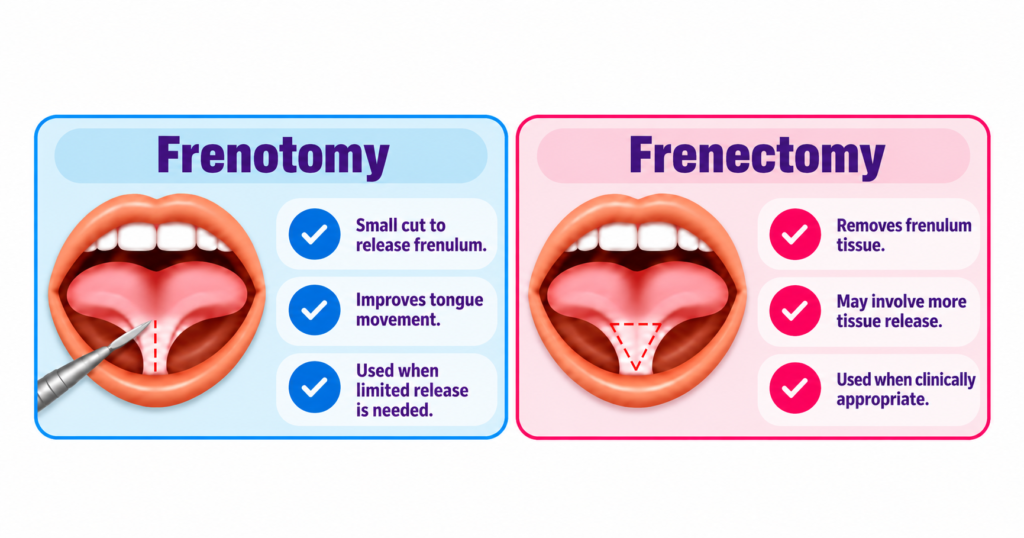
The main difference is how much tissue the dentist treats. A frenotomy cuts or releases the frenulum, while a frenectomy removes the frenulum or more of the tissue. However, healthcare providers may use these terms differently, so parents may hear them used in different ways.
At Palm Valley Pediatric Dentistry & Orthodontics, our pediatric dental team evaluates each child individually before recommending a tongue-tie or lip-tie release.
Quick Answer: What Is the Difference Between Frenotomy and Frenectomy?
A frenotomy is a procedure that makes a cut or release in a restrictive frenulum to improve movement.
A frenectomy generally involves removing the frenulum or a more extensive portion of the tissue.
Frenotomy, also called frenulotomy, is a simple cutting or incision of the frenulum. A frenectomy or frenulectomy is defined as complete removal of the frenum or frenulum, including its attachment to underlying bone.
However, terminology can vary between providers. Some healthcare sources use “frenotomy” and “frenectomy” interchangeably, particularly when discussing tongue-tie release in infants.
For this reason, parents should ask the dentist or healthcare provider exactly what procedure is being recommended and what tissue will be released or removed.
Is Your Child’s Smile on the Right Track?
Early dental visits aren’t just about cleaning teeth, they’re about catching problems before they become costly and painful. Our pediatric specialists create personalized care plans that grow with your child, from their very first tooth through their teen years.
Gentle, kid-friendly care in a welcoming environment.
What Is a Frenulum?
A frenulum is a small fold of tissue inside the mouth that helps connect and stabilize structures such as the lips, cheeks, and tongue.
Children have several oral frenula. The most commonly discussed include:
The lingual frenulum, located underneath the tongue
The maxillary labial frenulum, located between the upper lip and gum
The mandibular labial frenulum, located between the lower lip and gum
Buccal frenula, which connect the cheeks to the gums or oral tissues
A restrictive lingual frenulum can limit tongue movement and is commonly associated with a condition called ankyloglossia, or tongue-tie. A restrictive labial frenulum may be described as a lip-tie.
Not every prominent or tight-looking frenulum requires treatment. The appearance of the tissue is only one part of the evaluation. A pediatric dentist considers how the frenulum affects function, symptoms, development, and the child’s individual circumstances.
Frenotomy vs Frenectomy: What’s the Difference?
Feature
Frenotomy
Frenectomy
Basic meaning
Incision or release of the frenulum
Removal of the frenulum or a larger portion of it
Amount of tissue treated
Usually less extensive
Generally more extensive
Common discussion
Tongue-tie or restrictive frenulum release
Tongue-tie, lip-tie, or other restrictive frenulum concerns
Purpose
Release restriction and improve movement or function
Remove restrictive tissue when indicated
Is it appropriate for every child?
No
No
Who decides?
A qualified healthcare professional after evaluation
A qualified healthcare professional after evaluation
The exact technique depends on the location of the frenulum, the degree of restriction, the child’s age, symptoms, and the reason treatment is being considered.
What Is a Frenotomy?
A frenotomy is a simple procedure that cuts or releases the frenulum.
For example, a child with a tight lingual frenulum may have trouble moving their tongue. If the tight frenulum affects normal mouth function, a healthcare provider may recommend releasing the tissue.
In some infants, a frenotomy may help when tongue-tie is linked to breastfeeding problems. However, not every baby with tongue-tie needs surgery. Breastfeeding problems can have many causes, so the healthcare provider should look at the child’s overall situation before recommending treatment.
A frenotomy releases the tight tissue rather than completely removing the frenulum.
What Is a Frenectomy?
A frenectomy is a procedure in which the frenulum is removed, typically including its attachment as defined by the AAPD.
Frenectomy may be considered when a restrictive frenulum is contributing to a functional or oral health concern and surgical treatment is appropriate.
Depending on the location, a frenectomy may involve the lingual frenulum under the tongue or a labial frenulum between the lip and gum.
The timing, indications, and type of surgical treatment for frenulum restrictions should be considered individually because evidence and clinical recommendations are not completely uniform.
Is Frenotomy the Same as Frenectomy?
Not always. From a technical standpoint, the terms can describe different procedures. A frenotomy involves cutting or releasing the frenulum, while a frenectomy involves removing it.
However, medical terminology is not always consistent. Some providers use “frenotomy” and “frenectomy” interchangeably, particularly when talking about infant tongue-tie procedures.
This can be confusing for parents.
Instead of focusing only on the name of the procedure, ask:
Which frenulum is being treated?
What problem is the procedure intended to address?
How much tissue will be released or removed?
Why is surgery recommended for my child?
Are there non-surgical options?
What should we expect during recovery?
These questions can help you understand exactly what your child’s dentist is recommending.
Why Might a Child Need a Frenulum Release?
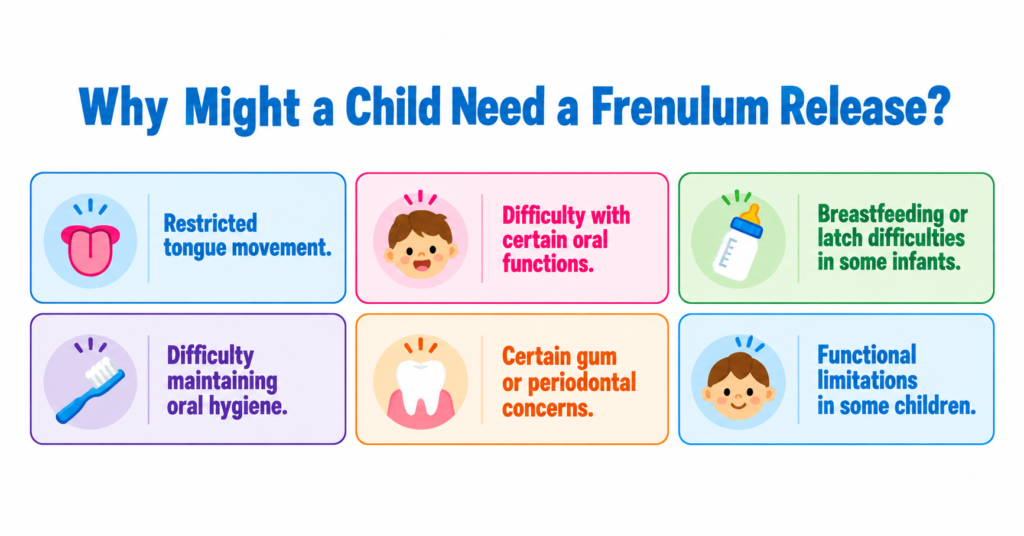
A restrictive frenulum may affect oral function in some children. Depending on the location and the child’s individual circumstances, concerns may include:
Restricted tongue movement
Difficulty with certain oral functions
Breastfeeding or latch difficulties in some infants
Difficulty maintaining adequate oral hygiene around a restrictive attachment
Certain gum or periodontal concerns
Functional limitations associated with a restrictive frenulum
However, a frenulum that looks prominent or tight does not automatically mean that surgery is necessary.
The AAPD emphasizes that the relationship between frenulum anatomy and problems such as breastfeeding difficulties, speech articulation, caries, periodontal disease, and oral development is complex. It also recognizes that further research is needed regarding the indications and long-term effects of frenulum procedures.
Frenotomy vs Frenectomy for Tongue-Tie
Tongue-tie, or ankyloglossia, occurs when the lingual frenulum restricts movement of the tongue.
A child with tongue-tie may have a lingual frenulum that is short, thick, or otherwise restrictive. The degree of restriction and its effect on function can vary significantly from one child to another.
When tongue-tie is being evaluated, the dentist or healthcare provider may look at:
Tongue movement
The appearance and attachment of the frenulum
Feeding or functional concerns
The child’s age and stage of development
Other possible causes of the symptoms
Whether non-surgical approaches have been tried
Whether releasing the frenulum is likely to improve the specific problem
Surgery should not be recommended simply because a frenulum looks different from average.
The AAPD supports a team-based approach when appropriate, particularly because breastfeeding and other functional concerns can have multiple possible causes.
Frenotomy vs Frenectomy for Lip-Tie
A labial frenulum connects the inside of the lip to the gum and surrounding oral tissues.
Parents may notice a prominent upper lip frenulum and wonder whether their baby or child has a lip-tie problem that needs treatment.
A visible or prominent maxillary frenulum is common in children and does not automatically require a frenectomy.
A pediatric dentist evaluates whether the attachment is causing a meaningful functional or oral health concern before considering treatment.
For older children, the dentist may also consider the child’s dental development, gum health, oral hygiene, tooth spacing, and orthodontic needs when deciding whether treatment is appropriate.
Does Every Child With Tongue-Tie Need a Frenotomy or Frenectomy?
No.
Not every child with ankyloglossia needs surgical treatment. Cleveland Clinic also notes that some babies may not need a frenotomy if breastfeeding adjustments resolve the problem.
Some children have a restrictive-looking frenulum but normal function and no significant symptoms. In these situations, observation may be appropriate.
Other children may have functional difficulties that require a broader evaluation before deciding whether surgery could help.
The AAPD specifically states that not all infants with ankyloglossia require surgical intervention and recommends considering other possible causes of breastfeeding difficulties.
The decision should therefore be based on the child’s individual needs rather than the appearance of the frenulum alone.
What Happens During a Frenulum Release?
The exact procedure depends on the type of frenulum being treated, the child’s age, the treatment technique, and the provider’s clinical approach.
In general, the process may include:
The pediatric dentist examines the frenulum and evaluates its effect on function.
The dentist discusses the reason for treatment with the parent.
Appropriate anesthesia or comfort measures are selected based on the child’s age and procedure.
The restrictive tissue is released or removed using the planned technique.
Bleeding is controlled.
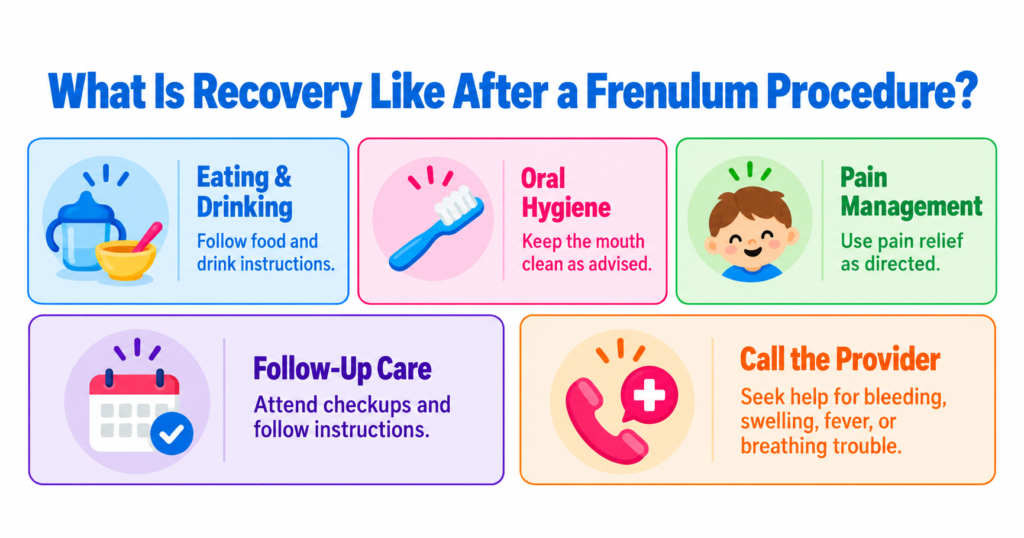
The dental team provides instructions for caring for the area during healing.
Follow-up is arranged when appropriate.
AAPD guidance notes that frenulum procedures involve surgical incision, control of bleeding, and wound management.
Can Frenotomy or Frenectomy Be Done With a Laser?
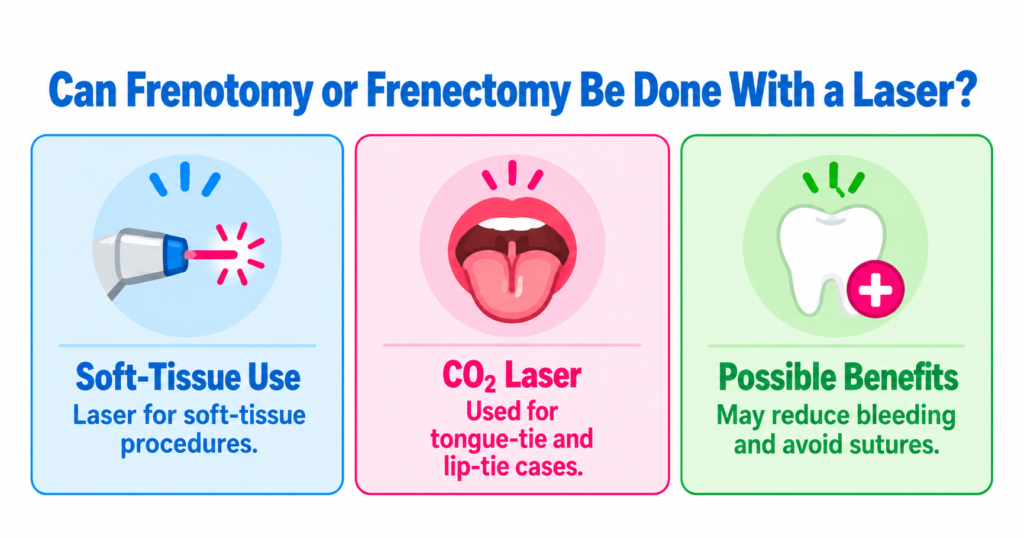
Laser technology can be used for certain soft-tissue dental procedures, including frenulum releases.
Palm Valley Pediatric Dentistry & Orthodontics uses CO₂ laser technology for certain tongue-tie and lip-tie procedures. The practice reports that laser treatment can help reduce bleeding and may eliminate the need for sutures in appropriate cases.
The choice of technique should depend on the child’s clinical needs and the provider’s training and experience.
A laser is a tool used to perform the procedure. It does not by itself determine whether a frenotomy or frenectomy is necessary.
Does Frenotomy or Frenectomy Hurt?
The procedure is performed with appropriate pain-control and comfort measures.
Children may experience some soreness or discomfort as the area heals, depending on the procedure and individual circumstances.
Your pediatric dental team will explain what to expect and provide aftercare instructions appropriate for your child’s procedure.
Parents should follow the specific instructions provided by their child’s dentist rather than relying on general recovery advice found online.
What Is Recovery Like After a Frenulum Procedure?
Recovery varies depending on the procedure, the location of the frenulum, the child’s age, and the technique used.
After a frenulum release, your child’s dental team may provide instructions about:
Eating and drinking
Oral hygiene
Pain management
Caring for the surgical area
Follow-up visits
Any exercises or functional therapy that are recommended
The AAPD’s oral surgery guidance includes soft foods, regular oral hygiene, and appropriate pain management among postoperative considerations for frenulum procedures.
If your child develops unusual bleeding, increasing swelling, fever, worsening pain, difficulty breathing, or another concerning symptom after a procedure, contact the treating healthcare provider promptly.
Help Your Child Get the Right Care for Tongue-Tie or Lip-Tie
Frenotomy and frenectomy are terms parents often hear when a child has a restrictive oral frenulum. Although they can describe different procedures, the terminology is not always used consistently.
What matters most is understanding why treatment is being recommended and how it may help your child.
At Palm Valley Pediatric Dentistry & Orthodontics, our pediatric dental team can evaluate your child’s tongue or lip frenulum and explain whether treatment may be appropriate.
PVPD doesn’t just treat teeth; we build lasting relationships with families. More confident kids. More comfortable appointments. More reasons to smile. Our patients leave happier and healthier, visit after visit.
Serving families across Scottsdale, because every child deserves a great smile.
People Also Ask
Is a frenotomy or frenectomy better for tongue-tie?
Neither procedure is automatically better for every child. The appropriate approach depends on the child’s anatomy, symptoms, function, age, and treatment needs.
Is frenotomy the same as tongue-tie release?
Frenotomy can be used to describe a tongue-tie release in which the restrictive lingual frenulum is cut or released. However, terminology varies between healthcare providers.
Does every baby with tongue-tie need a frenotomy?
No. Not every baby with ankyloglossia requires surgery. Feeding difficulties can have several causes, and an evaluation may be needed before deciding whether a frenotomy is appropriate.
Can a frenectomy treat a lip-tie?
A frenectomy may be considered for a restrictive labial frenulum when there is a clinical reason for treatment. A prominent lip frenulum alone does not necessarily mean that surgery is needed.
Does a frenulum grow back after frenotomy?
Healing and tissue appearance can vary depending on the procedure, location, and individual child. Follow the treating dentist’s instructions for postoperative care and follow-up.
Does a frenectomy hurt?
The procedure is performed using appropriate pain-control and comfort measures. Some children may experience soreness during healing, but the dental team will provide instructions for managing discomfort.
Dr. Olga brings years of specialized pediatric dental expertise and a genuine passion for children’s oral health to the PVPD team. She specializes in creating anxiety-free dental experiences and early-intervention care strategies that set children up for a lifetime of healthy smiles.
]]>Dental Emergencies in Children: Parents Should Know
https://pvpd.com/dental-emergencies/
Wed, 16 Sep 2026 20:39:44 +0000https://pvpd.com/?p=10656Dental emergencies can happen at any time. A fall, sports injury, toothache, or broken tooth can scare your child. Knowing what to do can help you stay calm. It can also protect your child’s teeth and prevent further problems. At Palm Valley Pediatric Dentistry & Orthodontics, our Pediatric Dentists provide emergency dental care for children...
Thanks for reading! I hope you enjoyed learning more about children’s dental health, early orthodontic care, and how to give your little one a healthy smile for life. Author: Dr. Olga | Owner and Pediatric Dental Specialist at PVPD
Dental emergencies can happen at any time. A fall, sports injury, toothache, or broken tooth can scare your child.
Knowing what to do can help you stay calm. It can also protect your child’s teeth and prevent further problems.
At Palm Valley Pediatric Dentistry & Orthodontics, our Pediatric Dentists provide emergency dental care for children and we offer same-day emergency appointments for kids.
If your child has severe tooth pain, swelling, bleeding, or a damaged tooth, book an appointment with our pediatric dental team. We will check your child’s mouth, find the problem, and recommend the right care.
What Is a Dental Emergency?
A dental emergency needs prompt care from a dentist. Some emergencies cause severe pain, while others may cause little pain at first.
Children can face dental emergencies during sports, play, bike rides, or everyday activities. Tooth decay can also cause sudden pain or infection.
Common dental emergencies include knocked-out teeth, broken teeth, severe toothaches, and dental infections. Gum injuries and damaged dental work can also need quick care.
If you notice sudden pain, swelling, bleeding, or tooth damage, contact your child’s dentist. Quick care can help protect your child’s smile.
Is Your Child’s Smile on the Right Track?
Early dental visits aren’t just about cleaning teeth, they’re about catching problems before they become costly and painful. Our pediatric specialists create personalized care plans that grow with your child, from their very first tooth through their teen years.
A dental emergency can feel stressful for both parents and children. Your child may feel scared, upset, or confused.
Start by keeping your child calm. Then check the mouth and look for the source of the problem.
If you see bleeding, use clean gauze or a clean cloth. If you see swelling, place a cold compress outside the mouth.
Save broken tooth pieces if you find them. Keep a knocked-out permanent tooth moist until your child sees a dentist.
Then contact your pediatric dentist and explain what happened. Tell the dentist when the injury happened and what symptoms your child has.
Your dentist can then guide you on the next step.
When Should You Go to the Emergency Room?
Some dental problems need care from a medical team. You should not wait for a dental appointment in these situations.
Go to the nearest emergency room if your child has trouble breathing or swallowing. You should also seek urgent medical care for fast-growing facial swelling.
Heavy bleeding also needs immediate medical attention. A serious head injury may need emergency care as well.
A pediatric dentist can treat many dental emergencies. However, some injuries need medical care first.
When you feel unsure, choose safety and seek urgent medical help.
What Should You Avoid During a Dental Emergency?
Parents often try home remedies when their child has tooth pain or a dental injury. Some remedies can make the problem worse or delay proper treatment.
1- Aspirin and Your Child’s Gums
Do not place aspirin directly on your child’s gums. Aspirin can irritate the soft tissue and cause painful burns. Instead, contact your child’s dentist for advice about managing the pain.
2- Removing Objects from Between Teeth
Food can sometimes get stuck between your child’s teeth. Do not use sharp objects to remove it. Sharp tools can cut the gums or damage the teeth. Ask your dentist for a safe way to remove anything that remains stuck.
3- A Knocked-Out Baby Tooth
Do not put a knocked-out baby tooth back into the socket. Replacing it can damage the permanent tooth developing underneath.
4- Caring for a Knocked-Out Permanent Tooth
A knocked-out permanent tooth needs quick attention. Do not scrub the root or remove any tissue attached to it. Handle the tooth by the crown and keep it moist while you contact your child’s dentist.
5- Treating a Dental Abscess at Home
A dental abscess usually needs professional dental care. Do not pop or squeeze the abscess at home. This can cause more pain and may spread the infection.
6- Ignoring Severe Dental Symptoms
Some dental problems can become worse without treatment. Do not ignore severe pain, swelling, bleeding, or signs of infection.
Contact your child’s dentist as soon as possible. Quick care can help protect your child’s teeth and overall oral health.
How Can You Prevent Dental Emergencies?
You cannot prevent every dental emergency. However, simple habits can lower your child’s risk.
Encourage your child to wear a mouthguard during contact sports. A properly fitted mouthguard can help protect the teeth during sports.
Teach your child not to chew ice or very hard objects. These habits can damage teeth and dental work.
Regular dental visits can also help catch problems early. Your dentist can find cavities and other concerns before they cause sudden pain. NIDCR reports that about 52% of children ages 6 to 8 had dental caries in their baby teeth. About 17% had untreated decay.
Good brushing and flossing also protect your child’s teeth. Help younger children brush properly until they can manage the routine alone.
Why Choose a Pediatric Dentist for Dental Emergencies?
Children need more than quick treatment during a dental emergency. They also need a team that understands how children feel.
A pediatric dentist knows how to make dental care easier for young patients. A calm and friendly approach can help your child feel safer during treatment.
PVPD provides pediatric emergency dental care for children. The team treats problems such as tooth injuries, severe tooth pain, and dental infections.
PVPD also provides treatments for damaged and infected teeth. These treatments include pulp therapy, fillings, crowns, and extractions when needed.
The goal is simple. Your child should receive the right care while feeling comfortable and supported.
What Happens During a Pediatric Dental Emergency Visit?
Your child’s visit will depend on the type of emergency. First, the dentist will examine your child’s teeth, gums, and mouth.
The dentist may take digital X-rays if needed. These images can help the dentist find damage that does not show during a regular exam.
Next, the dentist will explain the problem and treatment options. The team will also answer your questions before treatment begins.
Some children may need simple care and follow-up visits. Other children may need treatment to repair or remove a damaged tooth.
PVPD offers several treatments for children with damaged or infected teeth. The right option depends on your child’s age, tooth, and dental needs.
How Can Parents Help After a Dental Emergency?
Your child may need extra care after emergency treatment. Follow all instructions from your child’s dentist.
Your child may need soft foods for a short time. The dentist may also recommend changes to brushing or eating.
Watch for new swelling, bleeding, fever, or worsening pain. Contact your dentist if your child’s symptoms become worse.
Keep all follow-up appointments as well. These visits help your dentist check healing and protect your child’s oral health.
Your support can also help your child feel less afraid after an emergency. Stay positive and remind your child that dental care helps protect their smile.
Dental Emergencies Can Feel Scary, But You Are Not Alone!
Dental emergencies can happen at home, school, or during play. A quick and calm response can make a stressful moment easier.
Start by checking your child and keeping them calm. Then contact your pediatric dentist for guidance.
Do not ignore severe pain, swelling, bleeding, or damaged teeth. Quick dental care can protect your child’s smile and prevent more serious problems.
At Palm Valley Pediatric Dentistry & Orthodontics, we provide emergency dental care for children. Our team offers same-day emergency appointments and child-focused care. We have offices in Scottsdale, Buckeye, Surprise, Goodyear, Chandler, and East Mesa.
Get Help for Your Child’s Dental Emergency!
A dental emergency can feel frightening when it happens to your child. You do not have to handle it alone.
If your child has severe tooth pain, swelling, or a dental injury, contact PVPD. Our pediatric dental team can examine your child and recommend the right care.
We are here to help your child feel comfortable and protect their healthy smile.
Give Your Child the Gift of a Healthy Smile
PVPD doesn’t just treat teeth; we build lasting relationships with families. More confident kids. More comfortable appointments. More reasons to smile. Our patients leave happier and healthier, visit after visit.
Serving families across Scottsdale, because every child deserves a great smile.
People Also Ask
How quickly should I get help for a dental emergency?
Contact your child’s dentist as soon as possible after a dental emergency. Quick care can reduce pain and help prevent further damage.
Can a dental emergency happen without pain?
Yes, some dental injuries may not cause pain right away. Your child should still see a dentist after a serious mouth injury.
What should I bring to my child’s emergency dental visit?
Bring any broken tooth pieces or dental items related to the injury. Tell the dentist when the injury happened and what symptoms your child noticed.
Can a dentist save a damaged tooth?
A dentist may save a damaged tooth with the right treatment. The treatment will depend on the type and amount of damage.
How can I keep my child calm during a dental emergency?
Stay calm and speak to your child in a gentle voice. Explain that the dentist will check the problem and help them feel better.
Does my child need emergency care for a loose tooth?
A loose baby tooth may not need emergency care when it naturally falls out. A loose permanent tooth after an injury needs a dental check.
Can tooth decay cause a dental emergency?
Yes, untreated tooth decay can cause severe pain or infection. Regular dental visits can help find decay before it becomes an emergency.
What should I do if my child’s dental emergency happens after hours?
Call your child’s dental office and follow their emergency instructions. Seek urgent medical care for severe swelling, heavy bleeding, or breathing problems.
Dr. Olga brings years of specialized pediatric dental expertise and a genuine passion for children’s oral health to the PVPD team. She specializes in creating anxiety-free dental experiences and early-intervention care strategies that set children up for a lifetime of healthy smiles.
]]>Dental Resource Center: Helpful Dental Information for Parents
https://pvpd.com/dental-resource-center/
Wed, 09 Sep 2026 07:44:14 +0000https://pvpd.com/?p=10711A dental resource center gives parents one place to find helpful information about their child’s dental health. It can help you learn how to care for your child’s teeth, understand dental problems, explore treatments, and know when your child needs to see a dentist. Your child’s dental health changes as they grow. From their first...
Thanks for reading! I hope you enjoyed learning more about children’s dental health, early orthodontic care, and how to give your little one a healthy smile for life. Author: Dr. Olga | Owner and Pediatric Dental Specialist at PVPD
A dental resource center gives parents one place to find helpful information about their child’s dental health. It can help you learn how to care for your child’s teeth, understand dental problems, explore treatments, and know when your child needs to see a dentist.
Your child’s dental health changes as they grow. From their first baby tooth to their teenage years, children can face cavities, toothaches, dental injuries, and other dental problems.
As a parent, you may have questions about brushing, dental visits, treatments, orthodontics, or what to do when something goes wrong.
At Palm Valley Pediatric Dentistry & Orthodontics, we act as a 360 Dental Resource Center for children and their parents.
Our pediatric dental team provides care for infants, children, and teens. We offer preventive, restorative, emergency, and orthodontic care to support healthy smiles as your child grows.
What Is a Dental Resource Center?
A dental resource center is a place where parents can find information about different parts of their child’s dental health. You can use a dental resource center to learn about:
Children’s dental health
Common dental problems
Dental emergencies
Pediatric dental treatments
Preventive dental care
Dental care by age
Orthodontic care
When to see a pediatric dentist
Instead of searching for answers in different places, parents can use these resources to learn about their child’s teeth and understand what steps they may need to take.
A pediatric dentist can also provide care when your child needs more than information. Your dentist can examine your child’s teeth, answer your questions, and recommend treatment when needed.
Is Your Child’s Smile on the Right Track?
Early dental visits aren’t just about cleaning teeth, they’re about catching problems before they become costly and painful. Our pediatric specialists create personalized care plans that grow with your child, from their very first tooth through their teen years.
Gentle, kid-friendly care in a welcoming environment.
Children’s Dental Health
Good dental health starts early. Your child’s teeth help them eat, speak, and smile. Healthy baby teeth also help guide permanent teeth into the right positions.
Parents can help protect their child’s teeth with simple daily habits and regular dental care.
Baby Teeth
Baby teeth begin to appear during infancy. These teeth help your child chew food and learn to speak clearly.
Baby teeth also hold space for permanent teeth. This makes it important to care for them even though they will eventually fall out.
Start brushing your child’s teeth as soon as the first tooth appears. Your child’s dentist can also help you understand how to care for their teeth as they grow.
Permanent Teeth
Permanent teeth replace baby teeth as your child gets older. These teeth should last for many years, so your child needs to develop good dental habits early.
Your dentist can watch how your child’s permanent teeth develop and look for problems that may need treatment.
Brushing and Flossing
Help your child brush their teeth twice a day. Use fluoride toothpaste and teach your child to brush all surfaces of their teeth.
Flossing helps clean the areas between teeth where a toothbrush cannot reach.
Younger children may need help brushing and flossing until they can manage these habits on their own.
Fluoride
Fluoride helps strengthen tooth enamel and protect teeth from cavities. Your child’s dentist may recommend fluoride toothpaste or a professional fluoride treatment based on your child’s dental needs.
PVPD offers fluoride treatments as part of preventive dental care for children.
Regular Dental Visits
Regular dental visits help your child’s dentist find problems early. These visits can include an exam, cleaning, digital X-rays when needed, and preventive care.
The foods and drinks your child has can affect their teeth. Frequent sugary snacks and drinks can increase the risk of tooth decay.
Encourage your child to drink water and choose healthy foods. Try to limit sugary drinks, candy, and snacks between meals.
Dental Development
Your child’s mouth changes throughout childhood. Your dentist can monitor tooth growth, jaw development, and the way the teeth come together.
Regular visits give your dental team a chance to spot concerns before they become bigger problems.
9 Common Dental Problems in Children
Children can develop several types of dental problems. Some problems start slowly, while others can appear suddenly.
Knowing the common signs can help you decide when your child needs dental care.
1- Cavities and Tooth Decay
Cavities develop when bacteria and acids damage the tooth. Your child may have no symptoms at first.
As a cavity gets larger, your child may develop tooth sensitivity, pain, or difficulty chewing.
A dentist can check your child’s teeth and recommend treatment based on the size and location of the cavity.
2- Toothaches
A toothache can have several causes. Tooth decay, an infection, an injury, or another dental problem can cause pain.
If your child complains about ongoing tooth pain, contact their dentist. Do not ignore pain just because it becomes better for a short time.
3- Tooth Discoloration
A child’s tooth can change color for different reasons. An injury, tooth decay, or changes inside the tooth can cause discoloration.
If you notice a sudden or unusual change in your child’s tooth color, schedule a dental checkup. Your dentist can examine the tooth and find the cause.
4- Chipped or Broken Teeth
Children can chip or break teeth during sports, falls, or everyday activities.
Rinse your child’s mouth with water and look for any broken pieces. Save the pieces if you find them and contact your child’s dentist.
A small chip may need little treatment, while a larger break may affect the inner part of the tooth.
5- Loose Teeth
Loose baby teeth often mean that a permanent tooth is ready to come in. This is a normal part of growing up.
However, a permanent tooth that becomes loose after an injury needs a dental check.
Your child’s dentist can determine whether the tooth needs treatment.
6- Dental Abscesses
A dental abscess is an infection that can cause pain and swelling. You may notice a bump on your child’s gums or swelling around the tooth.
Your child may also have a fever, bad breath, or trouble chewing.
Contact your child’s dentist if you notice signs of an abscess. Fast treatment can help prevent the infection from getting worse.
7- Gum Problems
Red, swollen, tender, or bleeding gums can signal a dental problem. Poor brushing, plaque buildup, or infection can affect the gums.
Talk to your child’s dentist if gum problems continue or become worse.
8- Tooth Sensitivity
Some children feel pain when they eat or drink something hot, cold, sweet, or acidic.
Tooth sensitivity can have several causes, including cavities or damage to the tooth. Your child’s dentist can check the tooth and find the cause.
9- Bad Breath
Bad breath can happen when food, plaque, or bacteria build up in the mouth.
Good brushing, flossing, and regular dental visits can help. If your child’s bad breath continues even with good oral hygiene, contact their dentist.
Dental Emergencies
Dental emergencies can happen during sports, play, falls, or everyday activities. Quick action can help protect your child’s teeth. Common dental emergencies are knocked-out teeth, chipped or broken teeth, severe toothaches, dental abscesses, etc.
A knocked-out permanent tooth needs quick dental care. Hold the tooth by the crown and avoid touching the root. If possible, gently place it back into the socket. If you cannot do this, keep the tooth moist and contact your child’s dentist right away.
Do not put a knocked-out baby tooth back into the socket. This can damage the developing permanent tooth.
Seek urgent medical care if your child has trouble breathing or swallowing, heavy bleeding, fast-growing facial swelling, or a serious head or facial injury.
PVPD provides emergency dental care for children who experience dental injuries, severe tooth pain, infections, and other urgent dental problems.
Pediatric Dental Treatments
If your child has a dental problem, your dentist will first examine their teeth and mouth. The recommended treatment will depend on your child’s age, tooth, and dental needs.
Dental Fillings
Dentists use fillings to repair teeth damaged by cavities. PVPD uses tooth-colored fillings for children, which can blend with the natural color of the teeth.
Dental Crowns
A dental crown covers and protects a tooth that has more extensive damage. Children may need a crown when a tooth has too much decay or damage for a filling.
Dental Bonding
Dental bonding can repair some small chips, cracks, or changes in the shape of a tooth. Your dentist can tell you if bonding is right for your child’s tooth.
Pulp Therapy
A deep cavity or infection can reach the inner part of a tooth. Pulp therapy can treat the affected area and help save the tooth.
PVPD provides pulpotomy and pulpectomy treatments for children with infected or damaged baby teeth.
Tooth Extraction
Sometimes a dentist needs to remove a tooth that cannot be saved. A dentist may also recommend an extraction when a tooth creates another dental problem.
Your pediatric dentist will explain why your child needs the extraction and what to expect during the procedure.
Dental Sealants
Dental sealants protect the chewing surfaces of back teeth. These areas can be difficult for children to clean well.
A sealant creates a protective layer over the tooth and can help lower the risk of cavities. PVPD offers dental sealants as part of preventive care.
Fluoride Treatment
Professional fluoride treatments can strengthen tooth enamel and help protect against cavities.
Your child’s dentist can recommend fluoride treatment based on your child’s oral health and risk of tooth decay.
Space Maintainers
A child who loses a baby tooth too early may need a space maintainer. This appliance helps keep the space open for the permanent tooth.
Space maintainers can help prevent nearby teeth from moving into the open space.
Braces
Braces can help correct crooked teeth, crowded teeth, gaps, and bite problems.
PVPD provides orthodontic care for children and teens, including braces and Invisalign clear aligners.
Emergency Dental Care
Dental emergencies need quick attention. Your child’s dentist can examine the injury, relieve pain, and recommend treatment to protect the affected tooth.
Preventive Dental Care for Children
You cannot prevent every dental problem. However, simple habits can help protect your child’s teeth.
Help your child brush twice a day.
Use fluoride toothpaste.
Floss between your child’s teeth.
Schedule regular dental checkups.
Ask your dentist about dental sealants.
Give your child a mouthguard for contact sports.
Limit sugary foods and drinks.
Encourage your child to drink water.
Do not let your child chew ice or very hard objects.
Help younger children develop good brushing habits.
Regular dental visits also help your dentist find cavities and other concerns before they cause pain.
Dental Care by Age
Your child’s dental needs change as they grow. What works for a toddler may not work for a teenager.
Babies and Toddlers
Dental care starts with the first tooth.
Brush your baby’s teeth with a small, soft toothbrush and fluoride toothpaste. Avoid putting your baby to bed with a bottle filled with milk or juice.
Your child should have their first dental visit by their first birthday or when their first tooth appears. Early visits help parents learn how to care for developing teeth and give children a chance to become comfortable with the dental office.
Preschool and School-Age Children
Children in this age group become more independent with brushing, but many still need help.
Continue checking your child’s brushing routine and make sure they clean all areas of their mouth.
School-age children may also need dental sealants, fluoride treatments, fillings, or other preventive and restorative care.
This is also a good time to watch for changes in tooth development and bite.
Tweens and Teens
Tweens and teens may have more independence with their dental habits. They may also face new concerns, including cavities, gum problems, sports injuries, and orthodontic issues.
Encourage your teen to keep brushing and flossing every day. If they play contact sports, make sure they use a properly fitted mouthguard.
Regular dental visits remain important during the teenage years.
When Should My Child See a Pediatric Dentist?
Your child should see a pediatric dentist for regular checkups, even when they have no obvious dental problems.
Contact your child’s dentist if you notice tooth pain, swelling, bleeding, tooth damage, discoloration, or a dental injury.
You should also seek dental care if your child has difficulty chewing, changes in tooth development, concerns about tooth alignment, or persistent bad breath.
Regular dental visits give your dentist a chance to find problems early. Your dentist can also track your child’s dental development and help you build healthy habits at home.
PVPD provides pediatric dental care from infancy through the teen years, including preventive care, restorative treatments, emergency care, and orthodontics.
Give Your Child the Gift of a Healthy Smile
PVPD doesn’t just treat teeth; we build lasting relationships with families. More confident kids. More comfortable appointments. More reasons to smile. Our patients leave happier and healthier, visit after visit.
Serving families across Scottsdale, because every child deserves a great smile.
Your Child’s Dental Resource, All in One Place!
Your child’s dental needs change as they grow. You may need information about baby teeth today, help with a cavity tomorrow, and orthodontic guidance as your child gets older.
You do not have to figure out every dental concern on your own. A pediatric dentist can answer your questions, check your child’s teeth, and help you understand the care your child needs.
At Palm Valley Pediatric Dentistry & Orthodontics, we bring pediatric dental and orthodontic care together in one place. From preventive care and common dental problems to emergency treatment and orthodontic care, our team supports children through every stage of growth.
If you have a question or concern about your child’s dental health, explore our dental resources or contact PVPD to schedule an appointment. We are here to help you understand your child’s dental needs and protect their healthy smile.
Dr. Olga brings years of specialized pediatric dental expertise and a genuine passion for children’s oral health to the PVPD team. She specializes in creating anxiety-free dental experiences and early-intervention care strategies that set children up for a lifetime of healthy smiles.
]]>Cosmetic Dentistry & Smile Aesthetics: Benefits & Treatment
https://pvpd.com/cosmetic-dentistry-smile-aesthetics/
Tue, 01 Sep 2026 07:21:24 +0000https://pvpd.com/?p=10707Every parent wants their child to have a healthy smile. Sometimes, children also have concerns about how their teeth look. A chipped tooth, tooth discoloration, uneven teeth, or gaps can affect a child’s confidence and make them feel uncomfortable when they smile. Cosmetic dentistry can address some of these concerns. However, children have developing teeth...
Thanks for reading! I hope you enjoyed learning more about children’s dental health, early orthodontic care, and how to give your little one a healthy smile for life. Author: Dr. Olga | Owner and Pediatric Dental Specialist at PVPD
Every parent wants their child to have a healthy smile. Sometimes, children also have concerns about how their teeth look. A chipped tooth, tooth discoloration, uneven teeth, or gaps can affect a child’s confidence and make them feel uncomfortable when they smile.
Cosmetic dentistry can address some of these concerns. However, children have developing teeth and jaws, so cosmetic treatment requires careful planning.
Palm Valley Pediatric Dentistry & Orthodontics team considers your child’s age, dental development, oral health, and needs before recommending treatment.
We can examine your child’s teeth and help you understand which treatment options may be appropriate.
What Is Cosmetic Dentistry for Children?
Cosmetic dentistry helps improve the appearance of your child’s teeth and smile. For children, treatment may repair damaged teeth, improve tooth appearance, or fix concerns that can also affect their oral health.
A pediatric dentist will not recommend cosmetic treatment just to change healthy teeth. First, the dentist will check your child’s teeth, gums, bite, and overall oral health.
Some children may need treatment after a dental injury. Others may have tooth discoloration, an unusual tooth shape, or damaged enamel. Orthodontic treatment can also improve the appearance and function of a child’s smile in some cases.
The right treatment depends on your child’s age, dental development, and the cause of the concern.
Is Your Child’s Smile on the Right Track?
Early dental visits aren’t just about cleaning teeth, they’re about catching problems before they become costly and painful. Our pediatric specialists create personalized care plans that grow with your child, from their very first tooth through their teen years.
Gentle, kid-friendly care in a welcoming environment.
Why Might a Child Need Cosmetic Dental Treatment?
Children can have different concerns that change the way their smiles look. Some concerns develop as their teeth grow, while others can happen because of an injury, tooth decay, or another dental problem.
A child may have chipped or broken teeth, tooth discoloration, misshapen teeth, uneven teeth, or gaps between teeth. Crooked or crowded teeth can also affect their smile when these concerns involve the front teeth.
Sometimes, a smile concern points to a bigger dental issue. For example, a damaged tooth may need restorative treatment to protect the healthy tooth structure and keep the tooth strong.
What Cosmetic Dental Treatments Can Children Get?
Children do not always need the same cosmetic treatments as adults. A pediatric dentist will choose an option that suits the child’s age, developing teeth, and dental needs.
Dental Bonding
Dental bonding can repair small chips, cracks, or changes in tooth shape. The dentist applies tooth-colored material to the affected area and shapes it to improve the tooth’s appearance.
Bonding can work well for certain damaged front teeth. It can also help restore a more natural appearance after a dental injury.
The dentist will first check the tooth to make sure it does not have more serious damage. If the tooth has an injury or decay, your child may need additional treatment.
Tooth-Colored Fillings
Tooth-colored fillings can restore teeth affected by cavities while maintaining a natural appearance. The material matches the appearance of the tooth more closely than traditional metal fillings.
A filling does more than improve appearance. It also restores the tooth after decay damages the tooth structure.
Your child’s dentist will decide which filling material works best based on the location and condition of the tooth.
Dental Crowns
A dental crown can protect a tooth that has significant damage or decay. Pediatric dentists may recommend crowns when a tooth needs more protection than a filling can provide.
Crowns can also restore the appearance and function of a damaged tooth. The dentist will consider the child’s tooth, age, and overall dental health before recommending this treatment.
Orthodontic Treatment
Crooked, crowded, or uneven teeth may need orthodontic treatment rather than a cosmetic procedure. Braces or other orthodontic options can gradually move teeth into better positions.
Orthodontic treatment can improve both the appearance and function of a child’s smile. It can also address certain bite problems.
Your pediatric dentist may recommend an orthodontic evaluation if your child’s teeth or jaw need additional assessment.
Can Children Get Teeth Whitening?
Parents sometimes ask whether their child can have professional teeth whitening. Whitening is different from treating a damaged or discolored tooth.
Children can develop tooth discoloration for several reasons. Food, drinks, poor oral hygiene, dental injuries, certain medications, and changes in the tooth itself can affect tooth color.
Before considering whitening, your child’s dentist should find the reason for the discoloration. A discolored tooth may need dental treatment instead of whitening.
Teeth whitening may not be appropriate for every child when their teeth are still developing. The American Academy of Pediatric Dentistry discourages full-arch cosmetic bleaching for children and adolescents with primary or mixed dentition.
Do not use adult whitening products on your child without first speaking with a dentist.
Are Veneers Safe for Children?
Veneers are thin coverings that dentists place over the front of teeth to change their appearance. They are common in adult cosmetic dentistry, but they are usually not the first choice for children with developing teeth.
Children’s teeth and jaws continue to change as they grow. Because of this, a pediatric dentist needs to consider their long-term dental development before choosing a treatment that permanently changes a tooth.
If your child has a cosmetic concern, talk to a pediatric dentist first. The dentist can check your child’s teeth and explain whether a less invasive treatment can address the problem.
Cosmetic Dentistry vs. Restorative Dentistry
Cosmetic and restorative dentistry can sometimes work together. A treatment can improve your child’s smile while also repairing and protecting a damaged tooth.
For example, dental bonding can repair a chipped tooth and restore its shape. A tooth-colored filling can treat tooth decay while keeping the tooth looking natural. A dental crown can protect a severely damaged tooth and improve its appearance.
Your child’s dental health should always come first. Improving the appearance of the smile can be part of treatment, but the dentist should also protect the tooth and support healthy dental development.
When Should a Child See a Pediatric Dentist About Their Smile?
Talk to your child’s pediatric dentist if you notice a sudden change in the appearance of a tooth. You should also schedule an appointment if your child has a chipped, cracked, discolored, or damaged tooth.
A dental injury can cause damage that you may not notice right away. Your child may not feel pain even when a tooth needs attention.
Regular dental visits also help your dentist monitor your child’s tooth development. These visits can help the dentist spot changes early and recommend treatment when needed.
If your child feels embarrassed about their smile, mention it during the appointment. Your dentist can check the concern and tell you whether your child needs treatment or simply regular monitoring.
How Does a Pediatric Dentist Choose the Right Treatment?
Your child’s dentist will start with a dental examination. The dentist will check the teeth, gums, bite, and surrounding tissues.
The dentist may also take digital X-rays when they need to check areas that are not visible during a regular examination. X-rays can help identify problems below the surface of the tooth.
The dentist will then consider several factors, including:
Your child’s age
Whether the tooth is a baby tooth or a permanent tooth
The condition of the tooth
Your child’s overall oral health
Tooth and jaw development
After the examination, the dentist can explain the available treatment options. Some children may only need monitoring, while others may benefit from restorative, cosmetic, or orthodontic treatment.
How Can Parents Help Protect Their Child’s Smile?
Good daily dental habits can help children maintain healthy teeth and reduce the risk of dental problems. Help your child brush twice a day with fluoride toothpaste and clean between their teeth regularly.
Encourage your child to avoid chewing ice, hard objects, or other items that can damage teeth. Children who participate in contact sports should also wear a properly fitted mouthguard.
Regular dental visits are important as well. Your child’s dentist can check for cavities, monitor tooth development, and identify concerns before they become more serious.
If your child already has a cosmetic concern, avoid trying home remedies before speaking with a dentist. Some products or treatments can irritate the teeth and gums or cause additional damage.
Why Choose a Pediatric Dentist for Cosmetic Dental Care?
Children have different dental needs from adults. Their teeth, jaws, and bite continue to develop, so treatment needs to account for these changes.
A pediatric dentist has training in caring for children’s developing teeth and understands the dental needs of young patients. The dentist can assess whether a cosmetic concern requires treatment and recommend an option that supports your child’s oral health.
At Palm Valley Pediatric Dentistry & Orthodontics, our team provides child-focused dental care for children of different ages. We offer treatments for damaged and decayed teeth and can help parents understand their child’s dental needs.
Our goal is simple. We want your child to have a healthy smile that looks and feels good as they grow.
What Happens During a Cosmetic Dental Appointment?
Your child’s appointment will depend on the reason for the visit. First, the dentist will examine your child’s teeth and ask about the concern.
If your child has a damaged or discolored tooth, the dentist will look for signs of decay, injury, or other dental problems. The dentist may take X-rays when needed.
Next, the dentist will explain the findings and discuss treatment options with you. Some concerns may not require immediate treatment, while others may need repair or further evaluation.
The dental team will also explain what you can expect before treatment begins. This can help you and your child feel more comfortable about the next steps.
Give Your Child a Healthy, Confident Smile
A child’s smile can change as they grow. Some changes are a normal part of dental development, while others may need professional care.
Cosmetic dentistry for children can help address certain concerns, including chipped teeth, discoloration, damaged teeth, and changes in tooth appearance. However, the right treatment depends on your child’s age, dental development, and oral health.
If you have concerns about your child’s smile, talk to a pediatric dentist before choosing a cosmetic treatment. A dental examination can help identify the cause of the problem and determine whether treatment is necessary.
At Palm Valley Pediatric Dentistry & Orthodontics, we provide personalized dental care for children and help families understand their treatment options. Book an online appointment or call (623) 535-7873 to schedule a visit.
Give Your Child the Gift of a Healthy Smile
PVPD doesn’t just treat teeth; we build lasting relationships with families. More confident kids. More comfortable appointments. More reasons to smile. Our patients leave happier and healthier, visit after visit.
Serving families across Scottsdale, because every child deserves a great smile.
People Also Ask
Is cosmetic dentistry safe for children?
Some cosmetic dental treatments can be safe and appropriate for children when a pediatric dentist recommends them. The treatment should match the child’s age, dental development, and oral health.
Can a pediatric dentist fix a chipped tooth?
Yes, a pediatric dentist can repair certain chipped teeth. Treatment may include dental bonding or another restorative option, depending on the amount of damage.
Can children have dental bonding?
Children can receive dental bonding when it is appropriate for their dental needs. A dentist can use bonding to repair certain chips, cracks, or changes in tooth shape.
Should children get their teeth whitened?
Children should not use teeth-whitening products without speaking with a dentist first. The dentist should identify the cause of discoloration before recommending any treatment.
Are veneers appropriate for children?
Veneers are generally not the first choice for children because their teeth and jaws continue to develop. A pediatric dentist can recommend a more suitable option when a child has a cosmetic dental concern.
Can braces improve the appearance of a child’s smile?
Yes, braces can improve tooth alignment and the appearance of a child’s smile. Orthodontic treatment can also address certain bite and spacing concerns.
Does every child with uneven teeth need cosmetic treatment?
No. Some uneven teeth are part of normal dental development and may not need treatment. Your child’s dentist can monitor the teeth and recommend treatment if a dental or orthodontic concern develops.
Dr. Olga brings years of specialized pediatric dental expertise and a genuine passion for children’s oral health to the PVPD team. She specializes in creating anxiety-free dental experiences and early-intervention care strategies that set children up for a lifetime of healthy smiles.
]]>Primary Teeth vs Permanent Teeth: How Are They Different?
https://pvpd.com/primary-teeth-vs-permanent-teeth/
Wed, 26 Aug 2026 14:48:00 +0000https://pvpd.com/?p=10695Your child’s smile changes a lot during the early years. First, those tiny baby teeth begin to appear. Then, they slowly fall out and make room for permanent teeth. Many parents assume that baby teeth do not matter much because they eventually fall out. That is not true. Primary teeth help children chew food, speak...
Thanks for reading! I hope you enjoyed learning more about children’s dental health, early orthodontic care, and how to give your little one a healthy smile for life. Author: Dr. Olga | Owner and Pediatric Dental Specialist at PVPD
Your child’s smile changes a lot during the early years. First, those tiny baby teeth begin to appear. Then, they slowly fall out and make room for permanent teeth.
Many parents assume that baby teeth do not matter much because they eventually fall out. That is not true.
Primary teeth help children chew food, speak clearly, and develop healthy oral habits. They also help maintain space for permanent teeth. Permanent teeth need care too. Your child will use most of these teeth for the rest of their life.
At Palm Valley Pediatric Dentistry & Orthodontics, we help children build healthy dental habits from their earliest years.
Your child’s first dental visit is an important part of this process. We offer a baby’s first dental cleaning to help parents start their child’s oral care early and learn how to protect those first little teeth.
What Are Primary Teeth?
Primary teeth are also called baby teeth, milk teeth, or deciduous teeth. Children usually have 20 primary teeth. They include:
8 incisors
4 canines
8 molars
These teeth usually begin appearing during infancy. Most children have their full set of 20 primary teeth by about age 3.
Your child’s primary teeth do much more than create a cute smile. They help your child bite and chew food. They also support speech development.
Most importantly, primary teeth hold space for the permanent teeth that develop underneath them.
Why Do Baby Teeth Matter If They Fall Out?
This question comes up often.
Parents sometimes think, “If that tooth will fall out anyway, why treat a cavity?”
A cavity can still cause pain and infection in a baby tooth. Untreated decay can also make it harder for children to eat, speak, play, and learn.
Imagine your four-year-old has a large cavity in a baby molar.
The tooth may still need to stay in place for several more years. If decay leads to an infection, your child may experience pain or require more extensive treatment.
That is why dentists do not simply ignore cavities in primary teeth.
We focus on keeping children’s teeth healthy through every stage of development.
Most adults have 32 permanent teeth, including wisdom teeth. These teeth include:
8 incisors
4 canines
8 premolars
12 molars
Unlike primary teeth, most permanent teeth do not have a replacement waiting underneath them. Once your child loses a permanent tooth, they will not naturally grow another one in its place.
That makes permanent teeth especially important to protect.
Permanent teeth also include the first molars that usually appear around age 6. These teeth do not replace baby teeth.
They grow behind the primary molars.
This creates an important moment for parents. Some parents mistake these new molars for baby teeth because they do not replace an existing tooth.
Your child needs to brush these teeth carefully from the day they appear.
Is Your Child’s Smile on the Right Track?
Early dental visits aren’t just about cleaning teeth, they’re about catching problems before they become costly and painful. Our pediatric specialists create personalized care plans that grow with your child, from their very first tooth through their teen years.
Gentle, kid-friendly care in a welcoming environment.
Primary Teeth vs Permanent Teeth: Key Differences
Primary and permanent teeth help your child chew, speak, and maintain a healthy smile. However, they have several important differences.
Knowing these differences can help you understand what happens as your child’s smile changes.
1. Number of Teeth
Children have 20 primary teeth.
These include incisors, canines, and molars.
Most adults have 32 permanent teeth, including premolars and wisdom teeth. However, not everyone develops or keeps all four wisdom teeth.
Your child will gradually replace their 20 primary teeth with a larger set of permanent teeth as they grow.
2. Size and Enamel
Primary teeth usually look smaller and more delicate than permanent teeth.
Their enamel also differs from permanent teeth. Primary enamel has a lower mineral density and can be more susceptible to acid-related demineralization.
This matters when your child develops a cavity.
Tooth decay can progress quickly in young children. That makes early dental care especially important.
For example, a small cavity in a baby molar may seem harmless because the tooth will eventually fall out. However, untreated decay can cause pain and infection.
That is why dentists treat cavities in primary teeth seriously. The American Dental Association provides separate clinical recommendations for treating cavities in primary and permanent teeth.
3. Color
Have you noticed that your child’s new adult teeth look slightly more yellow than their baby teeth?
That can be normal.
Primary teeth often look whiter. Permanent teeth can have a more yellow or cream-colored appearance.
The difference becomes easier to notice when a new permanent tooth appears next to a bright white baby tooth.
Color alone does not mean that your child’s permanent tooth has a problem.
However, tell your child’s dentist if you notice sudden or unusual discoloration. A dental examination can help identify the cause.
4. Lifespan
Primary teeth stay in your child’s mouth for a limited period.
Permanent teeth should serve your child for many decades.
The first baby teeth usually appear during infancy. Children often begin losing them around age 6. Permanent teeth then begin to appear and gradually replace the primary teeth.
For example, your six-year-old may lose a lower front baby tooth and soon see a permanent tooth appear in its place.
The exact timing varies from child to child.
Your child may also have both primary and permanent teeth at the same time. Dentists call this the mixed dentition stage. This stage usually occurs between about ages 6 and 11.
5. Root Structure
Primary teeth have roots, just like permanent teeth.
However, their roots gradually resorb as the permanent teeth develop underneath them.
As the roots become shorter, the baby tooth becomes loose. Eventually, your child loses the tooth and the permanent tooth can move into its place.
Think about a loose baby tooth that your child keeps wiggling with their tongue.
That looseness happens because the tooth’s roots have gradually broken down.
Permanent teeth do not normally go through this natural process of root resorption and replacement. They remain in place instead of making room for another set of teeth.
6. The Types of Teeth Are Different
Primary teeth and permanent teeth do not have exactly the same lineup.
Primary teeth include:
Incisors
Canines
First molars
Second molars
Permanent teeth include all of these basic tooth types, along with premolars and additional molars.
Premolars replace the primary molars as your child’s permanent teeth develop.
Permanent first molars do something different. They usually erupt behind the primary molars rather than replace them. The first permanent molars commonly appear around ages 5 to 7.
This can surprise parents.
Your child may suddenly have a new tooth at the back of their mouth without losing a baby tooth first.
That new tooth is permanent.
How Do Primary Teeth Help Permanent Teeth?
Think of primary teeth as placeholders.
They help maintain the space that permanent teeth need. They also guide permanent teeth into the mouth as your child grows. This explains why early tooth loss can sometimes create dental problems.
For example, imagine a five-year-old loses a baby molar because of severe decay.
The permanent tooth may not come through for several years.
Nearby teeth can shift into the empty space. That movement can reduce the space available for the permanent tooth.
A pediatric dentist may recommend a space maintainer when a child loses a primary tooth too early.
PVPD offers space maintainers to help prevent future dental problems after premature tooth loss.
Imagine two children.
Child A keeps their baby molars healthy until they fall out naturally. The teeth remain in place while the permanent teeth develop.
Child B loses a baby molar several years early because of untreated decay. Nearby teeth may move into the open space.
The two children may need different dental care as their permanent teeth develop. This example shows why parents should not treat baby teeth as disposable teeth.
Can Baby Teeth Get Cavities?
Yes.
Baby teeth can develop cavities just like permanent teeth.
In fact, young children can develop tooth decay quickly because primary teeth have thinner enamel.
Asking the dentist about fluoride treatments and sealants when appropriate.
Fluoride varnish can reduce cavities in primary teeth by about one-third.
What Happens When Permanent Teeth Start Coming In?
Permanent teeth do not appear all at once.
They arrive gradually as your child grows.
Around age 6, many children get their first permanent molars. They may also start losing their lower front teeth.
Your child may have a mix of primary and permanent teeth for several years. You may notice:
Loose baby teeth.
Gaps between teeth.
Larger permanent teeth.
Permanent molars appearing behind baby teeth.
Temporary crowding as teeth change position.
Changes in your child’s bite.
These changes often look strange to parents.
In many cases, they form part of normal dental development.
However, your child’s pediatric dentist can check whether the teeth are developing as expected.
What If a Permanent Tooth Looks Yellow?
Do not panic if your child’s new permanent teeth look slightly darker than their baby teeth.
Permanent teeth often have a naturally different color.
The contrast can make the new tooth look yellow next to bright white baby teeth.
However, parents should mention unusual discoloration to the dentist.
A dentist can determine whether the color is due to normal enamel variation, an injury, decay, or another dental concern.
What If a Baby Tooth Does Not Fall Out?
Sometimes a permanent tooth starts coming in while the baby tooth remains in place.
You may notice two rows of teeth.
Parents sometimes call this “shark teeth.”
The lower front teeth often show this pattern.
Your child’s dentist can check the position of both teeth and decide whether the baby tooth needs more time or treatment.
Do not pull the tooth yourself unless your dentist gives you specific instructions.
A pediatric dentist can monitor the eruption pattern and check whether the permanent tooth has enough room.
A Six-Year-Old With a New Permanent Molar
Consider a six-year-old who comes home excited because a new tooth appeared behind the baby teeth.
The parent assumes the tooth will eventually fall out because it looks like the other childhood teeth.
But this tooth is actually a permanent first molar.
It will not replace a baby tooth.
Our dentist explained that this molar needs careful brushing and may benefit from preventive care, such as a dental sealant.
This simple situation happens because permanent molars can appear without pushing out a baby tooth. Regular dental visits help parents recognize these changes early.
Why Should Parents Care for Baby Teeth and Permanent Teeth Differently?
The basic rules stay the same.
Your child needs to brush, floss, eat a balanced diet, and visit the dentist regularly.
However, the dentist may recommend different treatments depending on the tooth and your child’s age.
For example, a dentist may treat a cavity in a baby tooth with a filling or crown when the tooth needs to remain in place.
Permanent teeth may require different treatment because they need to serve your child for many years.
Your dentist considers the tooth’s development, condition, and expected lifespan before recommending treatment.
5 Ways to Protect Your Child’s Teeth
Good dental habits start early.
1. Start brushing early
Begin caring for your child’s mouth as soon as the first tooth appears. Use fluoride toothpaste as recommended for your child’s age. Young children often need help brushing until they can clean every surface properly.
2. Watch sugary snacks and drinks
Frequent exposure to sugar can increase the risk of cavities. The bacteria in the mouth use sugars to produce acids that attack tooth enamel. Water makes a better everyday drink than sugary beverages.
3. Do not ignore baby-tooth cavities
A cavity in a baby tooth still needs attention. Your child may experience pain or infection if decay continues. Early treatment can also help protect your child’s comfort and oral health.
4. Protect new permanent molars
Pay special attention when your child’s first permanent molars appear. These teeth contain grooves and pits that can trap food and plaque. Ask your pediatric dentist whether sealants can help protect them.
Dental sealants can prevent about 80% of cavities in back teeth.
5. Keep regular dental appointments
Regular visits allow your dentist to monitor tooth eruption and development. Your dentist can also spot cavities, crowding, bite problems, and other concerns early. Early care often gives parents more options.
Give Your Child a Healthy Smile From the Start!
Primary teeth may not stay forever, but they still matter.
They help your child eat, speak, smile, and grow. They also help guide permanent teeth into the right spaces.
Permanent teeth need even more attention because your child will rely on them for many years.
The best approach is simple: care for both.
If you have questions about your child’s baby teeth, loose teeth, new permanent teeth, cavities, or tooth development, a pediatric dentist can help.
PVPD doesn’t just treat teeth; we build lasting relationships with families. More confident kids. More comfortable appointments. More reasons to smile. Our patients leave happier and healthier, visit after visit.
Serving families across Scottsdale, because every child deserves a great smile.
People Also Ask
Are permanent teeth stronger than primary teeth?
Permanent teeth have thicker enamel than primary teeth. However, they can still develop cavities without proper brushing, flossing, and dental care.
Why are baby teeth important if they fall out?
Baby teeth help children chew and speak. They also hold space for permanent teeth and support healthy oral development.
Can a baby tooth get a cavity?
Yes. Primary teeth can develop cavities. Untreated decay can cause pain, infection, and problems with eating and other daily activities.
What happens if a child loses a baby tooth too early?
Nearby teeth can shift into the empty space. In some cases, a pediatric dentist may recommend a space maintainer to help preserve the space for the developing permanent tooth.
When do permanent teeth start coming in?
Many children begin getting permanent teeth around age 6. The first permanent molars often appear around this time. The exact timing varies from child to child.
Should parents worry about yellow permanent teeth?
Not always. Permanent teeth can naturally look slightly more yellow or cream-colored than baby teeth. However, parents should ask a dentist about unusual or sudden discoloration.
Dr. Olga brings years of specialized pediatric dental expertise and a genuine passion for children’s oral health to the PVPD team. She specializes in creating anxiety-free dental experiences and early-intervention care strategies that set children up for a lifetime of healthy smiles.
]]>Pediatric Dentistry: How to Keep Your Child’s Smile Healthy?
https://pvpd.com/pediatric-dentistry/
Sat, 22 Aug 2026 21:28:54 +0000https://pvpd.com/?p=10373The best time to care for your child’s smile is from the very beginning. Pediatric dentistry is dental care for babies, children, and teens. A pediatric dentist helps keep your child’s teeth and gums healthy with regular checkups, cleanings, cavity prevention, and early treatment as they grow. Many parents are unsure when to schedule their...
Thanks for reading! I hope you enjoyed learning more about children’s dental health, early orthodontic care, and how to give your little one a healthy smile for life. Author: Dr. Olga | Owner and Pediatric Dental Specialist at PVPD
The best time to care for your child’s smile is from the very beginning. Pediatric dentistry is dental care for babies, children, and teens.
A pediatric dentist helps keep your child’s teeth and gums healthy with regular checkups, cleanings, cavity prevention, and early treatment as they grow.
Many parents are unsure when to schedule their child’s first dental visit, how to prevent cavities, or how to find a dentist their child feels comfortable with.
At Palm Valley Pediatric Dentistry & Orthodontics, we provide gentle pediatric dental and orthodontic care for children of all ages in Scottsdale, Arizona.
From preventive care and routine checkups to same-day emergency appointments, our team helps your child enjoy a healthy smile at every stage of life.
What Is Pediatric Dentistry?
Pediatric dentistry is dental care made just for babies, children, and teenagers. It focuses on keeping young teeth and gums healthy while supporting proper growth from the first tooth through the teen years.
A pediatric dentist completes extra training to understand how children’s mouths grow and change.
They know how to treat young patients, spot dental problems early, and make each visit feel calm and comfortable.
Let us share some reasons why pediatric dentistry is important for your baby:
1- Care That Grows With Your Child
A child’s mouth changes a lot while they grow. Baby teeth fall out, permanent teeth come in, and the jaws continue to develop.
Each stage needs the right care to keep everything on track.
Pediatric dentists at PVPD check your child’s oral health, watch how their teeth are growing, and treat small problems before they become bigger ones.
2- A Child-Friendly Dental Experience
Children deserve a dental office where they feel safe and welcome. Pediatric dental offices are designed with kids in mind, and the dental team uses simple words, patience, and a gentle approach to help children feel at ease.
A positive first experience can help children feel more confident about visiting the dentist as they grow.
Healthy teeth do much more than help your child smile. They support everyday activities and play an important role in your child’s overall health.
3- Baby Teeth Have an Important Job
Although baby teeth do not last forever, they play an important role in your child’s growth. They help children chew food, speak clearly, and hold space for permanent teeth.
Healthy baby teeth also support proper jaw development and help children smile with confidence.
4- Early Care Helps Prevent Bigger Problems
Small dental problems can become painful if they are ignored. Cavities, tooth injuries, or gum problems may affect eating, sleeping, and even learning at school.
Regular dental visits help find these issues early, making treatment easier and more comfortable for your child.
5- Parents Get Helpful Support Too
Pediatric dentistry is not only about caring for your child’s teeth. It also gives parents trusted guidance at every stage.
Your pediatric dentist can answer all baby-teeth-related questions. These include brushing, flossing, teething, thumb sucking, pacifier use, healthy eating, fluoride, and other daily habits that keep little smiles healthy.
Is Your Child’s Smile on the Right Track?
Early dental visits aren’t just about cleaning teeth, they’re about catching problems before they become costly and painful. Our pediatric specialists create personalized care plans that grow with your child, from their very first tooth through their teen years.
Gentle, kid-friendly care in a welcoming environment.
What Does a Pediatric Dentist Do?
Pediatric dentistry includes much more than checking for cavities.
A pediatric dentist helps children maintain healthy smiles through preventive care, education, and treatment when needed. Common services include:
1- Dental Exams
Regular exams allow the dentist to monitor your child’s teeth, gums, bite, and overall oral development.
Many dental problems begin small. Finding them early often means simpler and more comfortable treatment.
2- Professional Teeth Cleanings
Even children who brush every day benefit from professional cleanings.
Dental hygienists remove plaque and tartar that brushing alone cannot eliminate. Cleanings also polish teeth, helping reduce the buildup of stains and bacteria.
3- Fluoride Treatments
Fluoride strengthens tooth enamel and helps protect teeth from cavities.
Children at higher risk of tooth decay often benefit from professional fluoride treatments during routine visits.
4- Dental Sealants
The back teeth contain deep grooves where food and bacteria can collect.
Dental sealants create a protective layer over these areas, making them easier to clean and lowering the risk of cavities.
5- Tooth-Colored Fillings
If a cavity develops, early treatment helps preserve the tooth.
Modern tooth-colored fillings blend naturally with the tooth while restoring strength and function.
6- Emergency Dental Care
Children love to run, jump, climb, and play. Sometimes accidents happen.
A pediatric dentist can treat chipped teeth, knocked-out teeth, toothaches, and other dental emergencies quickly to protect your child’s smile.
7- Growth Monitoring
As children grow, their teeth and jaws change continuously.
Regular visits allow the dentist to identify bite problems, crowding, or other concerns early. If needed, they can recommend orthodontic care at the right time.
When Should Your Child First Visit a Pediatric Dentist?
Many parents wait until their child starts school before scheduling a dental appointment.
In reality, experts recommend much earlier care.
You should schedule your child’s first dental visit by age 1 or within 6 months of their first tooth coming in, whichever comes first.
Although that may seem early, these visits provide several important benefits. The dentist can:
Check that teeth are developing normally.
Look for early signs of tooth decay.
Show parents the best brushing techniques.
Discuss healthy feeding habits.
Answer questions about teething.
Recommend ways to prevent cavities.
These first appointments are short, gentle, and focused on education.
Instead of waiting until a problem arises, early visits help children become familiar with the dental office while everything is still healthy.
That positive start often reduces fear and makes future appointments much easier.
What Happens During the First Visit?
The first appointment is usually simple and comfortable.
The dentist will gently examine your child’s mouth, teeth, gums, and jaw development. Depending on your child’s age, the visit may also include a light cleaning or fluoride treatment if appropriate.
Parents can expect plenty of conversation during this visit. Your pediatric dentist may discuss:
Teething.
Thumb sucking.
Pacifier habits.
Bottle feeding.
Nutrition.
Brushing and flossing.
Fluoride.
Healthy daily routines.
No question is too small. Every child develops differently, and personalized guidance helps parents feel confident about caring for their child’s teeth at home.
Complete Pediatric Dental Services for Healthy Smiles
Every child needs different dental care as they grow. A baby’s first tooth, a child’s first loose tooth, and a teen’s growing smile all need the right care at the right time.
At Palm Valley Pediatric Dentistry & Orthodontics, Dr. Olga Dolghier and her team provide gentle pediatric dentistry for infants, children, and teens.
Our goal is to prevent dental problems, treat concerns early, and help every child enjoy a healthy smile.
1- Routine Dental Exams
Regular dental exams help keep your child’s teeth and gums healthy. During each visit, the pediatric dentist checks the teeth, gums, bite, jaw growth, and incoming permanent teeth.
These checkups help find small problems before they become painful or need more treatment.
2- Professional Dental Cleanings
Even if your child brushes every day, plaque can still build up in hard-to-reach places.
A professional dental cleaning removes plaque and tartar, lowers the risk of cavities, helps keep gums healthy, and leaves teeth feeling clean. It is also a great time to teach children better brushing and flossing habits.
3- Fluoride Treatments
Fluoride helps make tooth enamel stronger. Strong enamel protects teeth from cavities and everyday wear.
If your child needs extra protection, Dr. Olga Dolghier may recommend a quick fluoride treatment during a regular dental visit.
4- Dental Sealants
The back teeth have small grooves where food and bacteria can hide. These areas are often hard for children to clean.
Dental sealants cover those grooves with a thin layer to help prevent cavities. The treatment is quick and painless, and it can protect your child’s teeth for years.
5- Tooth-Colored Fillings
Sometimes children get cavities, even when they brush and floss every day.
Tooth-colored fillings repair the damaged tooth and match its natural color. Treating cavities early helps prevent the decay from worsening and keeps your child’s smile healthy.
6- Space Maintainers
Baby teeth save space for adult teeth. If a baby tooth falls out too early, nearby teeth can move into the empty space.
A space maintainer keeps that space open until the permanent tooth is ready to come in. This can help prevent crowding later.
7- Early Orthodontic Evaluations
As your child grows, the pediatric dentist also checks how the teeth and jaws are developing.
During regular visits, Dr. Olga Dolghier looks for signs of crowded teeth, bite problems, or jaw growth issues. Finding these problems early gives your child the best chance for a healthy, straight smile.
Not every child needs braces right away. Sometimes the dentist simply keeps an eye on your child’s growth and recommends orthodontic treatment only if it becomes necessary.
Common Dental Problems in Children
Children’s teeth face many challenges as they grow.
Understanding the most common problems helps parents know when to seek care.
Cavities
Cavities are one of the most common chronic childhood diseases.
They develop when bacteria feed on sugars left on the teeth. Over time, acids wear away the enamel and create small holes.
Without treatment, cavities can cause tooth pain, infection, trouble eating and sleeping, and even affect permanent teeth.
You can prevent most dental cavities through good daily habits and regular dental visits.
Tooth Sensitivity
Some children experience pain when eating cold or sweet foods.
Your child may have sensitive teeth because of worn enamel, tooth decay, cracked teeth, or erupting permanent teeth.
A dental exam can identify the cause and decide if your child needs treatment for tooth sensitivity.
Gum Problems
Healthy gums are just as important as healthy teeth.
Children can develop swollen or bleeding gums if plaque builds up around the gumline.
Daily brushing, flossing, and professional cleanings help keep gums healthy.
Thumb Sucking and Pacifier Use
Thumb sucking is completely normal during infancy.
Most children naturally stop between the ages of two and four.
When the habit continues for several years, it can lead to bite problems and changes in jaw and mouth development.
Your pediatric dentist can recommend gentle ways to help your child stop when the time is right.
Dental Injuries
Children stay active every day.
They can injure their teeth while playing, causing chipped or broken teeth, loose teeth, knocked-out teeth, or mouth injuries.
Quick treatment often improves the outcome, so it is important to contact your pediatric dentist as soon as possible after an injury.
How Can Parents Help Prevent Cavities at Home?
The dentist sees your child a few times each year. You care for their smile every day.
Simple daily habits make the biggest difference.
1- Brush Twice Every Day
Brush your child’s teeth every morning and every night.
Use a soft-bristled toothbrush and a fluoride toothpaste recommended for your child’s age. The National Health System recommends using toothpaste with at least 1,000 ppm of fluoride.
Young children usually need help brushing until they develop the hand skills to do a thorough job on their own.
2- Don’t Forget Flossing
Floss removes food and plaque between the teeth where toothbrushes cannot reach.
Once two teeth touch, flossing should become part of the daily routine.
3- Offer Tooth-Friendly Snacks
Children love snacks, but some choices are better for their teeth than others.
What your child eats between meals can have a big impact on their oral health.
Try to offer snacks like cheese, yogurt, apples, pears, carrots, and cucumbers, which are better for growing teeth. If your child is old enough to eat them safely, nuts can also be a healthy choice.
At the same time, try to limit sticky candy, sugary drinks, and frequent sweet snacks.
These foods leave sugar on the teeth, giving cavity-causing bacteria more time to damage tooth enamel.
4- Encourage Water
Water helps wash away food particles and keeps the mouth hydrated.
Drinking water after meals is a simple habit that supports good oral health.
If your local water contains fluoride, it also provides extra protection against cavities.
5- Make Brushing Fun
Children are more likely to brush every day when it feels like fun rather than a chore.
Try brushing together as a family, playing a two-minute song, or letting your child pick their own toothbrush and toothpaste flavor.
Praise their effort, celebrate small wins, and encourage them to keep going.
Positive support helps build healthy brushing habits that can last a lifetime.
Helping Children Feel Comfortable at the Dentist
Many children feel nervous before their first dental visit. That is completely normal. They may not know what to expect, or they may have heard stories that make them feel worried.
The good news is that pediatric dentists know how to help children feel safe from the moment they walk through the door.
A child-friendly dental office looks and feels different from a typical dental clinic. The team uses simple words, speaks in a calm voice, and explains each step in a way children can understand. Instead of rushing through the appointment, they take time to build trust.
Many pediatric dentists also use a method called tell, show, do.
First, they explain what they are going to do. Next, they show the child the tool or simply demonstrate it. Finally, they perform the procedure once the child feels more comfortable.
This approach helps remove fear because children know what to expect.
How Parents Can Prepare Their Child
Parents play an important role in creating a positive dental experience.
Preparing your child in advance can help them know what to expect and feel less nervous.
Talk about the visit in a positive way.
Explain that the dentist helps keep teeth healthy.
Avoid using words like “pain,” “shot,” or “hurt.”
Read children’s books about visiting the dentist.
Schedule appointments when your child is well rested.
Stay calm because children often notice their parents’ emotions.
If your child asks questions, answer honestly while keeping your explanations simple.
For example, instead of saying, “It won’t hurt,” you can say, “The dentist will count your teeth and make sure they are healthy.”
What If My Child Is Afraid?
Some children need more time to feel comfortable, and that is okay.
A caring pediatric dental team understands that every child is different. They adjust their approach based on your child’s personality, age, and comfort level.
Many children become more confident after just a few positive visits.
The goal is not simply to complete the appointment. It is to help your child build trust and develop a healthy relationship with dental care for years to come.
5 Dental Emergencies in Children
Children are active. They run, climb, ride bikes, and play sports almost every day.
Along with all that fun comes the possibility of dental injuries.
Knowing what to do during an emergency can help protect your child’s smile.
1- Toothache
A toothache should never be ignored.
Rinse your child’s mouth with warm water and check for anything stuck between the teeth.
Do not place aspirin directly on the gums because it can damage the soft tissue.
If the pain continues, contact your pediatric dentist as soon as possible.
2- Chipped or Broken Tooth
Save any broken pieces if you can find them.
Rinse your child’s mouth gently with water and apply a cold compress to reduce swelling.
Even a small chip should be examined because it may expose the inside of the tooth.
3- Knocked-Out Permanent Tooth
If a permanent tooth comes out completely, hold it by the crown rather than the root.
If possible, gently place it back into the socket.
If that is not possible, keep it in milk or a tooth preservation solution and seek emergency dental care immediately.
Quick action gives the best chance of saving the tooth.
4- Knocked-Out Baby Tooth
Do not try to place a baby tooth back into the mouth.
Instead, contact your pediatric dentist for guidance.
The dentist will examine the area and make sure the developing permanent tooth has not been injured.
5- Soft Tissue Injuries
Cuts to the lips, cheeks, tongue, or gums can bleed heavily because these areas contain many blood vessels.
Apply gentle pressure with a clean cloth or gauze.
If the bleeding does not stop after several minutes or the injury appears severe, seek emergency medical care.
Choosing the Right Pediatric Dentist
Choosing a pediatric dentist is about more than finding an office close to home.
You want someone who treats your child with patience, answers your questions, and helps every visit feel a little easier than the last.
Experience With Children
Children need different care than adults.
A pediatric dentist understands how young teeth grow and knows how to care for children at every stage, from a baby’s first tooth to a teenager’s changing smile.
A Child-Friendly Office
Think about how your child reacts in new places. Some children walk in smiling, while others hold a parent’s hand and don’t want to let go. A good pediatric dental team knows how to welcome both.
Instead of rushing through the visit, they take time to talk with your child, explain what they are doing in simple words, and help them feel comfortable before treatment begins.
That is the kind of experience we work to create for every family who visits our office.
A Focus on Prevention
The best dental visits are often the ones where no treatment is needed. Regular checkups, cleanings, fluoride treatments, and dental sealants help prevent small problems from turning into painful cavities.
We also believe parents should leave every visit with practical tips they can use at home. It can be about helping a toddler learn to brush or encouraging an older child to floss every day.
Clear Communication
Parents should never leave a dental appointment feeling confused.
A good pediatric dentist explains what they see, why it matters, and what comes next in easy-to-understand words.
For example, if your child has a small cavity, you should know why it happened, how it will be treated, and what you can do to help prevent another one.
Emergency Dental Care
Children are always on the move. One day they are riding a bike, and the next they are chasing a soccer ball or climbing at the playground.
Accidents can happen when you least expect them.
Knowing your child’s dental office offers same-day emergency appointments can give you peace of mind when a chipped tooth, toothache, or other dental injury needs quick care.
Why Do Families in Scottsdale Choose Palm Valley Pediatric Dentistry & Orthodontics?
Finding the right pediatric dentist is about more than clean teeth. Parents want a dental team that listens, understands their child’s needs, and creates a positive experience from the very first visit.
At Palm Valley Pediatric Dentistry & Orthodontics, every child receives care that matches their age, comfort level, and developmental stage.
Families throughout Scottsdale appreciate having a practice that offers both pediatric dentistry and orthodontics in one location.
As your child grows, their dental needs change. Having a trusted team that can support those changes makes dental care more convenient for busy families.
Palm Valley Pediatric Dentistry & Orthodontics provides a wide range of services, including:
Preventive dental exams and cleanings
Fluoride treatments
Dental sealants
Tooth-colored fillings
Emergency pediatric dental care
Early orthodontic evaluations
Orthodontic treatment for children and teens
Education to help parents build healthy habits at home
The practice welcomes new patients and understands that dental emergencies cannot always wait.
When your child needs prompt care, same-day emergency appointments help families get treatment as quickly as possible.
Most importantly, every visit focuses on helping children feel safe, respected, and confident.
A positive experience today can shape the way your child feels about dental care for many years to come.
Give Your Child the Gift of a Healthy Smile
PVPD doesn’t just treat teeth; we build lasting relationships with families. More confident kids. More comfortable appointments. More reasons to smile. Our patients leave happier and healthier, visit after visit.
Serving families across Scottsdale, because every child deserves a great smile.
Give Your Child a Healthy Start!
A healthy smile begins with simple daily habits and regular dental care. Starting early gives your child the best chance of having strong teeth, healthy gums, and the confidence to smile at every stage of childhood.
Whether your child is ready for their first dental visit, needs preventive care, or is showing signs that orthodontic treatment may be helpful, having the right dental team makes all the difference.
If you are looking for a caring pediatric dentist in Scottsdale, Palm Valley Pediatric Dentistry & Orthodontics provides gentle care for infants, children, and teens.
Contact our team today to schedule an appointment and help your child build healthy dental habits that can last a lifetime.
Dr. Olga brings years of specialized pediatric dental expertise and a genuine passion for children’s oral health to the PVPD team. She specializes in creating anxiety-free dental experiences and early-intervention care strategies that set children up for a lifetime of healthy smiles.